
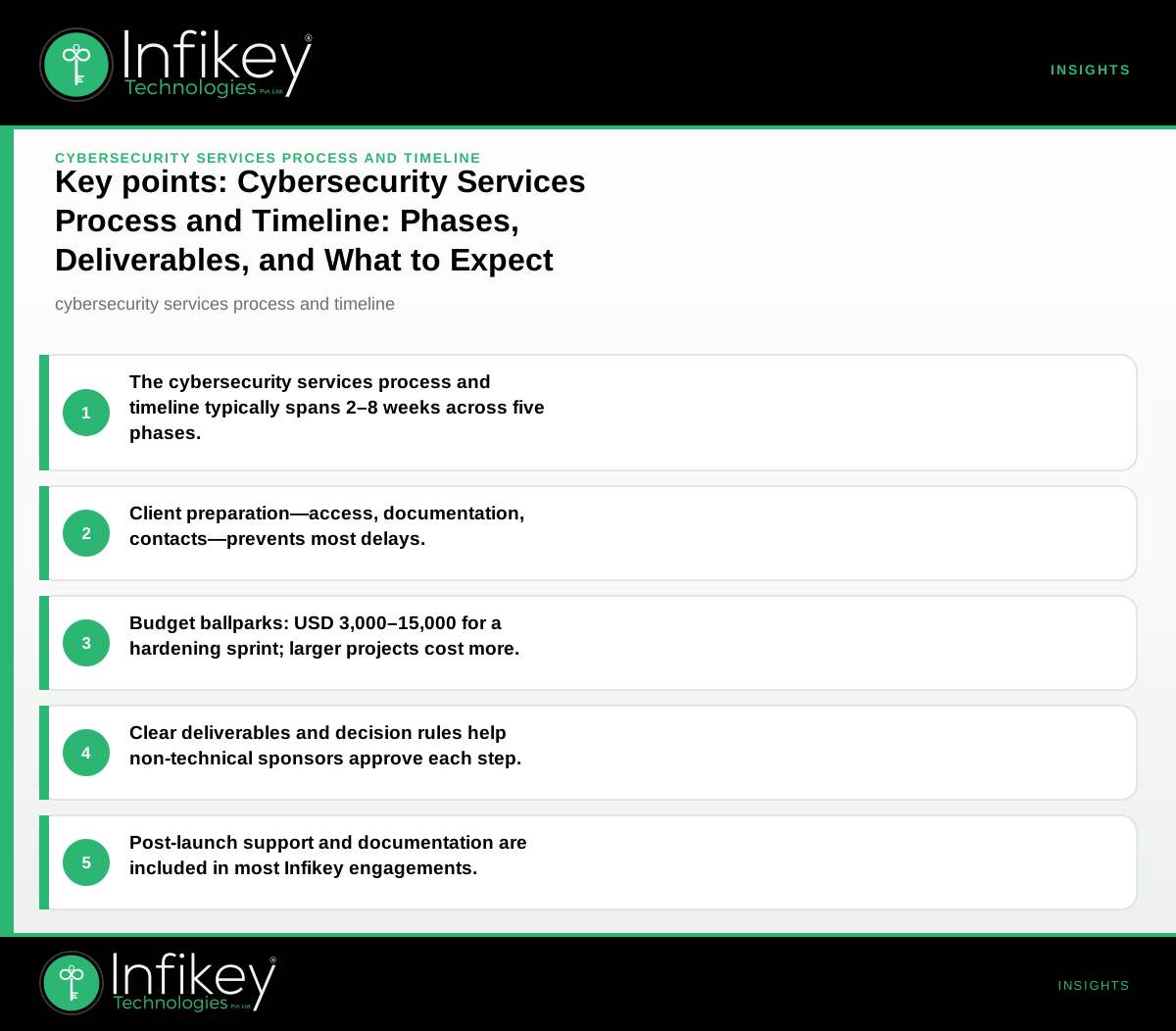
The cybersecurity services process and timeline typically covers five phases: discovery, assessment, remediation, validation, and handover. For most mid-sized projects, this takes 2–8 weeks from kickoff to completion, depending on scope and responsiveness. Each phase has clear deliverables and requires specific client inputs for a smooth delivery.
Cybersecurity Services Process: Phases, Durations, and Deliverables
Understanding the full cybersecurity services process and timeline is critical for organizations aiming to strengthen their security posture. The process is structured to ensure comprehensive coverage and measurable progress at each step. Here’s how the typical engagement unfolds:
| Phase | What Happens | Typical Duration | Deliverable(s) | What the Client Provides |
|---|---|---|---|---|
| Discovery | Kickoff, scope confirmation, access setup, stakeholder interviews | 2–5 days | Project plan, access checklist | Contacts, system inventory, access |
| Assessment | Vulnerability scanning, configuration review, threat modelling | 1–2 weeks | Assessment report, risk register | Credentials, architecture docs |
| Remediation | Fixes, patching, policy updates, configuration changes | 1–4 weeks | Remediation log, updated configs | Approval for changes, test windows |
| Validation | Re-testing, verification, compliance checks | 3–7 days | Validation report, compliance summary | Test environment, sign-off contacts |
| Handover | Documentation, knowledge transfer, support setup | 2–5 days | Final report, runbooks, support plan | Feedback, escalation contacts |
What Each Phase Means
- Discovery: This initial phase sets the foundation for the entire cybersecurity project. It involves clarifying the project scope, confirming which systems and applications are in scope, and establishing secure access for the assessment team. Early stakeholder interviews ensure alignment on objectives and expectations.
- Assessment: The assessment phase is where the core cybersecurity assessment process happens. Here, the team conducts vulnerability scans, reviews configurations, and models potential threats. The outcome is a detailed assessment report and a risk register that prioritizes issues by severity and business impact.
- Remediation: During remediation, identified vulnerabilities are addressed. This may include patching software, updating security policies, and making configuration changes. Collaboration is essential, as many fixes require coordination across IT, DevOps, and sometimes third-party vendors.
- Validation: After remediation, the validation phase ensures that all fixes are effective. The team re-tests systems, verifies compliance with relevant standards, and prepares a validation report. This step is crucial for regulated industries or organizations with strict compliance requirements.
- Handover: The final phase focuses on documentation, knowledge transfer, and support setup. Clients receive comprehensive reports, updated runbooks, and a support plan for the post-engagement period.
Cybersecurity Project Phases: What to Prepare Before Kickoff
A successful cybersecurity project starts with thorough preparation. Being ready on day one can prevent costly delays and ensure a smooth process across all cybersecurity project phases. Here’s a checklist to help your team prepare:
- System inventory: Compile a list of all systems, applications, cloud services, and endpoints in scope. This helps define the assessment boundaries and ensures nothing is missed.
- Access credentials: Arrange administrative or read-only access for all relevant environments. Early access enables faster discovery and assessment.
- Architecture documentation: Provide network diagrams, cloud configurations, and data flow charts. Clear documentation accelerates the assessment process and helps identify hidden risks.
- Key contacts: Assign technical and business points of contact for coordination, approvals, and escalation. Quick decision-making keeps the project on track.
- Maintenance windows: Identify periods when changes can be safely made without disrupting business operations. This is especially important during remediation and validation.
- Compliance requirements: Share any regulatory standards (e.g., ISO 27001, GDPR) that must be met. Compliance needs often shape the assessment and validation phases.
- Incident history: If available, provide details of recent security incidents or audits. This context helps focus the assessment on areas of known risk.
Cybersecurity Services Deliverables: What to Expect
Each phase of the cybersecurity services process and timeline produces distinct deliverables. Understanding these helps set expectations and ensures your organization receives actionable outcomes:
- Project plan and access checklist: Outlines the project scope, timeline, and required access.
- Assessment report and risk register: Documents vulnerabilities, misconfigurations, and prioritized risks.
- Remediation log and updated configurations: Tracks fixes made, patches applied, and policy changes.
- Validation report and compliance summary: Confirms that remediation actions were effective and compliance requirements are met.
- Final report, runbooks, and support plan: Comprehensive documentation for ongoing security operations and future audits.
These deliverables provide a clear trail of actions taken and support both technical and executive-level reporting.
Cybersecurity Project Timeline: Common Delays and How to Prevent Them
The cybersecurity project timeline can be impacted by several common delays. Proactive planning and clear communication can help avoid these pitfalls:
| Common Delay | How to Prevent |
|---|---|
| Slow access provisioning | Prepare credentials and permissions before kickoff. |
| Unclear scope | Confirm systems and objectives in writing during discovery. |
| Change approval bottlenecks | Pre-assign approvers and define escalation paths. |
| Incomplete documentation | Gather architecture and asset lists early. |
| Limited test windows | Schedule remediation and validation during agreed maintenance periods. |
Proactive preparation and clear decision-making are the best ways to keep your cybersecurity project on track.
The Cybersecurity Assessment Process: Steps and Best Practices
A robust cybersecurity assessment process is the backbone of any security engagement. Here’s how [Infikey Technologies](/) Pvt. Ltd. typically approaches this phase:
- Scoping and asset mapping: Define what’s in and out of scope, map assets, and identify critical data flows.
- Automated and manual testing: Run vulnerability scans, configuration reviews, and manual penetration tests as needed.
- Threat modeling: Identify likely attack vectors based on your industry, architecture, and recent threat intelligence.
- Risk analysis and prioritization: Evaluate findings based on business impact, exploitability, and compliance requirements.
- Reporting and recommendations: Deliver a clear, actionable report with prioritized remediation steps.
Best practices include involving both technical and business stakeholders, documenting all findings, and validating results before moving to remediation.
What Happens After Launch: Support, Iterations, and Handover
After the main engagement, most clients receive:
- Handover documentation: Final reports, risk registers, and updated runbooks.
- Knowledge transfer: Walkthroughs for technical and non-technical stakeholders to ensure understanding of findings and next steps.
- Support period: A defined window (often 2–4 weeks) for post-launch questions, minor fixes, or clarifications.
- Optional retainer or managed security: Ongoing monitoring, patching, or compliance checks can be arranged as a follow-on service. This is especially valuable for organizations without dedicated internal security teams.
If new vulnerabilities are found or compliance requirements change, further iterations can be scoped as separate mini-projects, ensuring continuous improvement.
Example Project Shapes and Ballpark Budgets
On global cybersecurity projects, the following shapes and ranges are typical (final scope and commercials are confirmed after discovery):
| Project Type | Scope Summary | Ballpark (USD) | Typical Timeline |
|---|---|---|---|
| Cloud/infrastructure hardening sprint | Review, CI/CD, monitoring, backups, security baseline | USD 3,000–15,000 | 2–6 weeks |
| Custom web application security | Auth, roles, dashboards, integrations, staging+prod | USD 15,000–60,000+ | 8–20 weeks |
For most first-time buyers, a hardening sprint is the fastest way to address urgent risks, while larger application projects require more planning and coordination. The cybersecurity project budget should always be aligned with the organization’s risk appetite, compliance needs, and available resources.
Decision Rules: How to Scope and Budget Your Cybersecurity Project
- If your need is urgent (e.g., compliance deadline, recent incident): Start with a targeted hardening sprint (2–6 weeks, USD 3,000–15,000).
- If you operate critical or regulated systems: Plan for a full assessment and remediation cycle, with budget and time for documentation and validation.
- If you lack internal IT resources: Consider a managed security retainer post-project for monitoring and support.
Always confirm the final scope, deliverables, and commercials after a discovery phase. This ensures transparency and alignment with your organization’s goals.
Questions to Ask Your Cybersecurity Partner
- What is included in each phase, and what do you need from us to start?
- How will you communicate progress and risks?
- What is the process for urgent fixes or escalations?
- How do you handle documentation and knowledge transfer for non-technical sponsors?
- What are the options for ongoing support or managed services?
Next Steps: Start Your Cybersecurity Services Process
A well-defined cybersecurity services process and timeline is essential for effective risk reduction and compliance. By understanding each phase, preparing required inputs, and setting clear expectations for deliverables, your organization can maximize the return on its cybersecurity investment.
For a tailored plan, see Cybersecurity services or [[contact Infikey]({{contact](/contact))}} to discuss your context.