
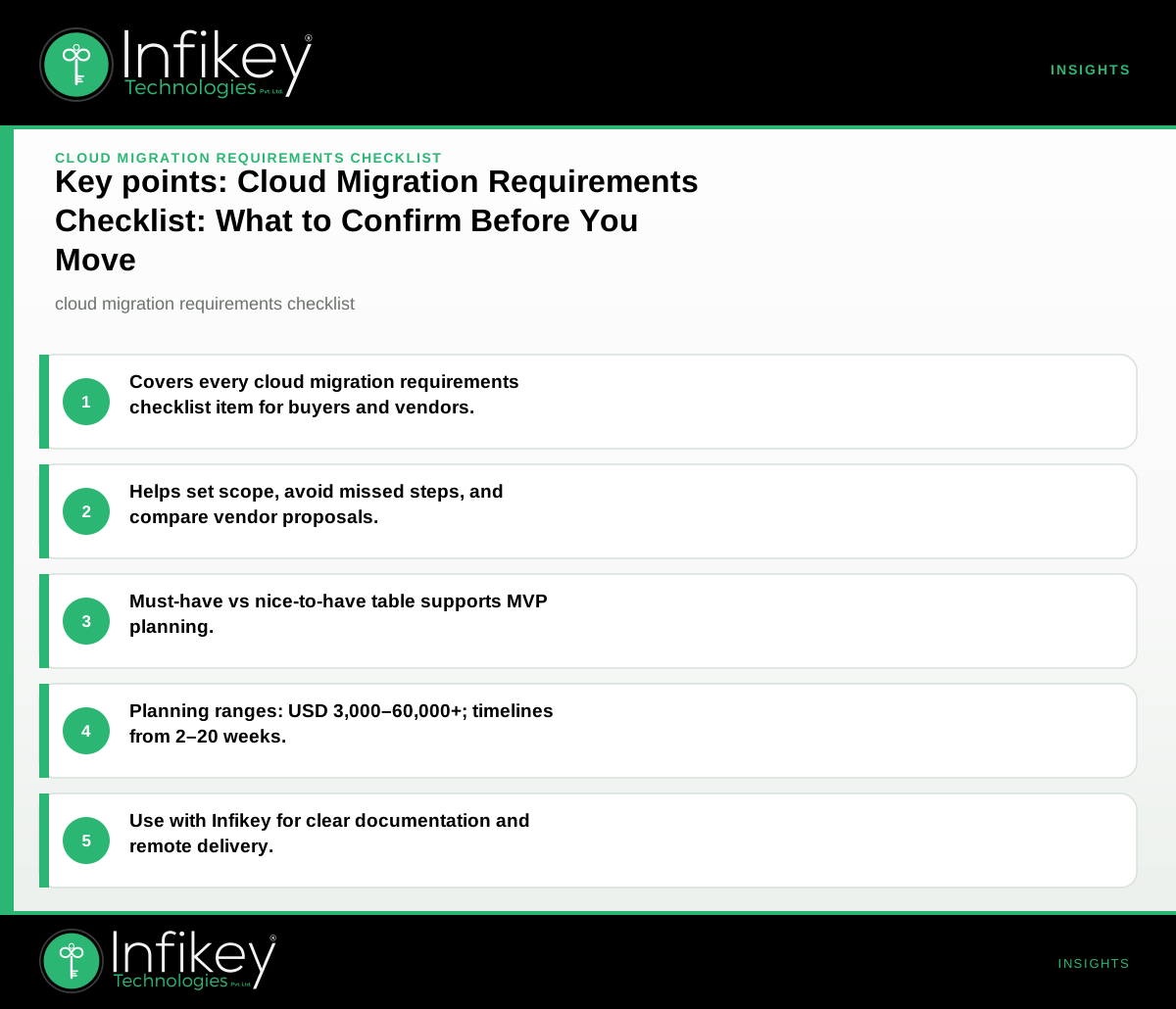
If you are planning a cloud migration, this cloud migration requirements checklist covers every item you need to confirm with vendors. Use it to brief partners, compare proposals, and ensure nothing is missed—especially for international projects with remote delivery and USD-friendly budgets.
How to Use This Checklist with Vendors
Share this checklist directly with your shortlisted vendors. Ask them to respond to each section with their approach, assumptions, and any gaps. This ensures all parties work from the same baseline and reduces risk of scope creep or missed requirements. For best results, request that vendors provide detailed documentation and references for each area, and clarify any uncertainties during the proposal phase.
Cloud Migration Requirements Checklist
1. Migration Goals
- State the business objectives for migration (e.g. cost savings, scalability, disaster recovery).
- List specific outcomes expected (e.g. reduced downtime, faster deployment, improved security).
- Define success metrics (e.g. uptime %, cost reduction targets, performance benchmarks).
- Align these goals with your organization’s broader digital transformation strategy.
Decision Rule: If a migration goal does not directly support a business outcome or measurable KPI, reconsider its priority for the first release.
Vendor Question: How will your team ensure business objectives are met, and how do you measure success post-migration?
2. Scope and Inventory
- List all applications, workloads, and data sets to migrate.
- Identify dependencies between systems (databases, APIs, legacy integrations).
- Note any systems staying on-premises or in hybrid mode.
- Confirm required cloud regions (e.g. EU, US, APAC) for compliance or latency.
- Document any third-party services or integrations that must remain functional post-migration.
Cloud migration scope checklist tip: Use automated discovery tools or workshops to uncover hidden dependencies and legacy integrations. A thorough inventory reduces risk of missed components and post-migration issues.
Vendor Question: What tools or processes do you use to validate the migration scope and dependencies?
3. Technical Requirements
- Specify target cloud provider(s) and preferred services (e.g. AWS EC2, Azure SQL, Google Cloud Storage).
- Set performance and availability requirements (e.g. 99.9% uptime, response times).
- Define integration needs (identity, SSO, third-party APIs).
- List current technology stack and any constraints (OS, frameworks, licensing).
- Identify required migration tools or automation preferences.
- Plan for scalability, disaster recovery, and future growth.
Cloud migration technical requirements: Ensure your checklist includes compatibility with existing systems, network architecture, and any specific SLAs needed for business continuity. Document any non-negotiable technical standards or frameworks.
Vendor Question: How do you handle technical constraints or legacy systems that may not be cloud-ready?
4. Data and Content
- Estimate total data volume to migrate (GB/TB).
- Confirm data formats and structures.
- Document data retention, backup, and restore policies.
- List data cleansing or transformation needs.
- Identify sensitive data requiring encryption or masking.
- Plan for data validation and integrity checks post-migration.
Decision Rule: Prioritize critical and frequently accessed data for initial migration. Archive or defer non-essential data to reduce complexity.
Vendor Question: What is your approach to minimizing data loss and ensuring data integrity during migration?
5. Compliance and Security
- List applicable regulations (GDPR, HIPAA, PCI-DSS, etc.).
- Define access controls and identity management requirements.
- Specify audit logging, monitoring, and alerting needs.
- Confirm encryption standards (at rest/in transit).
- Identify any required certifications for the cloud environment.
- Plan for regular compliance reviews and security assessments.
Cloud migration compliance requirements: Document all regulatory obligations and industry standards relevant to your organization and market. Confirm with vendors how compliance will be maintained throughout the migration lifecycle.
Vendor Question: How do you ensure ongoing compliance and what certifications does your team hold for cloud environments?
6. Budget and Commercials
- State the available budget range for migration (see planning ranges below).
- Note preferred currency (USD, EUR, INR) and payment terms.
- List any cost-saving targets or constraints (e.g. cloud credits, reserved instances).
- Confirm licensing impacts (existing software, new cloud licences).
- Include estimates for both one-time migration costs and ongoing cloud operations.
Cloud migration budget range: For planning, expect cloud/infrastructure hardening sprints to fall in the USD 3,000–15,000 range for 2–6 weeks, and custom web application/portal migrations in the USD 15,000–60,000+ range over 8–20 weeks. Final costs depend on scope and are confirmed after discovery.
Decision Rule: Ensure budget includes a contingency for unexpected issues and post-migration support.
Vendor Question: Can you provide a detailed, itemized estimate covering all migration phases and ongoing costs?
7. Timeline and Milestones
- Set the target go-live date or window.
- Define key project milestones (discovery, pilot, cutover, post-migration support).
- Note blackout periods or business constraints (peak seasons, regulatory deadlines).
- Specify required support after migration (hypercare, training, documentation).
- Build in time for user acceptance testing and rollback planning.
Vendor Question: What is your typical timeline for similar migrations, and how do you manage delays or unforeseen issues?
Must-Have vs Nice-to-Have Items for First Release
| Checklist Area | Must-Have (MVP) | Nice-to-Have (Future) |
|---|---|---|
| Migration Goals | Clear business objectives, success metrics | Advanced analytics, AIOps |
| Scope & Inventory | Full system inventory, dependencies mapped | Automated discovery tools |
| Technical | Target cloud, uptime, integration needs | Multi-cloud, serverless refactoring |
| Data & Content | Data volume, format, backup policies | Data cleansing, archiving |
| Compliance | Regulatory requirements, access controls | Continuous compliance monitoring |
| Budget & Timeline | Budget range, milestones, support plan | Flexible payment, phased rollouts |
Example: Filled-In Checklist Entry (Anonymous Project)
- Migration Goals: Move core retail inventory and order management to cloud to reduce downtime and enable auto-scaling during promotions. Success = 99.9% uptime, 15% cost reduction in hosting.
- Scope: 3 web applications, 2 databases, 1 legacy integration. All to AWS EU region. Payment system stays on-premises.
- Technical: AWS EC2, RDS, S3. SSO via Azure AD. 24/7 monitoring. No serverless for phase 1.
- Data: 2TB sales data, 500GB product images. Daily backups, 30-day retention. No data transformation required.
- Compliance: GDPR applies. All data encrypted at rest. IAM roles reviewed quarterly.
- Budget: USD 25,000–40,000 (final after discovery). Payment in USD, 30% upfront.
- Timeline: Discovery: 2 weeks, migration: 6 weeks, hypercare: 2 weeks. Cutover outside Black Friday.
Cloud Migration Vendor Questions: What to Ask
Choosing the right migration partner is as important as the checklist itself. Use these questions to probe vendor experience, methodology, and fit:
- What is your experience with projects in our industry (e.g. financial services, healthcare, retail)?
- Can you provide references or case studies relevant to our migration scope?
- How do you manage communication and project updates, especially with remote or distributed teams?
- What is your approach to risk management and issue escalation?
- Which team members will be assigned to our project, and what are their certifications?
- How do you ensure knowledge transfer and documentation for in-house teams post-migration?
- What is your process for validating migration success and handling post-migration support?
Cloud Migration Compliance Requirements: Industry Examples
Compliance is a critical pillar of any cloud migration, especially for regulated sectors. Here’s how requirements can differ by industry:
- Financial Services: Must meet stringent data residency, encryption, and audit requirements (e.g. RBI, PCI-DSS).
- Healthcare: HIPAA or equivalent mandates for patient data privacy, access controls, and breach reporting.
- Retail: PCI-DSS for payment data, GDPR for customer privacy, and secure integrations with third-party platforms.
- Manufacturing: May require ITAR or export controls if operating internationally.
- Education: FERPA or local equivalents for student data protection.
Tip: Always confirm with vendors how they will maintain compliance in your specific market and region. Regular compliance checks post-migration are essential.
Example Project Shapes, Budgets, and Timelines
To help you benchmark your own migration, here are two common project types and their planning ranges:
Cloud/Infrastructure Hardening Sprint
- Scope: Review of current infrastructure, CI/CD setup, monitoring, backups, and security baseline.
- Budget Range: USD 3,000–15,000 (INR 2.5–12 lakh)
- Timeline: 2–6 weeks
Custom Web Application/Portal Migration
- Scope: Migration of authentication systems, user roles, dashboards, integrations, and deployment to staging/production environments.
- Budget Range: USD 15,000–60,000+ (INR 12–50 lakh+)
- Timeline: 8–20 weeks
Note: These are planning ranges only. Final scope and commercials are always confirmed after a detailed discovery phase. For more details, see our Cloud and infrastructure service.
Steps to Complete Your Cloud Migration Requirements Checklist
- Internal Alignment: Gather stakeholders from IT, security, compliance, and business units to define goals and constraints.
- Inventory & Discovery: Use automated tools and workshops to document all systems, dependencies, and data.
- Vendor Briefing: Share this checklist and request detailed responses, including assumptions and exclusions.
- Proposal Review: Compare vendor responses side by side, focusing on gaps, risks, and value-adds.
- Refinement: Clarify any ambiguities, confirm compliance and technical fit, and finalize scope.
- Budget & Timeline Confirmation: Align on commercials and delivery milestones before signing.
- Execution & Support: Monitor progress against the checklist, and ensure robust post-migration support and documentation.
Next Steps
Use this cloud migration requirements checklist to brief your vendors and compare their responses. For a structured migration plan and clear ownership, see our Cloud and infrastructure service or talk to Infikey for a discovery call. Our team at Infikey Technologies Pvt. Ltd. in Ahmedabad supports global cloud migration projects with a focus on compliance, technical excellence, and transparent delivery.
For related expertise, explore our Software engineering, Cybersecurity, and Digital transformation services. For questions or to start your migration journey, contact us today.