
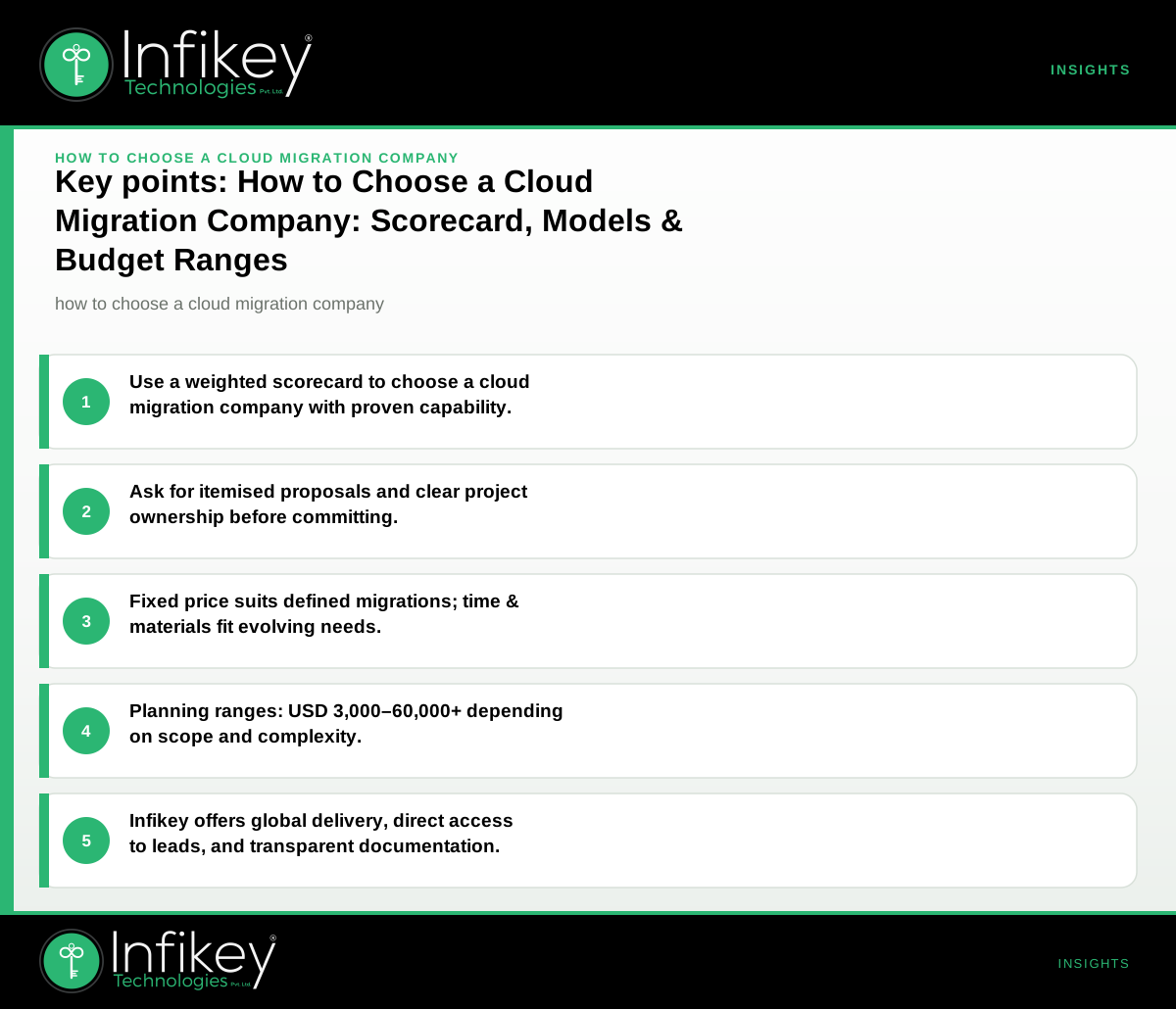
Choosing a cloud migration company comes down to four main criteria: proven technical capability, clear project ownership, transparent pricing, and a track record of secure delivery. To choose well, use a structured scorecard, ask the right questions, and demand a proposal that details scope, risk, and budget.
Cloud Migration Company Scorecard: What to Check and How to Verify
| Criterion | What Good Looks Like | How to Verify | Weight |
|---|---|---|---|
| Technical Expertise | Demonstrated cloud migrations on similar platforms & scale | Ask for anonymised case studies, certifications | 30% |
| Project Ownership | Single accountable lead, clear documentation, direct comms | Request sample project plans, meet delivery lead | 25% |
| Security & Compliance | Security-first approach, compliance with relevant standards | Review security practices, compliance checklists | 20% |
| Transparent Pricing | Clear, itemised estimates with planning ranges | Compare proposal breakdowns, ask about change process | 15% |
| Post-Go-Live Support | Defined support window, clear handover, knowledge transfer | Check support SLAs, ask for transition plan | 10% |
Tip: Weightings reflect typical impact on project outcomes for international buyers. Adjust if your priorities differ.
Why Each Scorecard Area Matters
- Technical Expertise: Cloud migrations are rarely copy-paste. Each platform (AWS, Azure, GCP) and workload (web apps, databases, legacy systems) brings unique challenges. A company that has executed similar projects is more likely to anticipate pitfalls and deliver a smooth transition.
- Project Ownership: A single accountable lead ensures communication stays clear and issues are resolved quickly. Without it, you risk delays and finger-pointing.
- Security & Compliance: Data breaches and compliance failures can cost far more than the migration itself. Insist on a company that can demonstrate secure practices and compliance with standards relevant to your industry (like GDPR, HIPAA, PCI-DSS).
- Transparent Pricing: Cloud migration company cost can vary widely. Itemised, transparent pricing helps you compare proposals and avoid hidden fees or scope creep.
- Post-Go-Live Support: Even the best migrations need post-launch support. Ensure the company offers a defined support period and clear handover to your team.
Key Questions to Ask on the First Call
- What is your experience with migrations to our target cloud (AWS, Azure, GCP, etc.) at our scale?
- Who will own delivery day-to-day, and how will we communicate during the project?
- How do you handle data security, compliance, and privacy in migrations?
- What is your approach to downtime and rollback planning?
- Can you walk us through a recent migration project, including challenges and outcomes?
- How do you structure pricing, and what could cause the budget to change?
- What support is included after go-live, and how do you handle post-launch incidents?
Additional Questions to Refine Your Shortlist
- Can you provide a sample cloud migration services quote based on a project similar to ours?
- What is your process for change management if requirements shift mid-project?
- How do you ensure knowledge transfer to our internal IT team?
- What tools and automation frameworks do you use to minimise manual errors?
Red Flags: When to End the Conversation
- No clear examples of similar migrations or only generic experience claims.
- Vague answers on security, compliance, or data protection.
- Unwillingness to provide a named delivery lead or avoidant about direct communication.
- Pricing is non-itemised, "ballpark only", or subject to hidden fees.
- No defined support or handover process after migration.
If you spot two or more of these, move on.
Engagement Models for Cloud Migration: Control, Risk, and Budget
| Model | Best For | Risk Profile | Budget Control |
|---|---|---|---|
| Fixed Price | Well-defined, smaller migrations | Low (if scope is stable) | High (predictable) |
| Time & Materials | Evolving requirements, complex integrations | Medium (scope can grow) | Medium (track spend) |
| Dedicated Team | Ongoing migrations, large/complex estates | Medium-High (needs oversight) | Variable (flexible) |
Rule of thumb: If you know exactly what you need, fixed price works. If your requirements may change, time & materials or dedicated team models are safer.
Deciding on the Right Engagement Model
- Fixed Price: Best when the migration scope is clear and unlikely to change. You get predictability in cost and timeline, but changes may incur additional fees. This model is common for straightforward migrations, such as moving a single application to the cloud.
- Time & Materials: Suited for projects where requirements may evolve, such as integrating multiple systems or handling legacy workloads. You pay for actual effort, which gives flexibility but requires active oversight to avoid budget overruns.
- Dedicated Team: Ideal for large enterprises or organisations with ongoing migration needs. You get a team of cloud migration experts who work as an extension of your IT department. This model offers flexibility and rapid scaling but requires strong project management on your side.
Cloud Migration Agency Pricing: What to Expect
Cloud migration agency pricing depends on project complexity, data volumes, legacy systems, compliance requirements, and support needs. While every project is unique, understanding typical pricing models and planning ranges helps you benchmark proposals and plan your budget.
- Discovery and Assessment: Many agencies start with a paid or free assessment to scope the migration. This phase may be quoted as a fixed fee or included in the total project cost.
- Migration Execution: The core migration work is usually priced as a fixed project fee or by time and materials. Expect a detailed breakdown by phase (assessment, planning, migration, testing, go-live, support).
- Support and Optimisation: Post-migration support may be included for a limited period or offered as an ongoing managed service.
Example Cloud Migration Project Shapes and Planning Ranges
On projects like this, we see these common shapes and planning ballparks (USD, confirmed after discovery):
| Project Type | Scope Summary | Planning Range | Timeline |
|---|---|---|---|
| Cloud/infrastructure hardening sprint | Review, CI/CD, monitoring, backups, security baseline | USD 3,000–15,000 | 2–6 weeks |
| Custom web application migration | Auth, roles, dashboards, integrations, prod/staging | USD 15,000–60,000+ | 8–20 weeks |
Final budgets depend on complexity, data volumes, and integration needs. For a quick estimate, request a cloud migration services quote tailored to your project.
How to Hire Cloud Migration Experts: Step-by-Step
- Define Your Objectives: Clarify which systems, data, and workloads you want to move and your business goals (cost savings, scalability, security).
- Shortlist Providers: Use your scorecard and research to identify 3–5 companies with relevant experience. Look for those with strong references and transparent pricing.
- Request Proposals: Share your requirements and request detailed proposals, including scope, timeline, pricing, and team structure.
- Evaluate Proposals: Score each proposal using your criteria. Pay close attention to technical fit, project ownership, and pricing transparency.
- Interview Delivery Leads: Meet the actual project leads, not just sales reps. Assess their communication style and depth of expertise.
- Negotiate Terms: Clarify support, change management, and escalation processes. Confirm how pricing will be adjusted if the scope changes.
- Check References: Ask for references or anonymised case studies from similar projects.
- Sign and Kick Off: Once satisfied, formalise the agreement and start with a kick-off meeting that includes all stakeholders.
What a Good Cloud Migration Proposal Must Include
- Scope and Deliverables: Clear description of what will (and won’t) be migrated, with milestones.
- Timeline: Realistic phases, with dependencies and critical path identified.
- Pricing: Itemised by phase or deliverable, with assumptions and exclusions.
- Risk and Mitigation: Key risks called out (downtime, data loss, compliance), with mitigation steps.
- Project Ownership: Named lead, escalation path, and communication plan.
- Security and Compliance: Approach to data protection, access control, and compliance requirements.
- Support and Handover: Post-go-live support window, documentation, and knowledge transfer plan.
Comparing Cloud Migration Company Cost: Decision Rules
- Don’t choose solely on price. The lowest bid may miss critical security or support elements.
- Ask for itemised breakdowns. This allows you to compare apples-to-apples and spot hidden costs.
- Check for change management fees. Understand what happens if your requirements evolve.
- Balance cost with expertise and support. A slightly higher price may be justified by a stronger team or better post-migration support.
How Infikey Fits as a Cloud Migration Partner
[Infikey Technologies](/) Pvt. Ltd. delivers cloud and infrastructure projects globally from its base in Ahmedabad, serving clients across financial services, healthcare, retail, manufacturing, technology, education, logistics, energy, public sector, startups, professional services, and media. With a focus on clear project ownership, structured documentation, and transparent, USD-friendly planning ranges, Infikey is a fit for buyers who want direct access to delivery leads, transparent proposals, and support for both fixed price and flexible engagement models.
Infikey’s Cloud and infrastructure service covers:
- Discovery and assessment
- Secure migration planning
- Implementation and testing
- Post-migration support and optimisation
We support both fixed price and flexible engagement models, with ballpark planning ranges provided upfront and final commercials confirmed after discovery. If you need a local on-site-only team or have highly specialised regulatory requirements outside our experience, we may not be the best fit. For most international migrations, we provide clear ownership, remote delivery, and documentation a non-technical sponsor can approve. See more about our Cloud and infrastructure service or contact us to discuss your project.
Next Steps: Shortlist the Best Cloud Migration Agency for Your Needs
- Use the scorecard and checklist above to compare providers.
- Request a cloud migration services quote from Infikey or other shortlisted agencies.
- Interview delivery leads and clarify support models.
- Balance cloud migration agency pricing with expertise, security, and support.
Ready to shortlist your cloud migration company? Use the scorecard and checklist above, then talk to Infikey for a proposal built around your requirements.