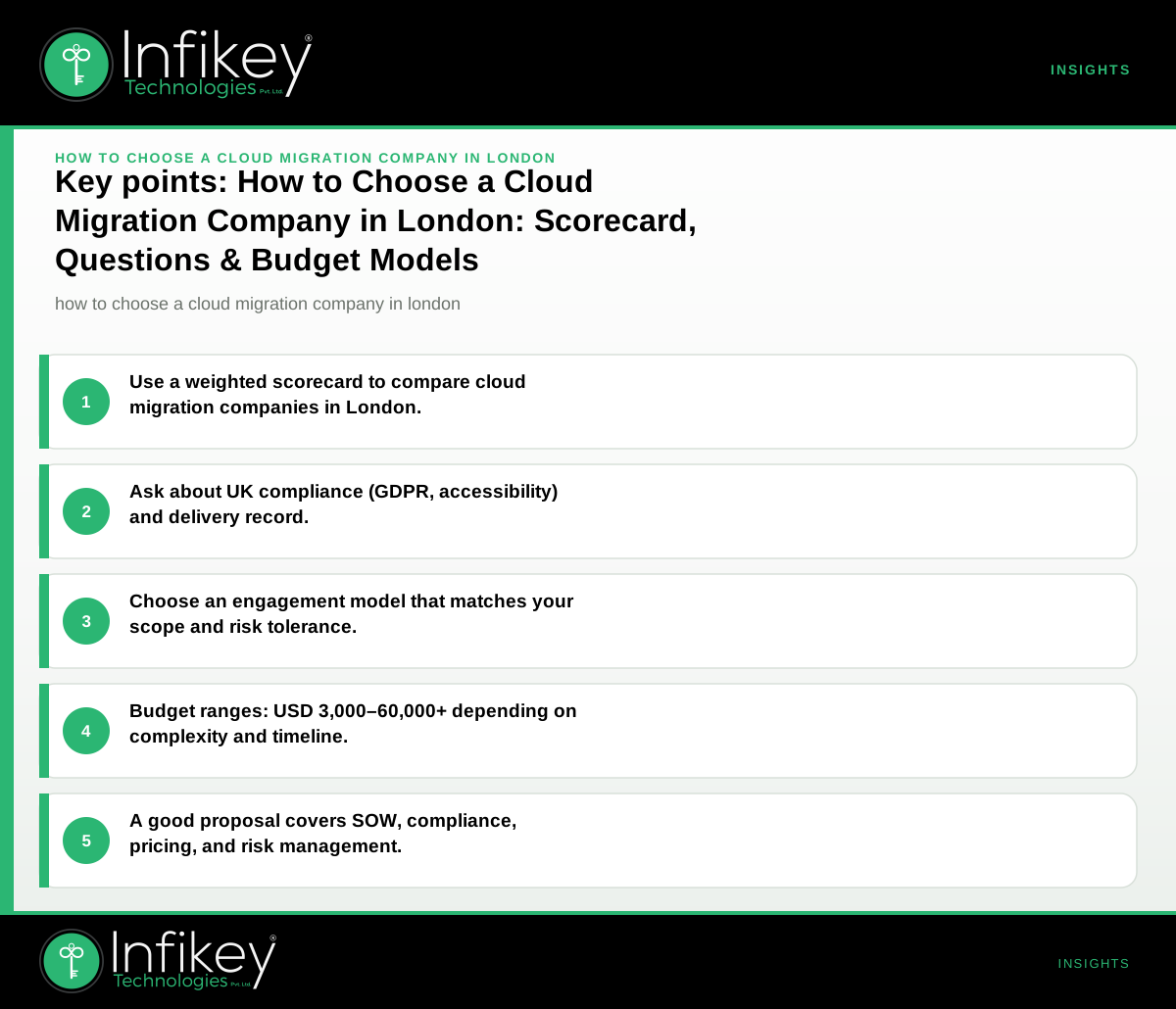
To choose a cloud migration company in London, prioritise technical capability with your platforms, experience in UK compliance (GDPR, accessibility), a proven delivery track record, and transparent engagement models. Use a weighted scorecard, ask targeted questions, and expect a proposal with clear scope, budget, and risk approach.
Scorecard: What to Check When Choosing a Cloud Migration Company
| Criterion | What Good Looks Like | How to Verify It | Weight |
|---|---|---|---|
| Technical expertise | Deep knowledge of your stack, cloud platforms, migration tooling | Ask for similar project examples, certifications | 30% |
| UK compliance | GDPR, accessibility, data residency, UK security best practices | Review policies, request compliance documentation | 25% |
| Delivery record | References, case studies, staged delivery, low disruption | Ask for project walk-throughs, delivery approach | 25% |
| Commercial clarity | Transparent pricing, clear SOW, risk sharing | Review proposal, check for hidden costs | 20% |
Tip: Weight these based on your risk tolerance and internal skills. For regulated sectors, compliance may outweigh cost.
Why the Scorecard Matters
A structured scorecard helps you compare cloud migration agencies in London on objective criteria, rather than gut feel or salesmanship. This is especially important if you’re evaluating several providers or need to justify your choice to stakeholders. For example, if your organisation handles sensitive data, UK compliance should be weighted more heavily. If you’re migrating a complex legacy application, technical expertise and delivery record may take precedence.
Questions to Ask on the First Call
- What experience do you have migrating workloads similar to ours (size, industry, tech stack)?
- How do you handle UK-specific compliance (GDPR, accessibility, data sovereignty)?
- What is your approach to minimising downtime and business disruption?
- Can you walk us through a recent migration project, including challenges and outcomes?
- How do you structure pricing and change management during the project?
- What is included (and not included) in your standard migration scope?
- Who will be our main point of contact, and how is communication managed?
- What does a typical timeline look like for a migration of our size?
Additional Questions for London-Based Providers
- Are your teams familiar with local data residency and UK-specific cloud regulations?
- How do you support hybrid or remote delivery models for London clients?
- Can you provide references from UK-based organisations or similar industries?
These questions help you assess if a cloud migration agency in London truly understands the regional context and your business needs.
Red Flags: When to Walk Away
- Vague or generic answers about compliance or previous projects.
- No clear project methodology or delivery plan.
- Reluctance to provide references or case studies.
- Unclear pricing or hidden fees in the proposal.
- No written process for risk management or rollback.
- Pushback on including staged releases or acceptance criteria.
Common Pitfalls in Cloud Migration Partner Selection
Many businesses rush to hire cloud migration experts without digging into delivery details. Watch for agencies that:
- Overpromise on timelines without understanding your legacy systems
- Offer only a single pricing model (e.g., fixed price for a complex, evolving migration)
- Lack a documented approach to security and compliance audits
If you encounter these issues, consider broadening your search for the best cloud migration company UK-wide, not just in London.
Engagement Models: Comparing Budget Control and Risk
| Engagement Model | Best For | Risk | Budget Control |
|---|---|---|---|
| Fixed Price | Well-defined, low-change migrations | Vendor absorbs overruns | High (scope must be clear) |
| Time & Materials | Evolving or complex migrations | Buyer absorbs overruns | Medium (track hours) |
| Dedicated Team | Ongoing or large-scale transformation | Shared | Low (variable, flexible) |
Rule of thumb: If your migration scope is stable and well-understood, fixed price gives budget certainty. For legacy systems or evolving requirements, time & materials or dedicated teams are safer.
Choosing the Right Engagement Model
- Fixed Price: Best for migrations with a clear, unchanging scope (e.g., moving a single application to the cloud with minimal integration). You gain budget certainty but must invest in detailed planning upfront.
- Time & Materials: Suited to projects where requirements may change or discovery is ongoing. You pay for the actual time spent, so it’s important to track hours and progress closely.
- Dedicated Team: Ideal for organisations with ongoing cloud transformation needs, such as phased migrations or continuous optimisation. This model offers flexibility but requires trust and close collaboration.
Budget and Timeline Ranges for Cloud Migration Projects
On projects like this, planning ranges depend on scope and complexity. For example:
- Cloud / infrastructure hardening sprint: USD 3,000–15,000 (2–6 weeks)
- Custom web application migration: USD 15,000–60,000+ (8–20 weeks)
Final scope and commercials are confirmed after a discovery phase. Use these as ballparks for budgeting, not as formal quotes. For a tailored estimate, try the cloud migration cost savings calculator.
Example Project Scenarios
- A mid-sized London retailer wants to migrate their e-commerce platform to the cloud for better scalability. This typically falls into the custom web application migration range, with a timeline of 8–20 weeks depending on integrations and data volume.
- A healthcare provider in the UK requires a secure, compliant migration of patient management systems. This project may include a cloud/infrastructure hardening sprint to ensure GDPR compliance, usually completed in 2–6 weeks before the main migration.
- A SaaS company with multiple microservices may opt for a dedicated team model, engaging cloud migration experts for ongoing transformation and optimisation.
Cloud Migration Cost UK: Factors That Influence Pricing
Cloud migration cost in the UK depends on several variables:
- Complexity of legacy systems: Older, highly customised systems require more effort to migrate.
- Volume of data: Large data sets may need special handling, increasing both cost and timeline.
- Compliance requirements: Additional security, documentation, and validation steps are needed for regulated industries.
- Integration needs: Connecting to third-party systems or APIs can add to project scope.
- Level of automation: Automated migration tools may reduce manual effort but require upfront investment.
When comparing cloud migration pricing in London, ask for a breakdown of these factors in your proposal.
What a Good Proposal Must Include
- Clear statement of work (SOW) with deliverables, exclusions, and assumptions
- Timeline with milestones and critical dependencies
- Pricing model and payment schedule (with change management process)
- Approach to compliance (GDPR, accessibility, UK data handling)
- Risk management and rollback/contingency plan
- Named delivery team and communication plan
- Reference projects or case studies
If any of these are missing or unclear, ask for clarification before proceeding.
Evaluating Proposals: Beyond the Basics
When reviewing proposals from a cloud migration agency London businesses trust, look for:
- Transparent descriptions of migration phases (discovery, planning, execution, validation)
- Defined acceptance criteria for each milestone
- Clear escalation paths for issues
- Flexibility in handling scope changes
The best cloud migration company UK organisations choose will not only provide a detailed proposal but also be willing to walk you through it and answer your questions.
How to Hire Cloud Migration Experts in London: Step-by-Step
- Define your migration objectives: What are your business drivers (cost, performance, compliance)?
- Shortlist providers: Use the scorecard to compare local and UK-wide agencies.
- Conduct discovery calls: Ask the questions above to assess fit and expertise.
- Request detailed proposals: Insist on clarity around scope, pricing, and compliance.
- Check references: Speak to other UK clients if possible.
- Review engagement models: Match your risk appetite and project complexity.
- Select your partner: Choose based on weighted criteria, not just price.
- Kick off with a discovery phase: Confirm final scope, timeline, and commercials before full commitment.
Where Infikey Fits (and When We’re Not the Right Choice)
Infikey Technologies delivers cloud and infrastructure projects for UK businesses needing clarity, compliance, and staged delivery. We are a fit if you want:
- A partner experienced in UK compliance and staged migrations
- Transparent pricing and clear SOWs
- Delivery teams that work to your pace and internal skills
We are not the right choice if you require:
- Onsite-only teams (we work hybrid/remote with UK overlap)
- Ultra-low-cost, one-off lift-and-shift with no compliance needs
- 24/7 UK-based support (we provide business hours support with escalation)
See more about our cloud and infrastructure services or contact us to discuss your migration.
Related Services and Next Steps
If your migration project involves more than just infrastructure, Infikey also provides:
- Website development
- Mobile app development
- Software engineering
- Cybersecurity
- AI
- Digital transformation
- Managed engineering
- Digital marketing and SEO
- Graphics designing
Ready to scope your migration? Review your priorities using the scorecard above, then contact Infikey for a tailored proposal and planning session.