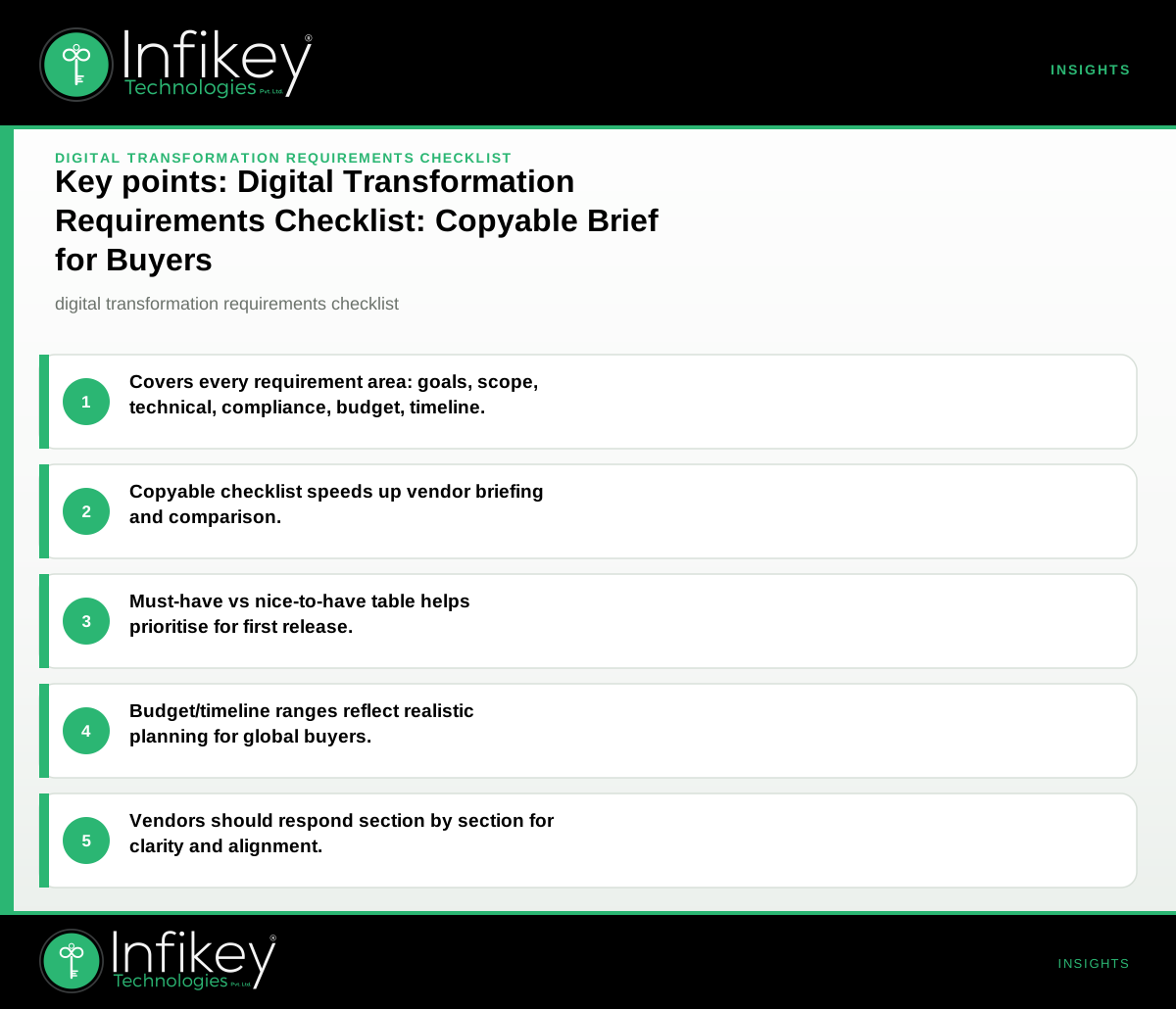
A digital transformation requirements checklist covers your project’s goals, scope, technical needs, content, compliance, budget and timeline—giving you and vendors a shared, actionable brief. Use this checklist to clarify what’s essential, compare proposals, and avoid scope gaps or budget surprises.
Digital Transformation Requirements Checklist: Copy-and-Use
A comprehensive digital transformation requirements checklist is your foundation for a successful transformation journey. It ensures that all stakeholders—from business leaders to IT teams and vendors—understand the project’s objectives, boundaries, and must-have features. Below, you’ll find a detailed, actionable checklist covering all critical aspects, including digital transformation project requirements, scope, technical needs, and budget planning.
1. Goals & Business Outcomes
- What specific business problems or opportunities are you addressing?
- What measurable outcomes (KPIs) define success? (e.g., cost reduction, process speed, customer satisfaction)
- Which teams or departments are impacted?
- Are there strategic deadlines (e.g., regulatory, market launch)?
- How will digital transformation align with broader business strategy?
- Are there customer experience improvements targeted?
2. Project Scope
- Which processes, products, or services are in scope for transformation?
- Are you replacing, upgrading, or integrating with existing systems?
- What is out of scope (to avoid scope creep)?
- Will this be a single-phase or multi-phase project?
- Are there dependencies on other ongoing initiatives?
- What is the expected scale—pilot, department-wide, or enterprise-wide?
#### Digital Transformation Scope Checklist Before finalizing your scope, ask:
- Have all stakeholders signed off on the in-scope and out-of-scope items?
- Are there legacy systems or manual processes that must be addressed?
- Will the project introduce new business models or channels?
- Are there planned integrations with partners or third-party platforms?
3. Technical Requirements
- What core platforms or technologies must be supported (ERP, CRM, cloud, mobile, etc.)?
- Are there preferred stacks, vendors, or open-source requirements?
- What integrations (APIs, data feeds, third-party tools) are required?
- What are the must-have security and uptime requirements?
- Is multi-language or multi-currency support needed?
- What are the scalability and future-proofing considerations?
- Are there requirements for mobile responsiveness or dedicated apps?
#### Digital Transformation Must Have Features When evaluating features, consider:
- Single sign-on (SSO) and unified user management
- Real-time analytics and reporting dashboards
- Automated notifications and workflow triggers
- Regulatory compliance (GDPR, HIPAA, etc.)
- Custom branding and UI/UX alignment
- Offline access or sync capabilities
- Integration with existing CRM, ERP, or other core systems
4. Content & Data
- What data sources, formats, and volumes are involved?
- Are there data migration or cleansing needs?
- Who owns content creation, migration, and ongoing updates?
- Are analytics or reporting dashboards required?
- What is the data governance model?
- How will data quality and consistency be ensured?
5. Compliance & Risk
- Which regulations apply (GDPR, HIPAA, PCI, etc.)?
- Are there industry-specific standards to meet?
- What are the data privacy, retention, and audit needs?
- What level of documentation and traceability is required?
- Are there known security threats or vulnerabilities to address?
- Is there a disaster recovery or business continuity plan?
6. Budget & Commercials
- What is your planning budget or range? (e.g., USD 15,000–60,000+ for a custom web application)
- What is your preferred commercial model (fixed price, time & materials, milestone-based)?
- Are there ongoing support or licensing costs to consider?
- What is your approval process for budget changes?
- Are there budget reserves for unforeseen requirements or scope changes?
- How will value and ROI be measured post-implementation?
#### Digital Transformation Budget Planning For effective budget planning:
- Break down costs by phase (discovery, build, rollout, support)
- Include contingency for change requests
- Account for internal resource allocation
- Plan for training and change management
- Consider costs for integrations, third-party licenses, and ongoing maintenance
7. Timeline & Milestones
- What is your target launch or go-live date?
- Are there hard deadlines (compliance, seasonality, board commitments)?
- What are the key milestones (MVP, pilot, full rollout)?
- What is your preferred cadence for status updates and demos?
- How will delays or blockers be managed?
- Are there dependencies on external vendors or partners?
Must-Have vs Nice-to-Have: First Release Table
| Requirement | Must-Have | Nice-to-Have |
|---|---|---|
| Core business workflows digitised | ✓ | |
| Integration with existing CRM | ✓ | |
| Multi-language support | ✓ | |
| Real-time analytics dashboard | ✓ | |
| Automated notifications | ✓ | |
| Advanced AI features | ✓ | |
| Custom branding | ✓ | |
| Offline access | ✓ | |
| Regulatory compliance (e.g., GDPR) | ✓ | |
| Mobile app version | ✓ |
This table helps prioritize digital transformation must have features for your first release, ensuring critical needs are addressed while planning for future enhancements.
Example: Filled-In Checklist Entry (Anonymous Project)
- Goal: Reduce manual order processing time by 60% in the next 6 months.
- Scope: Digitise order intake and approval for wholesale customers; integrate with existing ERP; exclude payment processing for phase 1.
- Technical: Web portal (React), ERP integration (SAP), SSO via Azure AD, minimum 99.5% uptime.
- Content/Data: Migrate 5 years of order data; client to provide product catalogue.
- Compliance: GDPR and industry-specific data retention; audit logs required.
- Budget: Planning range USD 25,000–40,000 (final after discovery).
- Timeline: MVP in 12 weeks, full rollout in 20 weeks; bi-weekly demos.
Additional Example: Multi-Phase Digital Transformation Project Requirements
- Goal: Enable omnichannel retail experience across web and mobile.
- Scope: Phase 1: Launch new e-commerce platform; Phase 2: Integrate loyalty and in-store systems.
- Technical: Cloud-native stack, mobile app (Flutter), integration with POS and inventory systems.
- Content/Data: Product and customer data migration; digital asset management.
- Compliance: PCI DSS for payments, GDPR for customer data.
- Budget: USD 40,000–60,000 for Phase 1; Phase 2 to be scoped post-launch.
- Timeline: Phase 1 in 16 weeks, Phase 2 in 10 weeks.
How Vendors Should Respond to Each Section
- Goals: Confirm understanding; suggest measurable KPIs; flag any ambiguity.
- Scope: Map in-scope and out-of-scope items; recommend phasing if needed.
- Technical: Specify proposed stack, integration approach, and security posture; highlight any dependencies.
- Content/Data: Outline migration plan, data mapping, and content responsibilities.
- Compliance: List how regulatory and audit needs will be met; propose documentation standards.
- Budget: Provide ballpark estimates (using planning ranges); clarify inclusions/exclusions; suggest commercial models.
- Timeline: Share a draft project plan with milestones; state assumptions and risks; propose demo/reporting cadence.
Digital Transformation RFP Template: Structure for Success
When preparing your RFP (Request for Proposal), structure it clearly to help vendors respond thoroughly and comparably. A good digital transformation RFP template should include:
- Executive Summary: Brief overview of your organization and transformation goals.
- Project Background: Context, drivers, and existing pain points.
- Detailed Requirements: Use your checklist above, organized by section.
- Must-Have vs Nice-to-Have Table: Clarify priorities.
- Scope Definition: In-scope, out-of-scope, dependencies.
- Technical Environment: Current stack, integration needs, security requirements.
- Compliance & Risk: All regulatory and documentation requirements.
- Budget & Commercials: Planning range, commercial model, payment terms.
- Timeline & Milestones: Target dates, key deliverables, reporting cadence.
- Evaluation Criteria: How proposals will be assessed (fit, experience, cost, timeline, support).
- Response Instructions: Format, deadline, points of contact.
Use this structure to ensure all digital transformation project requirements and digital transformation scope checklist items are addressed in vendor proposals.
Planning Your Digital Transformation Budget and Timeline
On projects like this, a global buyer can expect the following planning ranges (final scope and commercials are confirmed after discovery):
| Project Type | Planning Range (USD) | Timeline |
|---|---|---|
| Custom web application / portal | 15,000–60,000+ | 8–20 weeks |
| Mobile app (iOS + Android) | 12,000–45,000 | 10–18 weeks |
| Marketing website (brochure/CMS) | 4,000–12,000 | 4–8 weeks |
Remote delivery, clear documentation, and USD-friendly contracts are standard for Infikey Technologies Pvt. Ltd.’s international clients. See Digital transformation for details.
Example Project Shapes and Ballpark Ranges
To help with digital transformation budget planning, here are typical engagement types and timelines:
- Marketing Website: Design system, 8–15 pages, CMS, basic SEO foundations, forms. Ballpark: USD 4,000–12,000. Timeline: 4–8 weeks.
- Custom Web Application/Portal: Auth, roles, dashboards, integrations, staging + production. Ballpark: USD 15,000–60,000+. Timeline: 8–20 weeks.
- Mobile App (iOS + Android): MVP with core flows, API, store submission support. Ballpark: USD 12,000–45,000. Timeline: 10–18 weeks.
Final scope and commercials are always confirmed after a discovery phase. For more detail, see Digital transformation.
Decision Rules for Buyers: What to Prioritise
- If a requirement is critical for business continuity or compliance, mark as must-have.
- If a feature is valuable but can be deferred, mark as nice-to-have for later phases.
- If your team lacks clarity on a section, ask vendors to propose options with pros/cons.
- For global delivery, clarify time zones, languages, and currency preferences upfront.
- Prioritize features that directly impact your KPIs or regulatory obligations.
- Use the must-have/nice-to-have table to guide phased delivery and manage stakeholder expectations.
- Insist on transparency for ongoing support, licensing, and maintenance costs.
Next Steps: Send Your Checklist to Vendors
Copy this checklist into your RFP or vendor brief. Ask vendors to respond section by section, using your must-have/nice-to-have table. For a tailored scope or to discuss your project, see Digital transformation or [[Contact Infikey]({{contact](/contact))}}.
A robust digital transformation requirements checklist, clear scope, and disciplined budget planning will help you select the right partner, avoid surprises, and deliver lasting business value. For more guidance or to start your transformation journey, reach out to Infikey Technologies Pvt. Ltd. in Ahmedabad—your global partner for digital transformation, cloud, AI, and managed engineering.