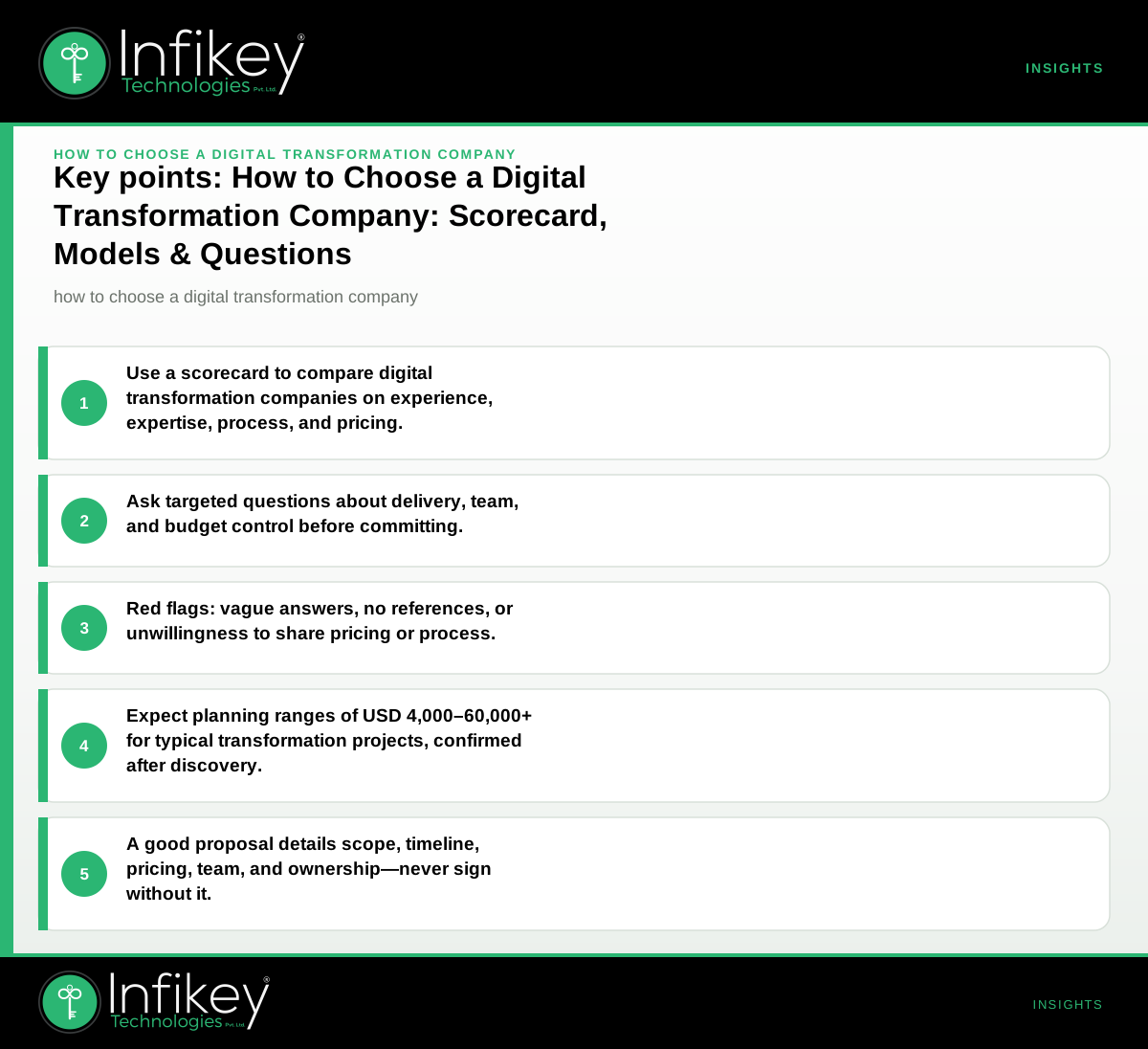
To choose a digital transformation company, focus on four criteria: relevant delivery experience, technical and domain expertise, clear process and communication, and transparent pricing with documented proposals. Evaluate each using a structured scorecard, ask targeted questions, and insist on a proposal that details scope, budget, and ownership. This approach helps global buyers avoid costly missteps and select a partner who can deliver.
Scorecard: Compare Digital Transformation Companies on What Matters
| Criterion | What Good Looks Like | How to Verify | Weight |
|---|---|---|---|
| Relevant Delivery Experience | Projects similar in size, complexity, and sector | Case studies, project outlines, references | 30% |
| Technical & Domain Expertise | Demonstrated skills in your required tech stack and industry | Team bios, certifications, tech stack match | 25% |
| Process & Communication | Documented delivery process, regular updates, clear escalation paths | Sample plans, reporting cadence, language fit | 25% |
| Transparent Pricing & Proposals | Ballpark ranges, itemised estimates, clear change process | Example proposals, change log, contract terms | 20% |
Tip: Assign weights based on your priorities, but all four are essential for a successful digital transformation engagement.
A structured scorecard ensures you compare each digital transformation agency on the factors that actually impact project success. For global buyers, this is especially important: the best digital transformation company for your needs will have proven delivery in your sector, not just broad claims. Ask for specific project outlines and references from clients in similar industries, such as financial services, healthcare, or manufacturing. If you operate in a regulated sector, verify that the company understands compliance and security requirements.
Questions to Ask on the First Call
- What similar digital transformation projects have you delivered, and what were their key challenges?
- Who will be responsible for day-to-day delivery and communication?
- How do you handle changes in scope or requirements during a project?
- Can you share a sample project plan and reporting template?
- What is your approach to documentation and handover?
- How do you ensure budget and timeline control for international clients?
- What engagement models do you offer, and which is best for our needs?
- How do you manage time zone differences and ensure responsive communication?
- What is your approach to cybersecurity and data privacy?
- Can you provide examples of transparent pricing and change management from past projects?
These questions help you hire digital transformation experts who are prepared for the realities of remote, cross-border delivery. Look for concrete answers—avoid agencies that rely on generic promises or cannot provide documentation.
Red Flags: When to Walk Away
- No clear examples of relevant projects or unwillingness to share references.
- Vague or generic answers about delivery process or team structure.
- Unwilling to provide ballpark pricing or a structured proposal.
- Overpromising ("guaranteed results") or dismissing risks and dependencies.
- Poor communication or slow response times, especially across time zones.
- Lack of clarity on intellectual property, data ownership, or handover process.
- Unclear or shifting digital transformation company cost estimates without explanation.
If you encounter any of these warning signs, consider other options. The best digital transformation company will be proactive, transparent, and willing to address your concerns directly.
Choosing the Right Engagement Model for Your Project
| Model | Best For | Risk (to Buyer) | Budget Control |
|---|---|---|---|
| Fixed Price | Well-defined scope, clear deliverables | Low (if scope stable) | High |
| Time & Materials | Evolving requirements, discovery-led projects | Medium (scope creep) | Medium |
| Dedicated Team | Ongoing, complex, or multi-phase transformation | Variable (team fit) | High (with oversight) |
Rule of thumb: If your requirements are clear and unlikely to change, fixed price offers the most budget certainty. For evolving needs, time & materials or a dedicated team may be more flexible but require stronger oversight.
When considering digital transformation agency pricing, ask for a breakdown of how each engagement model affects your costs and risk. For example, a fixed price model works well for a marketing website with a clear brief, but a custom portal with evolving features may benefit from time & materials or a dedicated team. Always request documentation on how changes are handled, and what triggers a scope or budget review.
Example Project Shapes and Budget Ranges
To help you understand digital transformation company cost expectations, here are three common project types with planning ranges (USD, confirmed after discovery):
1. Marketing Website (Brochure/Service Site)
- Scope: Design system, 8–15 pages, CMS, basic SEO foundations, forms
- Ballpark: USD 4,000–12,000
- Timeline: 4–8 weeks
- Best for: Companies needing a modern, responsive website to support digital marketing and lead generation
2. Custom Web Application / Portal
- Scope: Auth, roles, dashboards, integrations, staging + production
- Ballpark: USD 15,000–60,000+
- Timeline: 8–20 weeks
- Best for: Mid-market businesses or enterprises seeking workflow automation, client portals, or internal platforms
3. Mobile App (iOS + Android, Flutter or Native)
- Scope: MVP with authentication, core flows, API, store submission support
- Ballpark: USD 12,000–45,000
- Timeline: 10–18 weeks
- Best for: Organizations launching new digital products or extending services to mobile users
These digital transformation agency global ranges are for planning purposes. Final quotes depend on your specific requirements, integrations, and complexity. Always confirm scope and commercials after a discovery phase.
Understanding Digital Transformation Agency Pricing
Digital transformation agency pricing varies based on project scope, technology, and delivery model. Transparent agencies will provide ballpark ranges early, then refine estimates after requirements discovery. Here’s what to expect:
- Itemised Estimates: Look for proposals that break down costs by deliverable, phase, or resource.
- Change Management: Ensure the agency documents how changes in scope are handled and how additional costs are approved.
- Payment Schedules: Understand milestone payments, retainers, and what triggers each payment.
- Global Considerations: For international buyers, clarify currency, taxes, and any cross-border billing requirements.
When you hire digital transformation experts, insist on clarity at every stage. If pricing is vague or subject to unexplained changes, ask for documentation or consider other partners.
What a Good Digital Transformation Proposal Must Include
A robust proposal is your best defense against scope creep and budget surprises. Insist on the following:
- Detailed scope of work, with deliverables and acceptance criteria
- Timeline with key milestones and reporting cadence
- Pricing structure (fixed, T&M, or dedicated team), payment schedule, and change process
- Named team roles and escalation contacts
- Approach to documentation, handover, and support
- Clear ownership of code, data, and intellectual property
- Assumptions, exclusions, and dependencies
Use this as a checklist: if any item is missing or unclear, ask for clarification before signing.
Steps to Choose a Digital Transformation Company
- Define Your Goals: Clarify what success looks like—improved efficiency, new revenue streams, better customer experience, or regulatory compliance.
- Shortlist Agencies: Use referrals, industry directories, and online research. Focus on agencies with relevant sector experience and a global delivery footprint.
- Request Case Studies: Ask for project outlines in your industry or of similar complexity. Verify references where possible.
- Score Using the Criteria: Apply the scorecard above. Weight criteria based on your priorities (e.g., technical expertise vs. pricing transparency).
- Evaluate Proposals: Review itemised proposals for scope, budget, and process. Ask about digital transformation company cost structure and change management.
- Check Communication Fit: Assess responsiveness, language skills, and cultural fit—especially for remote or cross-border projects.
- Confirm Support and Handover: Ensure documentation, training, and post-launch support are included.
- Negotiate Terms: Clarify payment schedules, intellectual property, and escalation paths before signing.
Where Infikey Fits — and When We May Not Be Right
[Infikey Technologies](/) delivers digital transformation for global clients across financial services, healthcare, retail, manufacturing, and more. We specialise in projects needing clear documentation, remote delivery, and USD-friendly planning ranges. Our process is transparent, with itemised proposals and regular reporting. We are a strong fit if you want:
- A single accountable team for web, mobile, cloud, or AI transformation
- Delivery ownership with clear documentation for non-technical sponsors
- Flexible engagement models (fixed price, T&M, dedicated team)
We may not be the right choice if you require:
- Onsite-only delivery in a restricted geography
- Niche legacy technology support outside our core expertise
- Ultra-low-cost, one-off freelance work without process or documentation
See our Digital transformation service for details or talk to Infikey about your project.
Related Services and Industries
Infikey offers a full suite of digital transformation and technology services, including:
- Website development
- Mobile app development
- Software engineering
- Cloud and infrastructure
- Cybersecurity
- AI
- Managed engineering
- Digital marketing and SEO
- Graphics designing
We serve industries including financial services, healthcare, retail, manufacturing, technology, education, logistics, energy, public sector, startups, professional services, and media/hospitality. Explore our industries page for sector-specific expertise.
---
Ready to compare digital transformation partners or get a ballpark for your project? Review your shortlist using the scorecard and proposal checklist above, then contact Infikey for a structured discovery call and itemised estimate.