
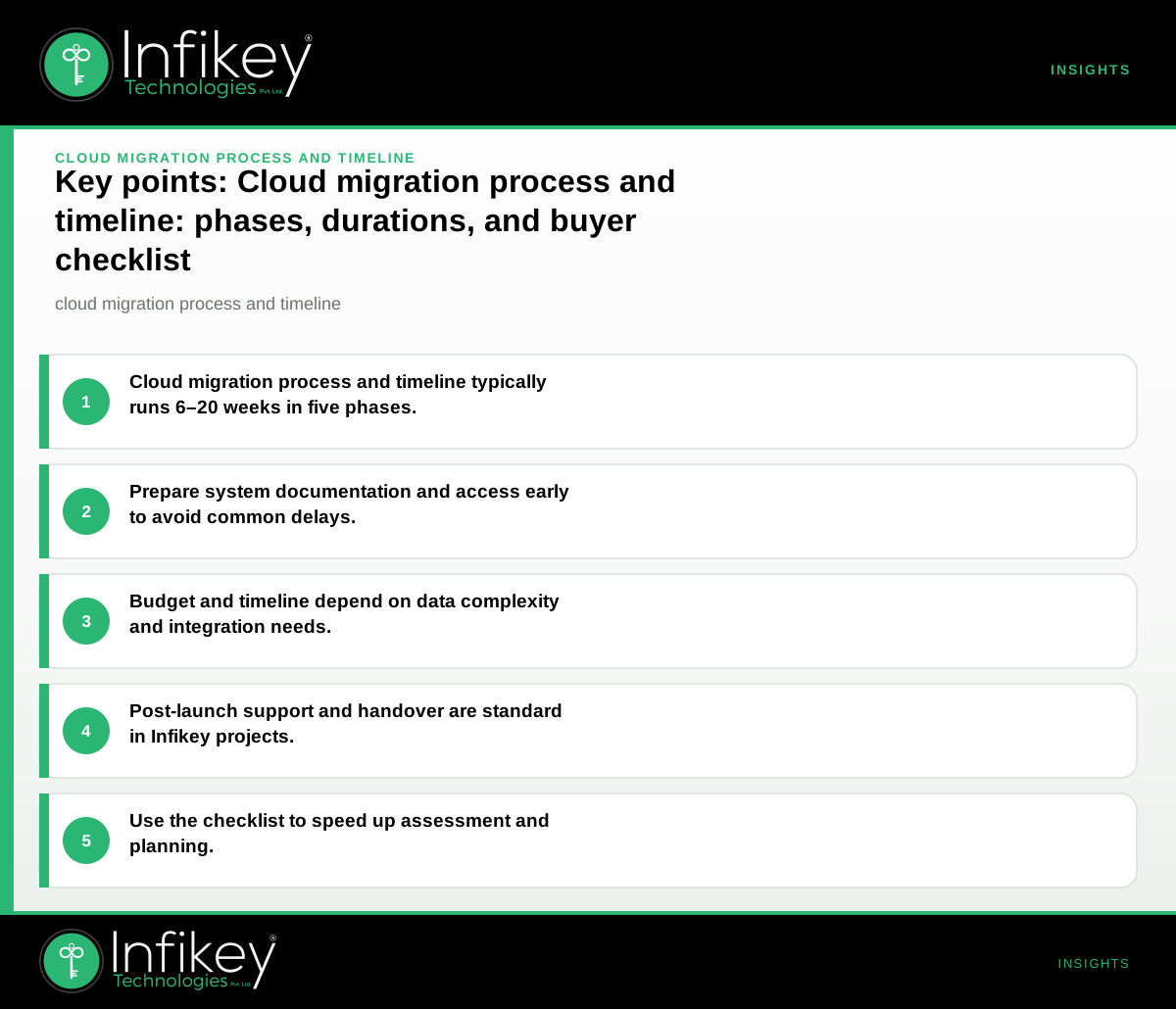
A typical cloud migration process and timeline involves five main phases: assessment, planning, preparation, migration execution, and post-launch stabilisation. For most mid-sized projects, the full cycle runs 6–20 weeks, depending on complexity and scope. Each phase has clear deliverables, and clients should prepare documentation and access in advance to avoid delays.
Cloud migration phases, deliverables, and typical durations
Understanding the cloud migration phases is essential for a predictable and secure transition. Each phase comes with specific deliverables and dependencies, impacting the overall cloud migration duration. Here’s a breakdown of the standard approach:
| Phase | What happens | Typical duration | Deliverable | What the client provides |
|---|---|---|---|---|
| Assessment | Current state review, goals, risk analysis | 1–2 weeks | Assessment report, recommendations | System inventory, business objectives |
| Planning | Target architecture, migration plan, cost estimate | 1–3 weeks | Migration plan, timeline, budget | Access to technical leads, priorities |
| Preparation | Cloud setup, security, connectivity, test runs | 1–4 weeks | Configured cloud environment | Credentials, compliance requirements |
| Migration execution | Data/app migration, cutover, validation | 2–8 weeks | Live migrated systems, test results | Downtime windows, sign-off availability |
| Post-launch support | Monitoring, optimisation, knowledge transfer | 2–3 weeks | Support plan, handover docs | Feedback, support contacts |
On projects like this, total duration is usually 6–20 weeks, with the biggest variable being data complexity and integration needs.
Assessment phase
The assessment phase sets the foundation for the entire cloud migration process and timeline. It includes a deep dive into your current IT landscape, business drivers, and risk profile. Deliverables typically include a detailed assessment report and migration recommendations. Clients should provide a comprehensive inventory of systems, integrations, and business objectives to enable accurate scoping.
Planning phase
During planning, the migration team designs the target cloud architecture, prioritises workloads, and creates a detailed migration plan with cost estimates. This phase is critical for setting stakeholder expectations and aligning on budget and timeline. The migration plan and timeline become the reference point for all future phases.
Preparation phase
Preparation involves setting up the cloud environment, configuring security controls, and running initial connectivity and test migrations. This is where compliance requirements and credentials are validated. Well-prepared clients provide timely access and clear compliance guidelines, reducing the risk of delays.
Migration execution phase
This is the most resource-intensive phase, covering data and application migration, cutover activities, and validation/testing. The migration execution phase duration varies widely depending on system complexity and downtime constraints. Clear client sign-off and availability for testing are essential to avoid bottlenecks.
Post-launch support phase
After migration, the provider offers post-launch cloud migration support, including monitoring, optimisation, and knowledge transfer. This ensures systems stabilise and your team is equipped to manage the new environment. Deliverables include a support plan and comprehensive handover documentation.
Cloud migration checklist: what to prepare before kickoff
A thorough cloud migration checklist helps avoid common pitfalls and accelerates the migration timeline. Here’s what clients should prepare:
- Document all critical systems, integrations, and dependencies.
- List business objectives and migration priorities (e.g., cost, uptime, scalability).
- Identify internal technical and business contacts for approvals.
- Gather compliance, security, and regulatory requirements (GDPR, HIPAA, etc.).
- Provide access to current infrastructure (credentials, network diagrams).
- Plan for downtime windows and user communication.
- Confirm budget range and decision-making process.
Having these ready speeds up assessment and avoids rework during planning.
What usually causes delays in cloud migration—and how to prevent them
Delays in the cloud migration process and timeline are often due to incomplete information or unclear priorities. Here are typical causes and prevention strategies:
| Cause of delay | How to prevent or minimise impact |
|---|---|
| Incomplete system documentation | Prepare inventory and diagrams up front |
| Unclear business priorities | Align stakeholders before planning |
| Access or credential issues | Assign a technical contact for prompt access |
| Compliance or security blockers | Involve compliance early, provide requirements |
| Data quality or integration surprises | Run discovery scripts and test migrations early |
| Slow sign-off or decision cycles | Nominate empowered approvers on client side |
Decision rule: If your data or integrations are complex, budget extra time for preparation and testing. Simple lift-and-shift migrations are faster; transformations or re-platforming take longer.
Cloud migration deliverables: what to expect at each stage
Each phase of the cloud migration process generates specific deliverables. Understanding these helps clients track progress and ensure nothing is missed:
- Assessment: Inventory, risk analysis, recommendations report
- Planning: Cloud architecture design, migration plan, cost estimate, detailed timeline
- Preparation: Configured cloud environment, security policies, connectivity tests
- Migration execution: Migrated applications and data, validation results, cutover documentation
- Post-launch support: Monitoring dashboards, support plan, handover and knowledge transfer materials
Clients should expect regular status updates and clear documentation at each step. These deliverables form the basis for successful handover and long-term cloud operations.
Cloud migration support: post-launch and ongoing services
After the initial migration, robust cloud migration support is essential for stability and optimisation. Post-launch support typically includes:
- Proactive monitoring of applications and infrastructure
- Troubleshooting and incident response
- Performance tuning and cost optimisation
- Security hardening and compliance checks
- Knowledge transfer and staff training
Many organisations opt for ongoing managed cloud support, which can include regular patching, security reviews, and continuous improvement. For clients seeking a focused engagement, a hardening sprint can further improve reliability and security in the weeks following migration. Infikey offers both models, ensuring flexibility for different operational needs.
Questions to ask your provider:
- What is included in post-launch support, and for how long?
- How will knowledge transfer and documentation be delivered?
- What are the options for ongoing managed cloud support?
- Can you provide a sample support plan or escalation matrix?
Example project shapes: planning ranges and timelines
To illustrate how the cloud migration process and timeline play out in practice, here are two common project shapes with ballpark budgets and durations:
- Cloud / infrastructure hardening sprint:
- Scope: Review, CI/CD, monitoring, security baseline - Planning range: USD 3,000–15,000 - Timeline: 2–6 weeks
- Custom web application migration:
- Scope: Auth, dashboards, integrations, staging + production - Planning range: USD 15,000–60,000+ - Timeline: 8–20 weeks
Final scope and commercials are confirmed after discovery; these are ballpark ranges for budgeting. For global buyers, Infikey delivers remotely with clear documentation and USD-friendly billing.
Industry-specific considerations for cloud migration
Different industries face unique challenges during cloud migration. For example:
- Financial services: Regulatory compliance and data privacy are paramount. Expect extended assessment and preparation phases.
- Healthcare and life sciences: Uptime and patient data security are critical; migration plans must account for HIPAA or similar regulations.
- Retail and consumer: Scalability and integration with supply chain systems often drive migration priorities.
- Manufacturing and industrials: IoT data and plant connectivity may require specialised migration strategies.
Infikey has experience across these sectors, tailoring the cloud migration checklist and process to each industry’s needs. See Cloud and infrastructure for more details.
How to choose the right cloud migration partner
Selecting a partner with proven expertise in cloud migration phases, deliverables, and support is crucial. Consider these factors:
- Experience with similar project sizes and industry requirements
- Clear communication and documentation standards
- Flexible engagement models (fixed-scope, managed support, hardening sprints)
- Transparent planning and budgeting
- Ability to provide references or case studies (see Infikey’s published work titles)
Next steps
For a tailored cloud migration process and timeline, or to discuss your specific requirements, see Cloud and infrastructure or [[contact Infikey]({{contact](/contact))}}. Our team will guide you through each phase with clear deliverables and documentation. Whether you need a full migration or targeted cloud migration support, Infikey Technologies Pvt. Ltd. in Ahmedabad serves clients across the Global with a focus on reliability, security, and transparency.