
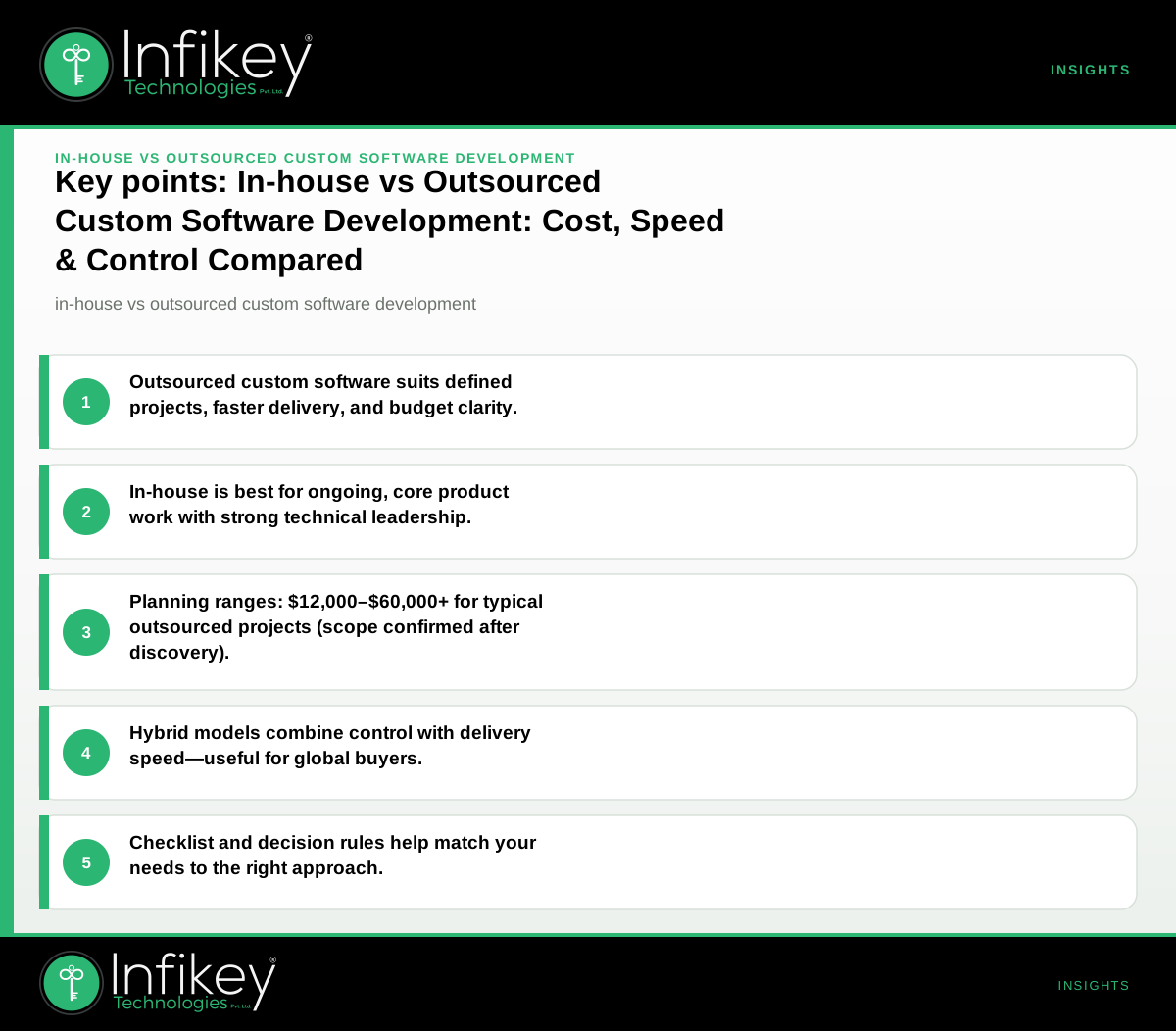
When deciding between in-house vs outsourced custom software development, choose in-house if you need full control and have existing technical leadership; outsource if you want faster delivery, access to specialist skills, or need to manage costs with clear planning ranges. Most global buyers benefit from outsourcing for defined projects, while in-house suits ongoing, core product work.
Side-by-side Comparison: In-house vs Outsourced Custom Software Development
| Option | Cost (USD) | Speed | Control | Risk | Best For |
|---|---|---|---|---|---|
| In-house | High, ongoing | Slower ramp-up | Maximum | Hiring, retention | Core IP, long-term, tech-driven firms |
| Outsourced | Planning ranges: | Faster start | Defined by SOW | Delivery, handover | Projects, MVPs, skill gaps, cost focus |
| $12k–$60k+ per proj | (vendor, IP) |
Use this table to align your priorities—cost, speed, control, or risk—with the best delivery model.
In-house vs Outsourced Software Pros and Cons
In-house Pros
- Full control over process and priorities: Direct management of staff, culture, and development standards.
- Long-term knowledge retention: Team members build deep understanding of business and technology context.
- Alignment with company vision: Easier to embed strategic direction and adapt to evolving needs.
In-house Cons
- Higher [custom software development cost](/tools/custom-software-cost-calculator): Ongoing salaries, benefits, recruitment, training, and infrastructure add up, even for a single project.
- Slower ramp-up: Hiring, onboarding, and forming a high-performing team takes time.
- Retention risk: Losing key staff can stall progress and erode institutional knowledge.
Outsourced Pros
- Faster delivery: Access to ready-made teams and established delivery processes accelerates timelines.
- Specialist skills on demand: Tap into expertise (e.g., AI, cloud, security) without long-term commitments.
- Predictable costs: Defined planning ranges and scoped contracts help manage budgets.
- Scalability: Easily scale teams up or down as project needs change.
Outsourced Cons
- Less day-to-day control: Must rely on vendor’s management and communication.
- Knowledge transfer required: Handover and documentation are critical for maintenance.
- Vendor selection risk: Choosing the wrong partner can impact delivery or IP security.
Decision Rules: When to Choose Each Option
- Choose in-house if:
1. You require deep integration with existing teams or systems. 2. Protecting intellectual property is critical. 3. You have or can hire experienced technical leaders. 4. You expect ongoing, evolving needs beyond a single project.
- Choose outsourced if:
1. You need to deliver quickly without building a team from scratch. 2. You lack specific technical skills or delivery experience in-house. 3. Budget predictability and planning ranges are important. 4. The project has a clear scope and timeline.
On projects like this, we usually see buyers outsource when speed, cost, or access to talent outweigh the need for day-to-day control.
Custom Software Development Cost: Planning Ranges and What Drives Them
The custom software development cost varies widely based on project type, scope, and delivery model. Outsourcing provides clear planning ranges, while in-house costs are ongoing and often less predictable for discrete projects.
Outsourced custom software development (planning ranges):
| Project Type | Planning Range (USD) | Typical Timeline |
|---|---|---|
| Custom web application / portal | $15,000–60,000+ | 8–20 weeks |
| Mobile app (iOS + Android, Flutter/native) | $12,000–45,000 | 10–18 weeks |
| AI feature on existing product | $8,000–35,000 | 6–14 weeks |
*Final scope and commercials are confirmed after discovery. In-house costs include ongoing salaries, recruitment, and overhead, which often exceed these ranges for a single project.*
What Affects Software Development Planning Ranges?
- Scope complexity: More features, integrations, or compliance requirements increase cost and timeline.
- Technology stack: Emerging tech (e.g., AI, cloud-native) may require higher expertise and budget.
- Team composition: Seniority and specialization of developers, designers, and project managers.
- Delivery location: Offshore or nearshore teams may offer cost advantages.
- Ongoing support: Maintenance and enhancements add to total cost of ownership.
What’s Included in Each Approach?
In-house:
- Full-time staff (developers, testers, PMs)
- Recruitment, onboarding, and retention costs
- Long-term knowledge retention
- Internal process and cultural alignment
Outsourced:
- Delivery by a specialist team (like Infikey Technologies Pvt. Ltd.)
- Fixed or scoped pricing, clear milestones
- Documentation and handover support
- Flexible scaling up or down
When to Outsource Software Development: Key Scenarios
Outsourcing is often the best fit when:
- Launching a new product or MVP: Speed is critical, and you need to validate an idea before investing in a full team.
- Filling skill gaps: Your in-house team lacks expertise in a specific technology or domain (e.g., AI, cloud, cybersecurity).
- Managing budget risk: You need defined costs and timelines for planning and stakeholder buy-in.
- Short-term or one-off projects: Building a full in-house team is not cost-effective for temporary needs.
- Scaling quickly: You want to ramp up delivery capacity without long-term hiring commitments.
Hybrid Software Development Teams: Combining Strengths
Hybrid models blend in-house and outsourced resources for flexibility and control. This approach is common among global buyers who want to:
- Retain core product ownership: Keep architecture, roadmap, and sensitive IP in-house.
- Accelerate delivery: Outsource feature builds, integrations, or modules to specialist partners.
- Smooth transitions: Use external teams for initial delivery, then transition maintenance to in-house staff.
- Balance cost and quality: Optimize spend while accessing the right expertise at each stage.
Hybrid teams require clear roles, strong communication, and robust documentation to succeed. Infikey Technologies Pvt. Ltd. often supports clients in Global with hybrid delivery, ensuring seamless collaboration between internal and external teams.
Example Project Shapes and Planning Ranges
- Mid-market retailer rebuilding a catalogue site: Outsourced web application, $15,000–60,000+, 8–20 weeks.
- Startup launching a mobile MVP: Outsourced mobile app, $12,000–45,000, 10–18 weeks.
- Healthcare provider adding AI scheduling: Outsourced AI feature, $8,000–35,000, 6–14 weeks.
These ranges help global buyers budget realistically, with clear documentation for non-technical sponsors.
Software Development Planning Ranges: How to Budget
When budgeting for custom software, consider:
- Discovery and requirements: Invest in upfront planning to clarify scope and avoid surprises.
- Phased delivery: Break large projects into milestones for better control and flexibility.
- Contingency: Allow for 10–20% contingency to handle unforeseen changes or risks.
- Post-launch support: Plan for maintenance, updates, and user feedback cycles.
Infikey Technologies Pvt. Ltd. provides planning ranges and phased roadmaps to help buyers in Ahmedabad and globally make informed decisions.
Checklist: Questions to Decide In-house vs Outsourced
- Is this a one-off project or ongoing product?
- Do you have technical leadership ready to hire, train, and retain a team?
- How important is delivery speed vs. full control?
- What is your planned budget (see planning ranges above)?
- Are there skills or compliance requirements your team lacks?
- Do you need clear documentation and handover?
If you answer “project”, “need speed”, or “have a fixed budget” to most, outsourcing is likely the better fit.
Steps to Get Started: From Planning to Delivery
- Define your goals: Clarify business objectives, user needs, and success criteria.
- Assess internal capabilities: Evaluate your team’s skills, capacity, and readiness.
- Estimate budget and timeline: Use planning ranges to set realistic expectations.
- Choose the right model: Decide between in-house, outsourced, or hybrid based on your priorities.
- Select partners or hire staff: Vet vendors or candidates for experience, communication, and cultural fit.
- Plan for handover and support: Ensure documentation and knowledge transfer for long-term success.
Next Steps: Get a Custom Estimate or Talk to an Expert
To discuss your project or get a tailored planning range for your custom software, see Software engineering or [[contact Infikey]({{contact](/contact))}} for a discovery call. We work with global buyers, supporting remote delivery, clear documentation, and USD-friendly budgeting.