
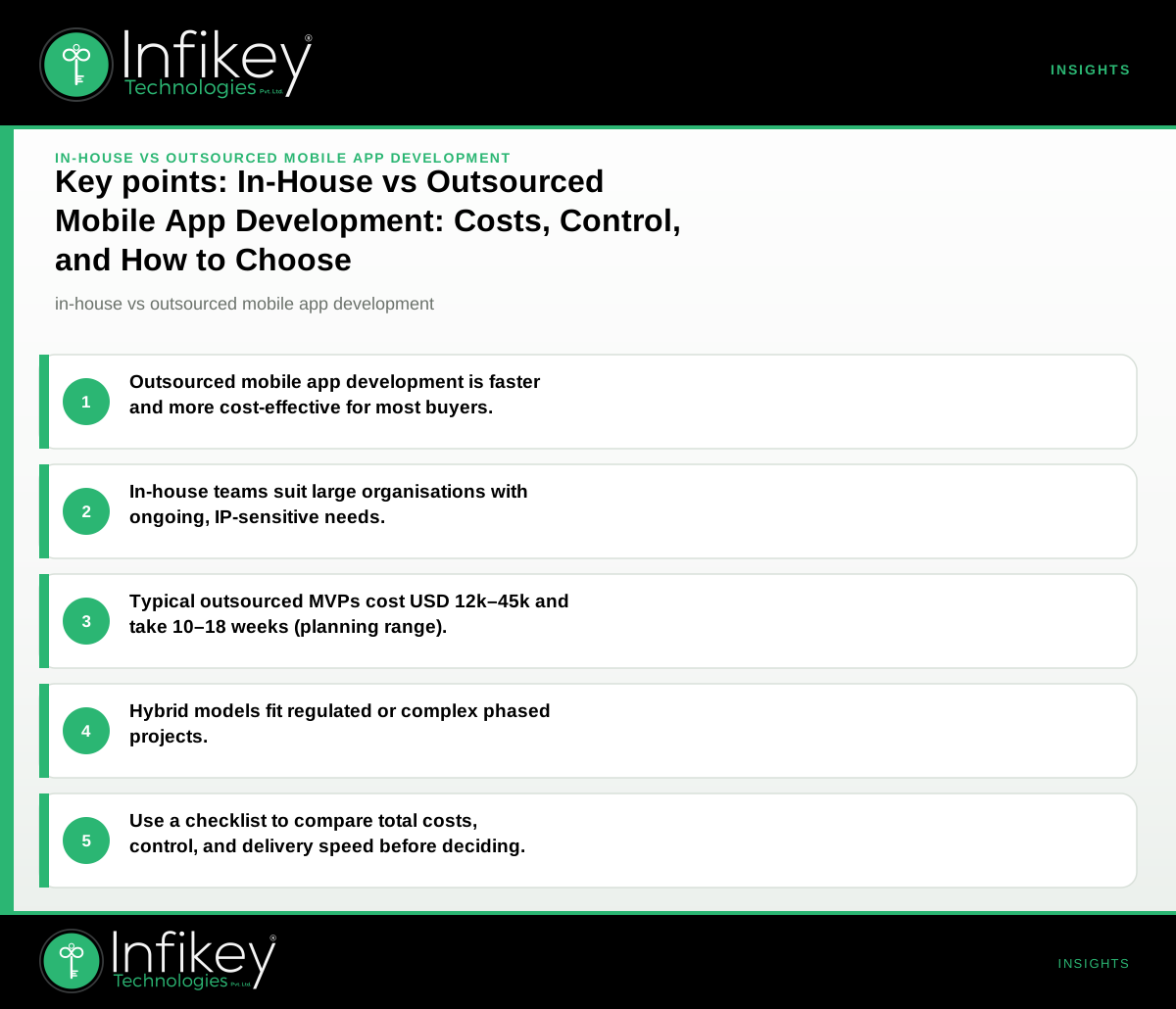
Choosing between in-house vs outsourced mobile app development comes down to your priorities: in-house teams offer maximum control and alignment but require higher upfront investment and longer ramp-up, while outsourcing delivers faster results and lower costs with less internal overhead—best for most businesses seeking a defined outcome within a set budget.
In-House vs Outsourced Mobile App Development: Quick Comparison Table
| Option | Cost (USD) | Speed | Control | Risk | Best For |
|---|---|---|---|---|---|
| In-house | High (USD 150k+) | Slowest | Full | Talent, delivery | Large orgs, IP-sensitive, ongoing products |
| Outsourced | USD 12k–45k (MVP) | Fastest | Moderate | Vendor, comms | Most SMEs, startups, fixed-scope projects |
| Hybrid | Medium (varies) | Medium | Shared | Integration, overlap | Complex, regulated, or phased delivery |
Note: Outsourced cost range reflects typical Infikey planning ranges for a cross-platform MVP (see below).
Understanding the In-House vs Outsourced Mobile App Development Decision
Mobile app development is a major investment, and the choice between building an in-house app development team or outsourcing to a specialist partner like Infikey Technologies Pvt. Ltd. can shape your project’s timeline, cost, and long-term success. Each approach has distinct advantages and trade-offs, depending on your business goals, available resources, and risk tolerance.
In-House Mobile App Development: What It Means
An in-house app development team consists of employees on your payroll—developers, designers, QA, product managers, and sometimes DevOps or security specialists—dedicated to your project. This model gives you:
- Direct control over hiring, technology stack, and day-to-day priorities.
- Full alignment with your company’s culture, processes, and IP protection needs.
- Long-term ownership of the codebase and product roadmap.
However, building and maintaining such a team requires significant upfront investment, ongoing management, and the ability to attract and retain technical talent—especially challenging outside major tech hubs like Ahmedabad.
Outsourcing Mobile App Development: What to Expect
Outsourcing mobile app development involves partnering with an external agency or software engineering firm (such as Infikey Technologies Pvt. Ltd.) to deliver your app against a defined scope, timeline, and budget. Key benefits include:
- Faster project kickoff and delivery, as the partner brings a ready team.
- Lower upfront costs—you pay for outcomes, not permanent headcount.
- Access to specialist skills (e.g., Flutter, native iOS/Android, API integration, UI/UX design).
- Scalability—ramp up or down as your needs change.
The main challenges are ensuring clear communication, managing expectations, and maintaining quality and security standards. With a reliable partner and robust documentation, these risks are manageable for most organizations.
Mobile App Development Cost Comparison
Understanding the true cost of in-house vs outsourced mobile app development is critical for effective mobile app project planning. Here’s a breakdown of typical cost elements:
In-House Team Costs
- Salaries: Developers, designers, QA, PMs (often USD 150,000+/year for a small team).
- Recruitment: Time and expense to hire skilled talent.
- Onboarding and training: Getting new hires up to speed on your product and processes.
- Tools and infrastructure: Licenses, devices, cloud services.
- Overhead: HR, benefits, workspace, and ongoing management.
Outsourced Development Costs
- Fixed project fee or milestone-based billing: Predictable costs for defined deliverables.
- No recruitment or onboarding costs: The partner brings a ready team.
- Tooling and infrastructure: Usually included in the partner’s fee.
- Support and maintenance: Can be scoped as part of the engagement or added later.
#### Typical Planning Ranges (Infikey)
- Cross-platform MVP: USD 12,000–45,000 (10–18 weeks)
- Web portal with mobile: USD 15,000–60,000+ (8–20 weeks)
- AI feature add-on: USD 8,000–35,000 (6–14 weeks)
All ranges are for planning; final scope and commercials are confirmed after discovery. For detailed estimates, try the mobile [app development cost calculator](/services/mobile-app-development).
Outsourcing Mobile App Development: Pros and Cons
Pros
- Speed to market: Launch faster by leveraging an experienced team.
- Cost efficiency: No long-term payroll or recruitment costs.
- Expertise: Access to proven delivery processes, up-to-date tech stacks, and industry best practices.
- Flexibility: Scale resources up or down as project needs shift.
Cons
- Less direct control: You must rely on partner transparency and communication.
- Vendor risk: Quality and reliability depend on partner selection.
- Knowledge transfer: Requires strong documentation and handover planning to avoid future bottlenecks.
In-House App Development Team: Pros and Cons
Pros
- Full control: Over every aspect of design, development, and deployment.
- Deep product knowledge: Team members become experts in your business and tech stack.
- IP protection: Sensitive data and code remain within your organization.
Cons
- High costs: Salaries, recruitment, and overhead add up quickly.
- Longer ramp-up: Hiring and onboarding can delay project start.
- Talent retention: Risk of turnover, especially in competitive markets.
Hybrid Mobile App Development Approach
A hybrid model combines the strengths of both in-house and outsourced development. This is increasingly popular for organizations that want to:
- Retain product ownership and control over core IP.
- Accelerate delivery with external engineering capacity.
- Outsource specific modules (e.g., UI, integrations) while keeping sensitive logic in-house.
- Manage compliance or data residency by splitting responsibilities.
Hybrid approaches are well-suited for complex, regulated, or phased projects—common in industries like financial services, healthcare, or manufacturing. For example, your internal team might define requirements, manage the backlog, and own key integrations, while Infikey Technologies Pvt. Ltd. delivers the front-end app or specific features. Clear documentation and a robust handover plan are essential to avoid knowledge gaps.
Mobile App Project Planning: Steps for Success
Effective mobile app project planning is vital regardless of your chosen model. Here’s a step-by-step checklist to guide your decision:
- Define business goals and success metrics.
- Map must-have features and delivery timeline.
- Estimate total cost for both in-house and outsourced options—including hiring, tools, and vendor quotes.
- Assess internal team capability, bandwidth, and experience with mobile projects.
- Clarify data, compliance, or IP requirements.
- Shortlist partners with strong documentation, remote delivery, and relevant industry experience ([see Infikey’s mobile app development service](/services/mobile-app-development)).
- Plan for ongoing maintenance and support—who will own updates post-launch?
How to Decide: Key Questions to Ask
- What is the business impact if launch is delayed by 3–6 months?
- Do you have access to proven mobile app talent internally?
- Is the app core IP, or can an external partner deliver safely with clear documentation?
- What is your total budget for the first release—including recruitment, not just build cost?
- How will you manage ongoing updates and support?
- Are there regulatory or data residency requirements that affect delivery location?
- Will your app require rapid scaling or frequent updates?
Example Project Shapes and Ballpark Budgets
To help you visualize what different approaches look like in practice, here are three common project types with planning ranges based on Infikey’s experience:
Startup MVP
- Scope: Cross-platform (Flutter or native), authentication, core user flows, API integration, app store submission.
- Planning range: USD 12,000–45,000
- Timeline: 10–18 weeks
- Best fit: Startups, SMEs, or product teams needing to validate an idea or launch quickly with limited internal resources.
Enterprise Pilot
- Scope: Authentication, user roles, dashboards, basic third-party integrations, potentially a web portal.
- Planning range: USD 15,000–60,000+ (if web portal included)
- Timeline: 8–20 weeks
- Best fit: Enterprises or regulated industries piloting new products or digitizing internal workflows.
AI Feature Add-On
- Scope: Add AI-driven features to an existing product (e.g., chat, recommendations), including prompt engineering, integration, and evaluation.
- Planning range: USD 8,000–35,000
- Timeline: 6–14 weeks
- Best fit: Companies seeking to enhance existing apps with intelligent features without rebuilding from scratch.
Note: All budgets are for planning purposes only. Final scope and commercials are confirmed after a discovery phase. For a tailored estimate, use the App development cost calculator.
When to Consider a Hybrid Mobile App Development Approach
A hybrid model is ideal when:
- You want to keep product vision and sensitive data in-house, but need external delivery muscle for speed or specialist skills.
- Certain modules (such as UI or third-party integrations) can be safely outsourced, reducing internal workload.
- Your industry has compliance or data residency requirements that dictate where and how certain parts of the app are built.
- You plan phased rollouts or complex integrations that benefit from both internal knowledge and external expertise.
Hybrid models are especially effective for organizations in financial services, healthcare, manufacturing, and other regulated sectors, as well as for startups scaling quickly but not ready to commit to a full internal team.
Mobile App Development Cost Comparison: In-Depth Analysis
When comparing mobile app development cost, it’s important to look beyond initial build fees. Consider:
- Total cost of ownership: Includes development, maintenance, updates, and support.
- Opportunity cost: Delays in hiring or ramp-up for in-house teams can mean lost market opportunities.
- Flexibility: Outsourced and hybrid models allow you to scale up or down without long-term commitments.
For most organizations, outsourcing provides the best balance of speed, cost control, and access to specialist skills—especially for MVPs, pilots, or projects with defined scope and timeline.
Next Steps
If you need to move fast, control costs, and get clear documentation for your mobile app, outsourcing is usually the best fit—especially with a partner experienced in remote delivery and global handover. For a tailored estimate or to discuss hybrid models, contact Infikey or see our mobile app development services.
---
About Infikey Technologies Pvt. Ltd.
Based in Ahmedabad, Infikey Technologies Pvt. Ltd. serves clients across the Global with a full spectrum of digital services—including mobile app development, website development, software engineering, cloud and infrastructure, cybersecurity, AI, digital transformation, managed engineering, digital marketing and SEO, and graphics designing. To discuss your mobile app project or explore the right development model for your business, Talk to Infikey.