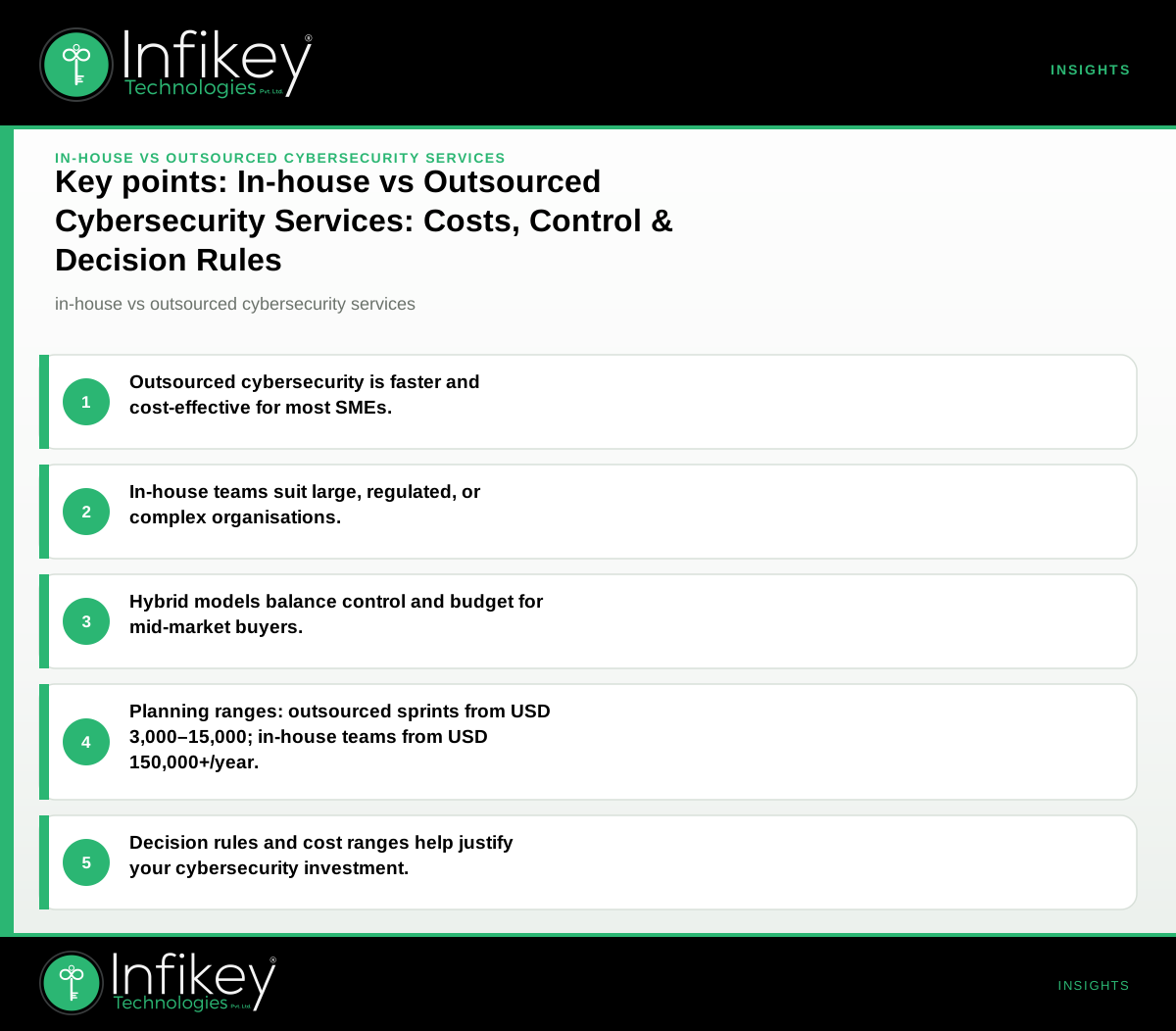
Choosing between in-house vs outsourced cybersecurity services depends on your business’s size, risk profile, and available expertise. In-house teams suit large organisations needing full control and ongoing investment, while outsourcing is faster, more cost-effective, and ideal for most small to mid-sized companies seeking reliable protection and clear accountability.
Quick Comparison Table: In-house vs Outsourced Cybersecurity
| Option | Cost (USD, planning range) | Speed to Deploy | Control Level | Risk Profile | Best For |
|---|---|---|---|---|---|
| In-house | $150,000–$500,000+/year* | 3–12 months | Full | Staff/knowledge gap | Large, regulated, complex needs |
| Outsourced | $3,000–$60,000+ (per project/sprint) | 2–8 weeks | Shared | Vendor dependency | SMEs, fast-moving, cost-focused |
*Estimate for a small internal security team (salaries, tooling, training, benefits); actual costs vary by region and scope.
Decision Rules: When to Choose Each Option
Choose In-house if:
- You require 24/7 coverage and deep integration with internal IT.
- Regulatory or data residency rules demand total control.
- You can budget for ongoing salaries, upskilling, and retention.
- Security is a core differentiator or compliance is business-critical.
Choose Outsourced if:
- You need rapid improvement or specific expertise (e.g., cloud, penetration testing).
- Your team lacks dedicated security staff or bandwidth.
- You want predictable, project-based costs and clear deliverables.
- You operate in a market where remote delivery is standard and documentation is key.
Cost Comparison: Planning Ranges for Each Approach
- In-house:
- Expect annual costs from USD 150,000–500,000+ for a basic team (2–4 staff, tools, training, benefits). - Add 3–6 months for hiring, onboarding, and process setup.
- Outsourced:
- For a cloud/infrastructure hardening sprint: USD 3,000–15,000, delivered in 2–6 weeks. - For a custom web application security engagement: USD 15,000–60,000+, delivered in 8–20 weeks. - Final scope and commercials are confirmed after discovery. See Cybersecurity for more on Infikey’s approach.
How to Decide: Key Questions to Ask
- What is your current security maturity?
- If you lack dedicated staff or policies, outsourcing brings rapid improvement.
- Are there regulatory or customer requirements?
- In-house may be required for strict data residency or industry compliance.
- What is your risk tolerance for vendor dependency?
- Outsourcing shifts some risk to the provider but requires clear contracts and documentation.
- Do you need round-the-clock coverage?
- In-house is best for 24/7 needs; many SMEs use a mix of internal and external support.
Hybrid Approaches: When Combining Makes Sense
A hybrid model—having a small in-house team manage vendors or handle sensitive incidents, while outsourcing specialist tasks—fits:
- Mid-market companies scaling security without full internal investment.
- Organisations with ongoing compliance needs but limited budgets.
- Businesses seeking coverage across time zones or requiring both proactive and reactive support.
On projects like this, we usually see a core internal contact (IT or compliance) working with an external provider for audits, penetration testing, or cloud hardening. This model balances control, cost, and speed.
Example Engagements: What Typical Projects Look Like
- Cloud/Infrastructure Hardening Sprint:
- Scope: Review, CI/CD, monitoring, backups, security baseline. - Planning range: USD 3,000–15,000. - Timeline: 2–6 weeks.
- Custom Web Application Security:
- Scope: Auth, roles, dashboards, integrations, staging + production. - Planning range: USD 15,000–60,000+. - Timeline: 8–20 weeks.
These ranges are for planning only; final scope and commercials are confirmed after discovery. For a tailored estimate, [[contact Infikey]({{contact](/contact))}}.
Outsourcing Cybersecurity: What to Look For
- Clear deliverables and documentation for non-technical sponsors.
- Proven remote delivery and global support.
- Transparent pricing and project scope (see above planning ranges).
- Ability to work with your in-house IT or compliance lead.
In-house vs Outsourced Cybersecurity Services: Which is Right for You?
For most global buyers, outsourcing cybersecurity is faster to implement, more cost-effective, and easier to document for board approval. In-house teams suit only the largest, most regulated, or security-driven organisations. Hybrid models are increasingly common for mid-market needs.
Ready to secure your business? See Cybersecurity for Infikey’s global delivery options or talk to Infikey for a planning session.