
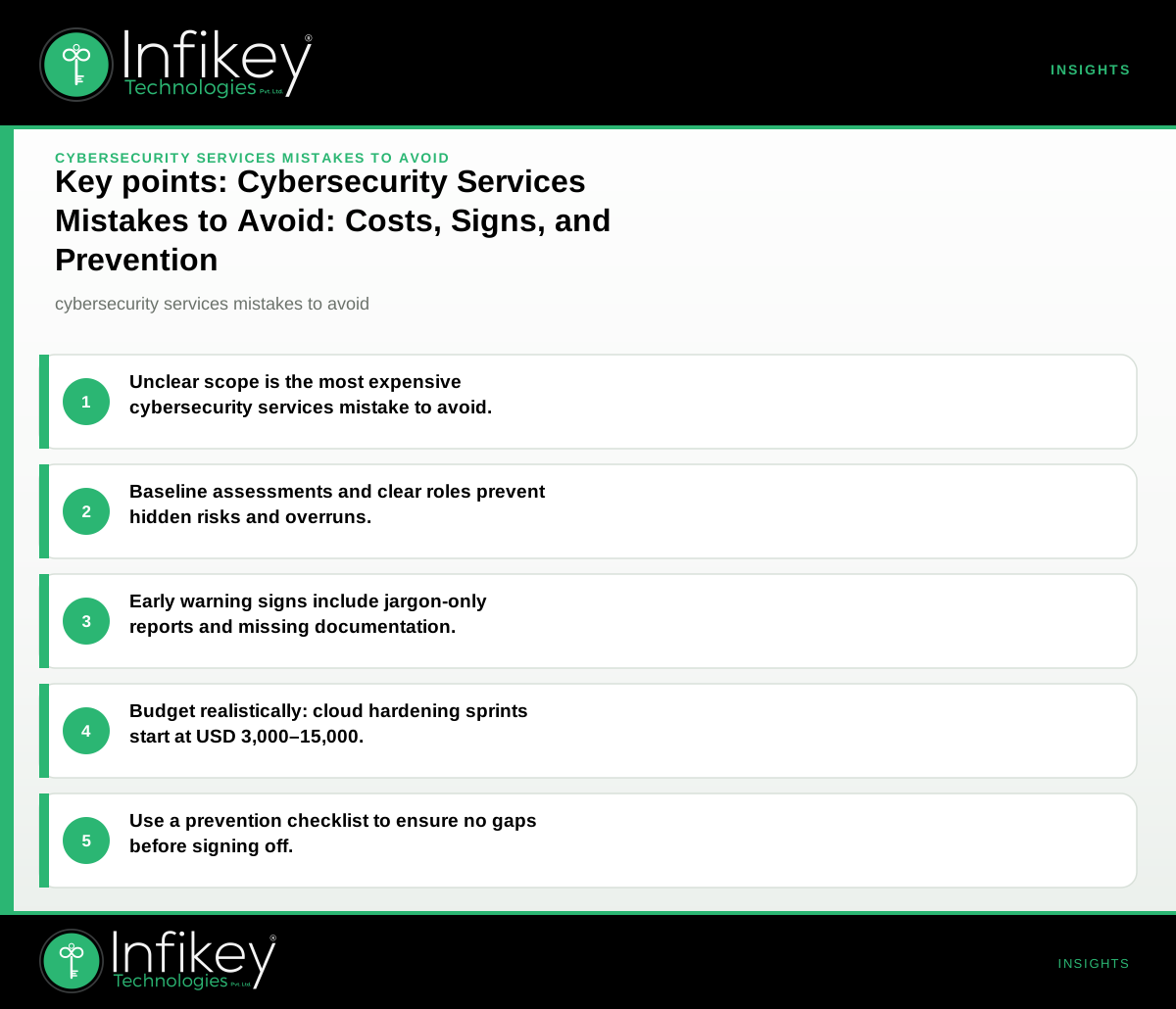
The most expensive cybersecurity services mistake is assuming your provider will handle everything without clear scope, ownership, and documentation. This leads to gaps, missed threats, and costly breaches. To avoid it, define responsibilities, review deliverables, and require documentation your non-technical sponsor can understand before starting.
Table: Cybersecurity Services Mistakes to Avoid
| Mistake | Why it happens | What it costs you | How to avoid it |
|---|---|---|---|
| Vague scope and unclear roles | Rushed procurement, no RACI, or unclear handover | Gaps in coverage, unaddressed risks, project overruns (USD 3,000–60,000+) | Define scope, RACI matrix, require documentation |
| No baseline assessment | Skipping discovery to save time or budget | Missed vulnerabilities, wasted spend | Insist on a baseline security review |
| Over-reliance on tools, not process | Belief that software alone solves security | False sense of safety, missed human factors | Combine tools with process and training |
| Ignoring compliance and local regulation | Assuming global standards are enough | Fines, legal exposure, blocked go-live | Map requirements for each market |
| Poor change management | No plan for updates, staff turnover, or new threats | Security drift, legacy risks | Schedule regular reviews and updates |
| Lack of incident response planning | "It won’t happen to us" mindset | Delayed response, higher breach impact | Build and test an incident response plan |
On projects like this, we usually see that unclear scope and missing baseline assessments are the root of most overruns and post-launch surprises. For a typical cloud/infrastructure hardening sprint, expect a planning range of USD 3,000–15,000 (2–6 weeks), and for custom web application security, USD 15,000–60,000+ (8–20 weeks), with final scope confirmed after discovery.
Understanding Cybersecurity Services Mistakes to Avoid
Many organizations, from financial services to healthcare and retail, face similar pitfalls when engaging cybersecurity partners. The most common cybersecurity services mistakes to avoid stem from unclear communication, rushed procurement, and lack of ongoing governance. These mistakes are not just technical—they can have wide-reaching impacts on compliance, budget, and business continuity.
Why Clear Project Scope Matters
One of the most frequent cybersecurity project scope mistakes is failing to define exactly what is included and excluded from the engagement. Without a precise scope, critical systems or data may be left unprotected, and both the client and provider may have mismatched expectations. For example, a cloud hardening sprint may cover infrastructure but not application-level security, unless specified. Use a detailed RACI matrix to clarify who is responsible, accountable, consulted, and informed for each risk area.
The Cost of Cybersecurity Budget Overruns
Cybersecurity budget overruns often result from scope creep, missed requirements, or unexpected compliance needs. When projects lack a baseline assessment, hidden vulnerabilities can emerge late, requiring additional spend. For instance, a mid-market retailer may budget for basic monitoring, only to discover after assessment that advanced threat detection is needed. This can push costs from the lower end (USD 3,000) to the higher end (USD 15,000 or more) for a cloud/infrastructure engagement. Always confirm the final scope and budget after a discovery phase, as recommended by Infikey Technologies Pvt. Ltd..
Compliance Issues: A Hidden Risk
Cybersecurity compliance issues are a leading cause of delays, fines, and reputational damage. Many organizations assume that following global frameworks (like ISO 27001 or NIST) is sufficient, but local regulations may impose additional requirements. For example, healthcare and life sciences projects in India must address both global standards and local privacy laws. Ignoring these can result in blocked go-lives or legal exposure. Map compliance requirements for every market where your business operates and ensure your cybersecurity provider has experience with those regulations.
Early Warning Signs During a Cybersecurity Project
- Deliverables are not mapped to business risks or compliance needs.
- No clear owner for each task or risk area.
- Security findings are delivered in jargon, with no actionable summary.
- Project updates skip over what is out of scope or deferred.
- No plan for ongoing monitoring, reviews, or training.
- Vendor hesitates to share process, documentation, or handover materials.
If you see these signs, pause and clarify scope, deliverables, and ownership immediately. Projects that ignore these warnings often run over budget or leave critical gaps.
Prevention Checklist: Avoiding Cybersecurity Services Mistakes
A robust cybersecurity planning checklist can help you avoid the most common pitfalls:
- Define a clear scope with a RACI (Responsible, Accountable, Consulted, Informed) matrix.
- Require a baseline assessment before any solutioning or tool selection.
- Map deliverables to your business risks and compliance requirements.
- Insist on plain-language documentation for each phase and handover.
- Schedule regular reviews for scope, findings, and incident response readiness.
- Confirm how ongoing monitoring, updates, and training will be handled.
- Validate that all parties understand their roles and escalation paths.
- Review the cybersecurity planning checklist at each project milestone to ensure nothing is missed.
Cybersecurity Project Scope Mistakes: How to Spot and Prevent Them
Cybersecurity project scope mistakes often start small but can have outsized consequences. Here’s how to identify and prevent them:
- Ambiguous language in contracts: Insist on specific, measurable deliverables. For example, instead of "improve security," require "implement multi-factor authentication on all admin accounts."
- Missing systems or data from the scope: List all critical assets, including cloud services, endpoints, and third-party integrations.
- No plan for future changes: Build in time for scope reviews if your business or technology stack evolves.
A well-defined scope is your best defense against budget overruns and compliance gaps.
Cybersecurity Budget Overruns: Decision Rules for Control
To avoid cybersecurity budget overruns, use these decision rules:
- Always conduct a baseline assessment first. This uncovers hidden risks and clarifies the true scope.
- Request a phased approach. Break large projects into smaller, manageable phases with clear deliverables and checkpoints.
- Insist on transparent reporting. Require regular updates on budget usage and any changes in scope.
Refer to Infikey Technologies Pvt. Ltd.’s engagement ballparks for realistic planning ranges, but remember that final pricing is confirmed after discovery.
Cybersecurity Compliance Issues: Key Questions
Addressing cybersecurity compliance issues requires proactive planning. Ask your provider:
- What regulations apply to our industry and markets (e.g., GDPR, HIPAA, local data laws)?
- How will you ensure ongoing compliance as regulations change?
- Can you provide documentation suitable for regulators and auditors?
For industries like financial services, healthcare, and public sector, compliance is not optional—it’s foundational.
Example Project Shapes and Planning Ranges
- Cloud/infrastructure hardening sprint: Includes review, CI/CD, monitoring, backups, and a security baseline. Planning range: USD 3,000–15,000. Timeline: 2–6 weeks.
- Custom web application security: Auth, roles, dashboards, integrations, staging + production. Planning range: USD 15,000–60,000+. Timeline: 8–20 weeks.
Final commercials and scope are always confirmed after a proper discovery phase. For global buyers, ensure all documentation is suitable for non-technical sponsors and that time zones and regulatory needs are addressed from the start.
Questions to Ask Your Cybersecurity Provider
Selecting the right partner means asking the right cybersecurity provider questions, such as:
- What is included and excluded in the scope? Who owns each risk area?
- How will you document findings and recommendations?
- What is your process for ongoing monitoring and incident response?
- How do you address compliance for our specific markets?
- What happens if we change staff or expand the project?
- Can you provide a cybersecurity planning checklist tailored to our needs?
Document the answers and use them to compare providers and ensure alignment.
Steps to Take Before Signing a Cybersecurity Services Contract
- Review the full cybersecurity planning checklist with your internal team.
- Confirm the provider’s experience in your industry and with your regulatory requirements.
- Validate the project scope, deliverables, and reporting cadence.
- Set escalation paths for urgent issues or incidents.
- Schedule a kickoff meeting to align all stakeholders.
Related Infikey Services
- Cybersecurity services: Project-based and ongoing security for global buyers.
- Cloud and infrastructure: Secure, monitor, and scale your infrastructure.
- Software engineering: Build with security in mind from day one.
- Contact Infikey: Book a discovery call to clarify scope and get a planning range.
Ready to avoid costly cybersecurity services mistakes? Review your scope, clarify ownership, and get a planning range from Infikey’s cybersecurity team before you spend.