
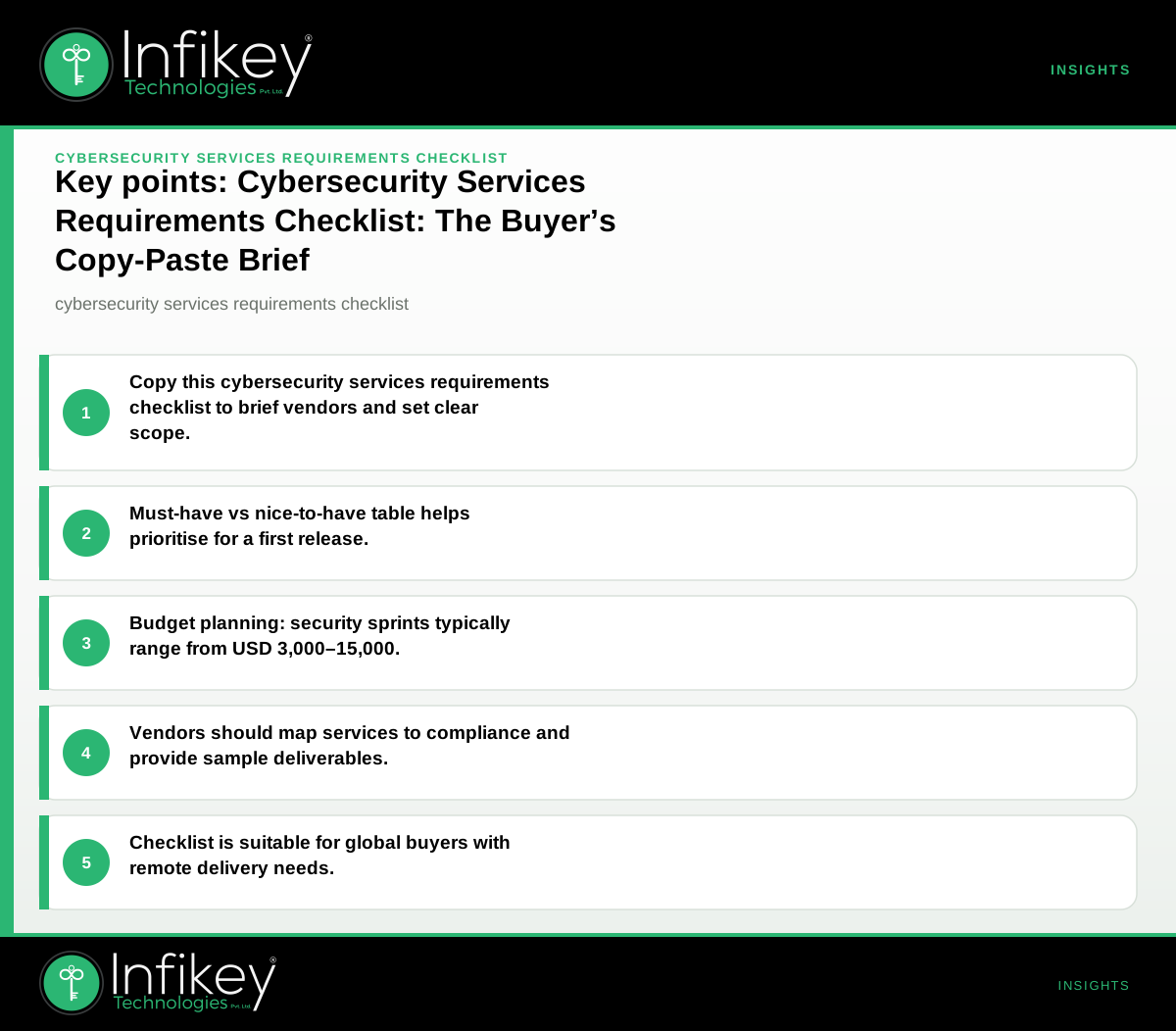
A cybersecurity services requirements checklist defines what you need, what to expect from vendors, and how to compare proposals. Use this checklist to brief providers, ensure all critical areas are covered, and set a clear scope, budget, and timeline for your project.
Cybersecurity Services Requirements Checklist: Copy-Paste for Vendor Briefs
A robust cybersecurity services requirements checklist is essential for organizations seeking to engage external partners or vendors. It ensures that all business, technical, compliance, and operational needs are addressed from the outset. Below is a comprehensive template you can adapt for your next cybersecurity project or RFP.
1. Project Goals
- State the business drivers (e.g., regulatory compliance, risk reduction, customer trust).
- List specific outcomes (e.g., pass audit, reduce incident response time, secure remote work).
- Identify key risks or threats to address (e.g., ransomware, phishing, insider threats).
- Define success criteria (e.g., zero critical vulnerabilities, successful penetration test).
Decision Rule: Tie each goal to a measurable outcome. For example, if "reduce phishing risk" is a goal, specify the desired reduction percentage or the target number of reported incidents.
2. Scope of Services
- List systems, applications, and networks in scope (e.g., cloud, on-premises, endpoints).
- Specify in-scope data types (e.g., PII, payment data, IP).
- Note out-of-scope areas (e.g., legacy systems, third-party sites).
- State if ongoing monitoring or one-off assessment is required.
- Indicate if remediation support is expected.
Tip: Use a cybersecurity project scope document to avoid misunderstandings. Clearly state which business units, geographies, or data flows are included. This helps vendors size their effort and prevents scope creep.
3. Technical Requirements
- Required security standards (e.g., ISO 27001, NIST, CIS Controls).
- Preferred tooling (e.g., SIEM, EDR, vulnerability scanners).
- Integration needs (e.g., with existing ticketing, cloud platforms).
- Reporting format and frequency (e.g., monthly dashboards, incident alerts).
- Access requirements (e.g., VPN, privileged accounts, remote access windows).
Decision Rule: If you have a preferred cybersecurity requirements template or specific technologies (like a chosen SIEM platform), mention them to ensure compatibility.
4. Content and Deliverables
- List deliverables (e.g., risk assessment report, remediation plan, security policy templates).
- Specify documentation needs (e.g., executive summary, technical appendices).
- Training or awareness sessions required (yes/no, audience, format).
- Incident response playbooks or tabletop exercises (yes/no).
Worked Example: For a financial services client, deliverables might include a detailed risk register, prioritized remediation roadmap, and a tailored security awareness session for front-office staff.
5. Compliance and Legal
- List applicable regulations (e.g., GDPR, HIPAA, PCI DSS, local data laws).
- Data residency and sovereignty requirements.
- Vendor certifications or evidence of compliance (e.g., SOC 2, ISO certificates).
- NDA or contractual security clauses needed.
Tip: Use a cybersecurity compliance checklist to ensure all local and industry-specific requirements are addressed. For example, healthcare organizations should reference HIPAA, while e-commerce platforms may need PCI DSS mapping.
6. Budget and Timeline
- State your planning budget range (e.g., USD 3,000–15,000 for a baseline hardening sprint; see below).
- Desired start and completion dates.
- Milestone or phased delivery preferences.
- Payment terms (e.g., milestone, monthly, on delivery).
Decision Rule: Use your cybersecurity services budget to prioritize must-have requirements. If budget is limited, focus on high-risk systems and compliance-driven needs first.
Must-Have vs Nice-to-Have: First Release Table
| Requirement | Must-Have | Nice-to-Have |
|---|---|---|
| Clear project goals and risks | ✓ | |
| List of in-scope systems and data | ✓ | |
| One-off security assessment | ✓ | |
| Ongoing monitoring | ✓ | |
| Remediation support | ✓ | |
| Compliance mapping (e.g., GDPR, PCI DSS) | ✓ | |
| Security awareness training | ✓ | |
| Integration with ticketing or SIEM | ✓ | |
| Detailed executive and technical reporting | ✓ | |
| Incident response playbooks | ✓ |
How to Use: When evaluating vendor proposals, use this table to score each offering. Prioritize vendors who cover all must-haves and offer nice-to-haves within your budget.
Example: Filled-In Entry for an Anonymous Project
- Project Goals: Achieve PCI DSS compliance and reduce phishing risk for a global e-commerce platform.
- Scope: Cloud infrastructure (AWS), payment processing systems, customer data; legacy ERP out of scope.
- Technical: NIST CSF baseline, use of existing SIEM, monthly reporting.
- Content: Risk assessment, remediation plan, executive summary, one training session for staff.
- Compliance: PCI DSS, GDPR, data residency in EU; vendor must provide ISO 27001 certificate.
- Budget/Timeline: USD 10,000–15,000, 6 weeks, payment on milestones.
Using a Cybersecurity Vendor Checklist
A cybersecurity vendor checklist is vital for comparing providers. It helps you:
- Assess vendor experience with your industry (e.g., healthcare, retail, manufacturing).
- Verify certifications and compliance history.
- Review sample deliverables (reports, playbooks, policies).
- Confirm support for your technical stack (cloud, on-premises, hybrid).
- Evaluate incident response capabilities.
- Check references from similar projects (if available).
Sample Vendor Checklist Items:
- Does the vendor have experience with your regulatory environment?
- Can they provide a cybersecurity requirements template tailored to your business?
- How do they handle sensitive data and ensure data residency?
- What is their escalation process for critical incidents?
- Are their deliverables mapped to your compliance checklist?
Defining Your Cybersecurity Project Scope
Defining a clear cybersecurity project scope is critical for success. A well-scoped project:
- Prevents misunderstandings between you and your vendor.
- Reduces the risk of missed requirements or hidden costs.
- Enables more accurate budgeting and scheduling.
Steps to Define Scope:
- List all systems, applications, and data types to include.
- Identify stakeholders and decision-makers.
- Specify boundaries (in-scope vs out-of-scope).
- Clarify dependencies (third-party systems, integrations).
- Document assumptions and constraints.
Tip: Use a cybersecurity requirements template to standardize scope documentation across projects.
Cybersecurity Compliance Checklist: What to Include
A cybersecurity compliance checklist ensures your project meets all regulatory and contractual obligations. Include:
- Applicable laws and standards (GDPR, HIPAA, PCI DSS, local data protection).
- Required controls (encryption, access management, logging).
- Documentation and evidence needs (audit trails, policies, training records).
- Vendor certification requirements (e.g., ISO 27001, SOC 2).
- Data residency and cross-border transfer rules.
Worked Example: For a healthcare project in India, include both HIPAA (for international clients) and local data protection laws. Require vendors to supply evidence of compliance and sign NDAs.
Planning Your Cybersecurity Services Budget and Timeline: Engagement Examples
On projects like this, we usually see:
| Engagement Type | Ballpark USD | Timeline |
|---|---|---|
| Cloud/infrastructure hardening sprint | USD 3,000–15,000 | 2–6 weeks |
| Custom web application security | USD 15,000–60,000+ | 8–20 weeks |
Final scope and commercials are confirmed after discovery. For a first engagement, most global buyers start with a focused hardening or assessment sprint, then expand.
How to Use: Align your cybersecurity services budget with your risk profile and compliance needs. For a limited budget, prioritize core systems and regulatory requirements. If you need ongoing support, request phased proposals with clear milestones.
Questions to Ask Vendors Before You Decide
- Which compliance standards do you map to by default?
- How do you handle out-of-scope findings?
- What is your process for urgent incident response?
- Can you provide sample reports and documentation?
- How is remote delivery managed across time zones?
- What are your payment and milestone terms?
- How do you ensure knowledge transfer to our internal teams?
- What is your approach to integrating with our existing tools and workflows?
- Can you support both one-off assessments and ongoing monitoring?
- How do you handle changes in project scope or requirements?
How Vendors Should Respond to Each Section
- Project Goals: Confirm understanding, suggest refinements, flag any missing risks.
- Scope: Validate in-scope/out-of-scope, clarify grey areas, estimate effort per system.
- Technical: Propose suitable standards and tooling, state compatibility with client stack, list access needs.
- Content: Share templates or sample deliverables, confirm documentation and training options.
- Compliance: Map services to regulations, provide evidence of certifications, confirm legal terms.
- Budget/Timeline: Provide itemised proposal, align milestones, clarify assumptions and exclusions.
Tip: Use the vendor’s responses to update your cybersecurity vendor checklist and compare offerings side by side.
Next Steps
Send this cybersecurity services requirements checklist to shortlisted vendors, then compare their responses using the table above. For a tailored scope or to discuss your project, see Cybersecurity services or [[Contact Infikey]({{contact](/contact))}} for a direct conversation.
Related Resources
- Cloud and infrastructure: Secure your cloud and hybrid environments.
- Software engineering: Build secure applications from the ground up.
- Digital transformation: Integrate cybersecurity into your modernization roadmap.
For more guidance, or to request a cybersecurity requirements template or compliance checklist, Talk to Infikey. Our team in Ahmedabad supports clients globally with clear, actionable cybersecurity project scoping and delivery.