Projects food and faith are initiatives that use technology to connect food distribution, donation, or community meals with faith-based or charitable missions. A business needs this when it wants to digitise or secure such programmes—often through a website, app, or secure data platform—to manage volunteers, donations, and sensitive information, especially in India where trust and compliance are key.
How Projects Food and Faith Work: Step-by-Step
On projects like this, we usually see the following steps:
- Discovery and Requirements: Define the mission (e.g., food relief, community kitchen, faith-linked giving), target users, and compliance needs (such as FCRA, GST, or data privacy).
- Platform Selection: Choose between a custom web portal, mobile app, or integrating with existing donation/volunteer systems.
- Design and Build: Develop the platform with secure authentication, donation/payment modules, volunteer management, and content (faith stories, impact updates, etc.).
- Cybersecurity Layer: Implement data encryption, secure hosting, access controls, and compliance checks—critical for trust and regulatory reasons.
- Testing and Launch: User testing (including accessibility and multilingual support), security checks, and phased rollout.
- Ongoing Support: Monitor for vulnerabilities, update content, and support users. Regular security reviews are essential.
Approaches to Projects Food and Faith: Options, Best Fit, Trade-offs
| Approach | Best For | Trade-off |
|---|---|---|
| Custom Web Portal | Mid-sized NGOs, faith orgs needing control | Higher upfront cost, more flexibility |
| Mobile App | Youth engagement, on-the-go volunteers | App store approval, ongoing updates |
| Off-the-shelf Donation Platform | Quick launch, limited budget | Less customisation, may lack faith features |
| Hybrid (Web + App + Integrations) | Large orgs, multi-location, complex needs | Highest cost, best user experience |
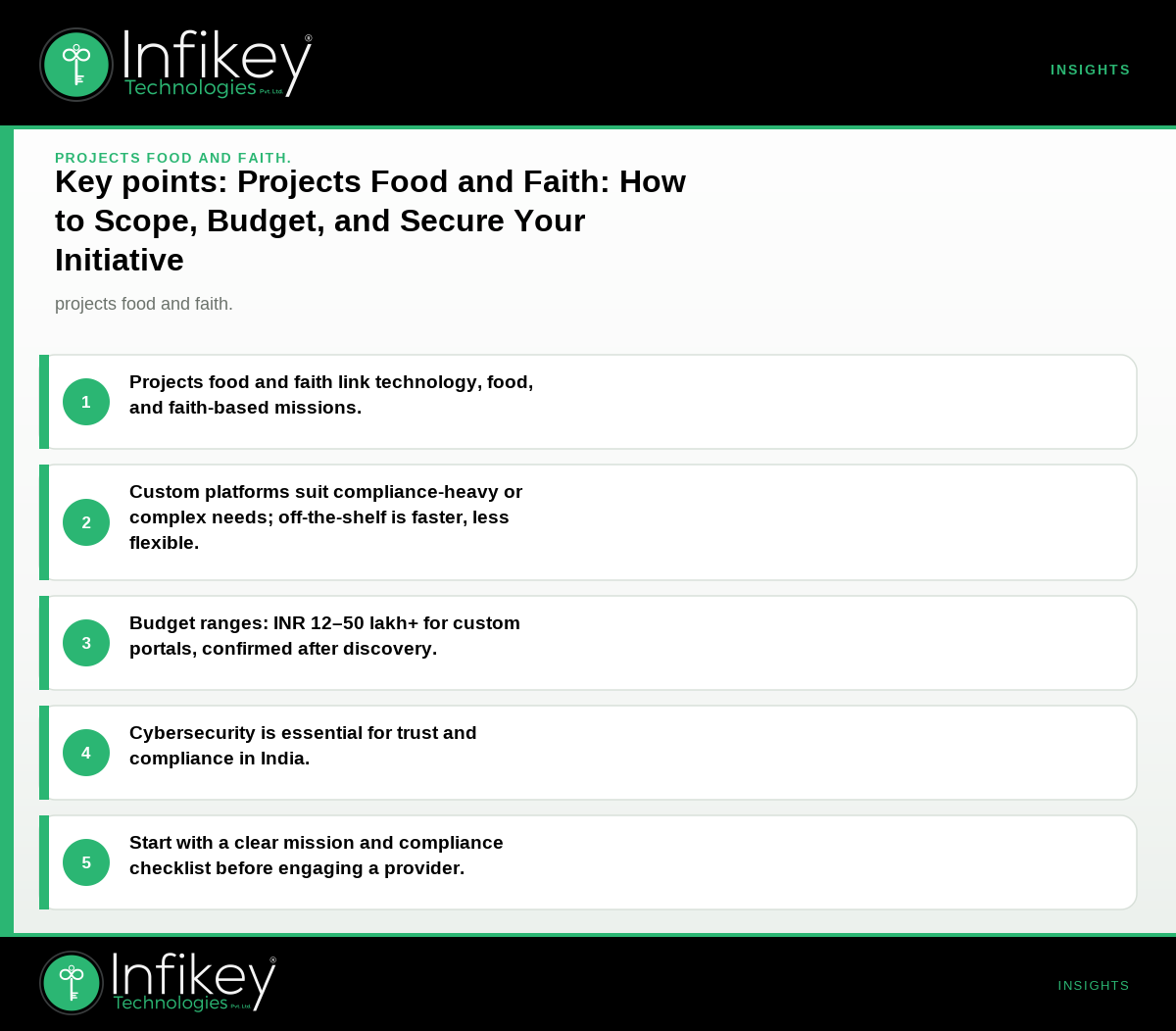
Rule of thumb: If you need custom workflows or compliance (FCRA, GST), choose a custom portal; for speed or budget, off-the-shelf platforms suffice but may not cover faith or local needs.
Example Project Shapes: Budgets and Timelines
Below are planning ranges for typical projects in India, confirmed after discovery:
| Project Type | Scope Summary | Ballpark INR | Timeline |
|---|---|---|---|
| Custom Web Portal | Auth, roles, dashboards, donations, integrations | 12–50 lakh+ | 8–20 weeks |
| Cloud/Infrastructure Hardening | Security review, monitoring, backups, compliance | 2.5–12 lakh | 2–6 weeks |
| Digital Marketing/SEO Retainer | Technical SEO, content, reporting (excl. media spend) | 60,000–2.5 lakh/mo | Ongoing |
Note: Final scope and commercials are set after a discovery call. For a detailed estimate, use the website cost calculator or talk to Infikey.
How to Get Started: 6 Steps
- Clarify Your Mission and Stakeholders: List your goals (e.g., food relief, faith outreach), partners, and user types.
- Map Compliance and Security Needs: Note any FCRA, GST, privacy, or faith-specific requirements.
- Choose Your Platform Type: Decide between custom web portal, app, or off-the-shelf solution.
- Set Your Budget Range: Use the planning ranges above to set an initial budget, including GST.
- Book a Discovery Call: Engage a provider like Infikey Technologies Pvt. Ltd. to confirm scope, timeline, and delivery model (on-site/remote mix).
- Plan for Ongoing Security: Schedule regular security reviews and updates—especially for platforms handling donations or personal data. See /in/services/cybersecurity for details.
Decision Rules: When to Choose Which Approach
- If you need to collect donations with faith-linked content and compliance: Custom web portal or hybrid is best.
- If you want to mobilise youth or field volunteers: Mobile app is worth the extra investment.
- If budget is tight but speed is critical: Off-the-shelf, but check for local payment and compliance support.
- If you handle sensitive data (donors, beneficiaries): Prioritise cybersecurity and regular audits.
Key Questions to Ask Before You Commit
- What data will you collect and how will it be protected?
- Does the platform support your faith or community workflows?
- How will you manage compliance (FCRA, GST, privacy)?
- What is your plan for ongoing support and security updates?
- Is the provider experienced in both tech and regulatory delivery in India?
Cybersecurity for Projects Food and Faith: What’s Included?
On projects like these, cybersecurity should cover:
- Secure authentication and access controls
- Data encryption (in transit and at rest)
- Regular vulnerability scans and compliance checks
- Incident response planning
- Ongoing monitoring and updates
For more, see Cybersecurity services from Infikey Technologies Pvt. Ltd..
Next Steps
If you are planning a projects food and faith initiative, start with a discovery call to confirm your scope, compliance, and security needs. Use the planning ranges above to budget realistically, and prioritise ongoing support. For a tailored roadmap or to discuss your requirements, [[contact Infikey]({{contact](/in/contact))}} or see our Cybersecurity service.