
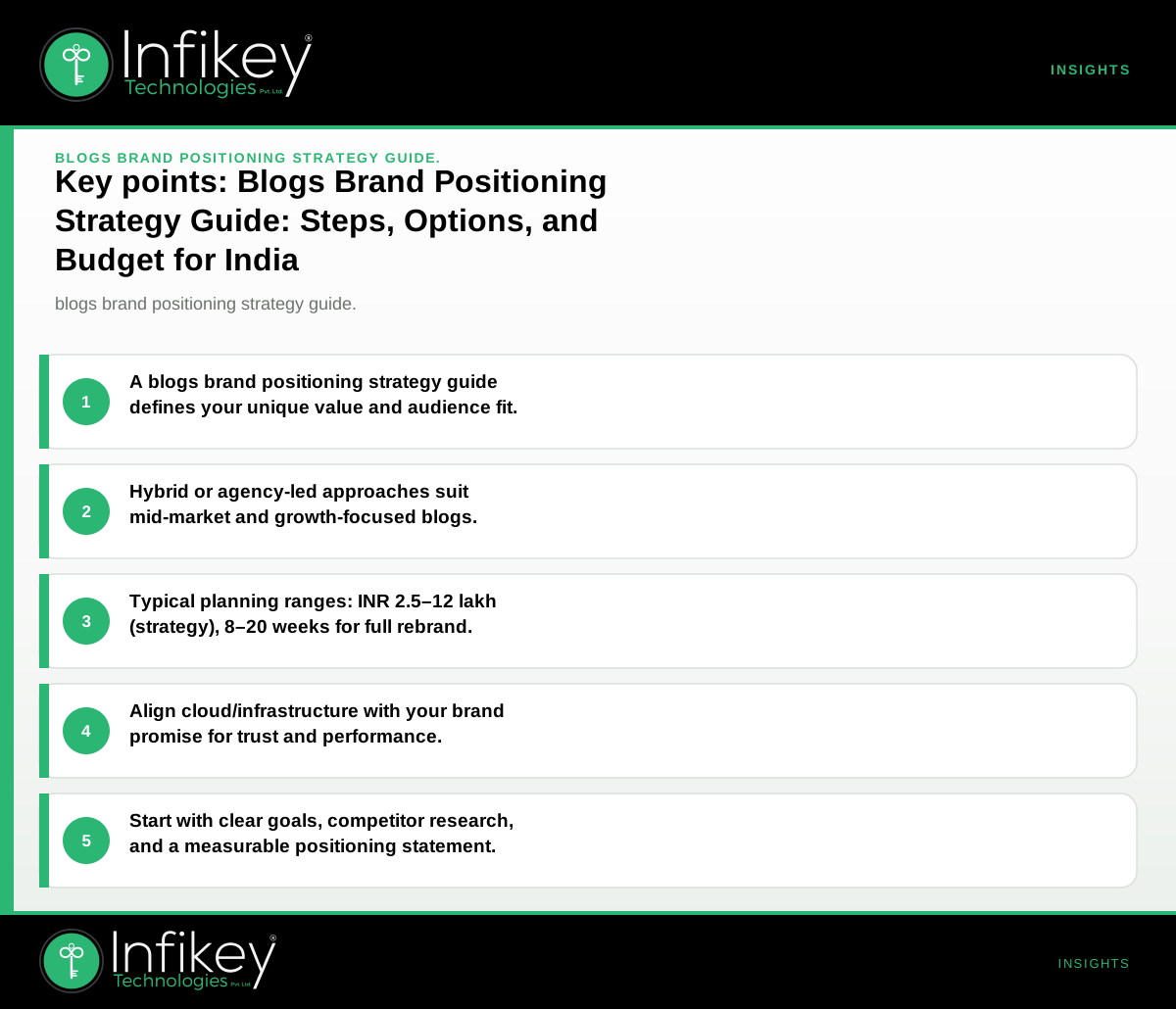
A blogs brand positioning strategy guide defines how your business will be perceived by your target audience, setting your blog apart from competitors. You need this when launching a new blog, rebranding, or aiming to increase authority and trust in a crowded market—especially if you’re investing in cloud and infrastructure to scale.
How Brand Positioning for Blogs Works: Step-by-Step
On projects like this, we typically follow these steps to ensure clarity and results:
- Discovery: Identify your target audience, competitors, and unique value proposition (UVP). This includes researching market trends, audience pain points, and the language your competitors use.
- Positioning Statement: Craft a concise statement describing your blog’s unique place in the market. This statement should be memorable and clearly communicate your blog’s promise.
- Messaging Framework: Develop key messages for different segments (e.g., SMEs, mid-market buyers). Tailor your tone and content themes to each segment’s needs and expectations.
- Visual and Content Alignment: Ensure blog design, tone, and topics reflect the positioning. Consistency across visuals, headlines, and calls-to-action builds trust and recognisability.
- Implementation: Apply the strategy to your blog, marketing materials, and cloud/infrastructure touchpoints. This could include updating your blog’s About page, refining SEO keywords, and ensuring your site’s technical performance aligns with your brand promise.
- Review and Optimise: Monitor performance and adjust based on analytics and feedback. Regularly revisit your positioning to keep pace with changes in your industry or audience preferences.
Table: Brand Positioning Approaches for Blogs
| Approach | Best For | Trade-off |
|---|---|---|
| DIY (In-house) | Early-stage blogs, tight budgets | Slower, risk of misalignment, less depth |
| Agency-led | Growth-focused, mid-market, complex needs | Higher cost, faster, expert perspective |
| Hybrid (Consult + Internal) | SMEs scaling with tech investment | Balance of control and expertise |
Decision rule: If your blog is core to lead generation or reputation, invest in agency or hybrid. DIY suits low-risk or early validation phases.
Typical Budget and Timeline for Brand Positioning in India
For India-based businesses investing in cloud and infrastructure, these are realistic planning ranges (final scope confirmed after discovery):
| Project Type | Planning Range (INR) | Timeline |
|---|---|---|
| Brand positioning + strategy workshop (SME) | 2.5–12 lakh | 2–6 weeks |
| Full rebrand + blog platform refresh | 12–50 lakh+ | 8–20 weeks |
| Infrastructure hardening (add-on) | 2.5–12 lakh | 2–6 weeks |
GST applies. Hybrid on-site + remote delivery is common for Ahmedabad and India-wide buyers.
Blog Brand Positioning Examples: What Works in Practice
To illustrate how a blogs brand positioning strategy guide is applied, consider these project shapes:
- SME launching a new blog platform: A business in Ahmedabad wants to establish thought leadership in digital transformation. They run a hybrid strategy workshop, define a clear positioning statement, and launch a blog with a visually consistent design and focused messaging. The planning range is INR 2.5–12 lakh, delivered in 2–6 weeks.
- Mid-market firm rebranding with [cloud migration](/tools/cloud-migration-cost-savings-calculator): A technology company in India needs to refresh its brand and migrate its blog to a more resilient cloud platform. The project includes a full rebrand, blog redesign, and infrastructure upgrade, with a budget of INR 12–50 lakh+, typically delivered over 8–20 weeks.
- Existing blog adding cloud resilience: An established blog wants to ensure uptime and security for its growing audience. They invest in an infrastructure hardening sprint, with a planning range of INR 2.5–12 lakh and a 2–6 week timeline.
These examples show how brand positioning for cloud services and infrastructure can directly impact your blog’s credibility and performance.
How to Position a Blog in India: Local Factors
India’s digital landscape is highly competitive, with diverse audiences and rapid technology adoption. When considering how to position a blog in India, keep these factors in mind:
- Cultural Relevance: Tailor your messaging to local values, languages, and business norms.
- Performance Expectations: Indian audiences expect fast-loading, mobile-optimised blogs. Leveraging local cloud and infrastructure partners can help meet these expectations.
- SEO and Discoverability: Use region-specific keywords and content themes to improve search visibility. Collaborate with digital marketing and SEO experts who understand the Indian market.
- Trust Signals: Display clear contact information, client logos (if permitted), and certifications relevant to your industry.
A strong blogs brand positioning strategy guide for India should address these local nuances while maintaining global best practices.
Brand Positioning for Cloud Services and Infrastructure
Cloud and infrastructure branding is a critical part of your blog’s positioning, especially if performance, uptime, or data security are part of your value proposition. Here’s how to align your technical foundation with your brand:
- Reliability as Brand Value: If your blog promises expert insights or timely updates, ensure your cloud infrastructure supports high uptime and scalability.
- Security Messaging: For industries like financial services, healthcare, or technology, highlight how your cloud and infrastructure choices protect user data and privacy.
- Seamless Experience: Fast page loads, responsive design, and robust backup systems reinforce your brand’s professionalism.
For more on this, review Cloud and infrastructure or Digital marketing and SEO.
Brand Positioning Strategy Cost: What to Plan For
The cost of a brand positioning strategy depends on the project’s complexity, the need for technical upgrades, and the level of external expertise required. Use these planning ranges for India:
- Strategy workshop (SME): INR 2.5–12 lakh, 2–6 weeks
- Full rebrand + infrastructure: INR 12–50 lakh+, 8–20 weeks
- Infrastructure hardening: INR 2.5–12 lakh, 2–6 weeks
Final costs are always scoped after a discovery call. For a tailored estimate, talk to Infikey.
How to Get Started: Numbered Steps
- Clarify your blog’s business goals: Lead generation, authority, or support?
- Audit your current brand and content: What works, what doesn’t, and where are the gaps?
- Research competitors: Identify how they position their blogs and what audiences they serve.
- Draft your positioning statement: Focus on your unique value for your target audience.
- Align your tech stack: Ensure your cloud and infrastructure supports your brand promise (performance, uptime, security).
- Engage a partner if needed: For expert help, contact Infikey or review Cloud and infrastructure.
- Set measurable KPIs: Track engagement, SEO, and lead quality to measure success.
Example Project Shapes and Planning Ranges
- SME launching a new blog platform: Hybrid strategy workshop and implementation, INR 2.5–12 lakh, 2–6 weeks.
- Mid-market firm rebranding with cloud migration: Full rebrand, blog redesign, and infrastructure upgrade, INR 12–50 lakh+, 8–20 weeks.
- Existing blog adding cloud resilience: Infrastructure hardening sprint, INR 2.5–12 lakh, 2–6 weeks.
Final commercials are always confirmed after a discovery call. Contact Infikey to discuss your scope.
Checklist: Key Questions Before You Invest
- Is your blog central to your business growth or reputation?
- Do you have a clear, differentiated positioning statement?
- Is your cloud/infrastructure aligned with your brand promise (speed, security, uptime)?
- Are you targeting SMEs, mid-market, or enterprise buyers?
- Do you have internal capacity, or do you need external expertise?
- What is your realistic budget and timeline?
What to Avoid When Positioning Your Blog
- Copying competitors without clear differentiation.
- Underinvesting in technical infrastructure—slow or unreliable blogs damage brand trust.
- Ignoring analytics: adjust positioning based on real user data, not assumptions.
- Overcomplicating your messaging—clarity beats jargon.
Cloud and Infrastructure Branding: Why It Matters
A strong technical foundation is part of your brand. Cloud and infrastructure branding means ensuring your blog delivers on the promises you make—whether that’s reliability, speed, or data privacy. For example, a blog targeting financial services or healthcare needs to demonstrate not just thought leadership but also technical credibility. This might involve showcasing uptime stats, data protection measures, or partnerships with trusted cloud providers.
For more on how Infikey supports cloud and infrastructure branding, see Cloud and infrastructure.
Next Steps
If you’re planning a brand positioning project for your blog and need your cloud and infrastructure to match, review Cloud and infrastructure or talk to Infikey for a discovery call. We’ll help you scope, budget, and execute a positioning strategy that fits your market and technology needs.