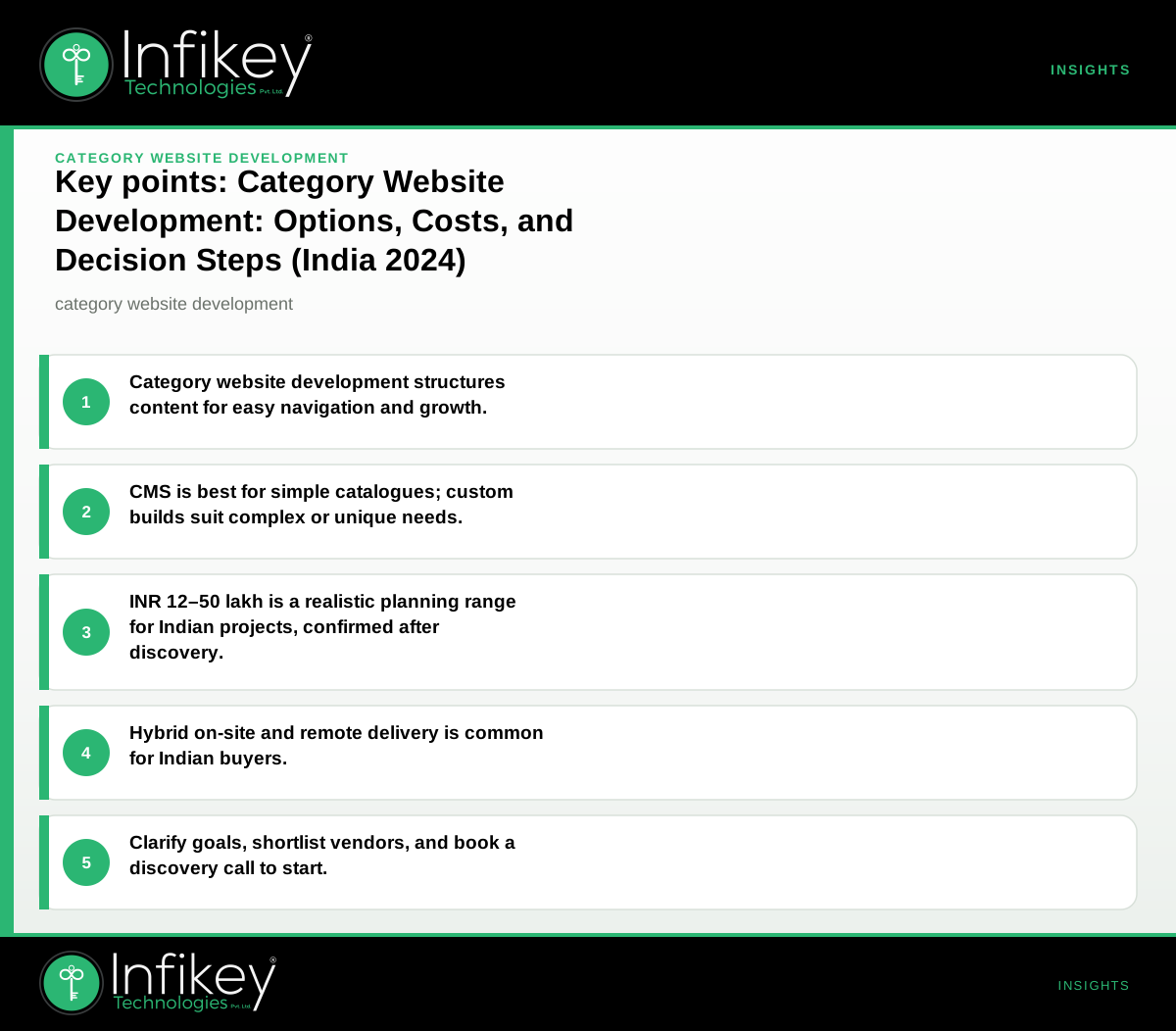
Category website development is the process of building a website structured around clear categories—such as product types, services, or content themes—so users can easily find what they need. Businesses in India typically need this when launching a catalogue, e-commerce portal, or industry-specific site that must scale and stay reliable as content grows.
How Category Website Development Works: Step-by-Step
On projects like this, we usually follow these steps to ensure the site is robust, scalable, and easy for both users and administrators:
- Discovery and Planning: Define business goals, target users, and required categories. Map out content, products, or services to be organised.
- Platform and Infrastructure Selection: Choose between CMS (like WordPress), e-commerce platforms (like Shopify), or custom development, considering future growth and integration needs.
- Information Architecture: Design the category structure, navigation, and user flows. Prioritise clarity and scalability.
- Design and Prototyping: Create wireframes and visual designs that reflect the category hierarchy and brand.
- Development and Integration: Build the site, set up hosting (cloud or hybrid), and integrate required features—filters, search, user roles, analytics.
- Testing and QA: Validate category logic, performance, and security. Test on multiple devices and browsers.
- Deployment and Training: Launch the site, provide admin training, and set up monitoring for uptime and performance.
Table: Category Website Development Approaches
| Approach | Best For | Trade-Offs |
|---|---|---|
| CMS (WordPress, Drupal) | Content-heavy or SME catalogue sites | Fast to launch, limited deep customisation |
| E-commerce Platform | Online stores, product catalogues | Built-in commerce, less flexible for non-retail |
| Custom Web Application | Complex, industry-specific portals | Fully tailored, higher cost & timeline |
| Headless CMS + Cloud | Multi-channel, scalable content delivery | Modern stack, more setup & integration work |
Rule of thumb: If your categories are simple and unlikely to change, a CMS suffices. For complex, growing, or integrated needs, consider custom or headless solutions.
Example Project Shapes: Budget and Timeline Ranges
Planning for category website development in India? Here are realistic ballpark ranges based on recent Infikey-style projects. Final scope and commercials are always confirmed after discovery.
| Project Type | Typical Scope | Budget (INR, excl. GST) | Timeline |
|---|---|---|---|
| SME catalogue site (CMS) | 10–50 categories, basic filters, admin panel | ₹12–28 lakh | 8–14 weeks |
| E-commerce portal (Shopify/Custom) | 50–200 categories, cart, payment, integrations | ₹18–50 lakh+ | 12–20 weeks |
| Industry portal (Custom/Headless) | Custom roles, advanced search, cloud infra | ₹20–50 lakh+ | 14–20 weeks |
Note: These are planning ranges. GST applies. Hybrid on-site and remote delivery is common for Indian buyers seeking local support with global best practices.
Decision Rules: How to Choose Your Approach
- If you need to launch quickly and budget is tight: Use a proven CMS or e-commerce platform.
- If your categories or workflows are unique: Invest in custom development or headless CMS.
- If you expect high traffic or multi-channel delivery: Prioritise cloud infrastructure and scalable architecture (Cloud and infrastructure).
- If ongoing SEO and content growth matter: Ensure your platform supports structured data, fast page loads, and easy admin updates.
How to Get Started: Action Checklist
- Clarify your goals: What do you want users to achieve? List your main categories and any special workflows.
- Set a realistic budget: Use the table above or try the website cost calculator for a tailored estimate.
- Choose your delivery model: Decide if you need local on-site support, remote delivery, or a hybrid (common in India).
- Shortlist vendors: Look for partners with experience in your industry and infrastructure needs. Ask for references and example category sites.
- Prepare for discovery: Gather sample content, product lists, and any required integrations (ERP, CRM, payment gateways).
- Book a discovery call: This is where scope, commercials, and delivery approach are confirmed. Contact Infikey to get started.
Key Questions to Ask Before You Commit
- How will the category structure scale as my business grows?
- What are the ongoing hosting and maintenance costs?
- Does the platform support GST compliance and Indian payment gateways?
- How is data security and uptime monitored?
- What is the process for future updates or adding new categories?
Internal Links for Further Reading
- Website development: Full-service web builds for Indian businesses
- Cloud and infrastructure: Scalable, secure hosting and ops
- Digital marketing and SEO: For ongoing traffic and content growth
Ready to scope your category website development project? Contact Infikey for a discovery call and a tailored plan, or explore our Cloud and infrastructure services for scalable delivery.