
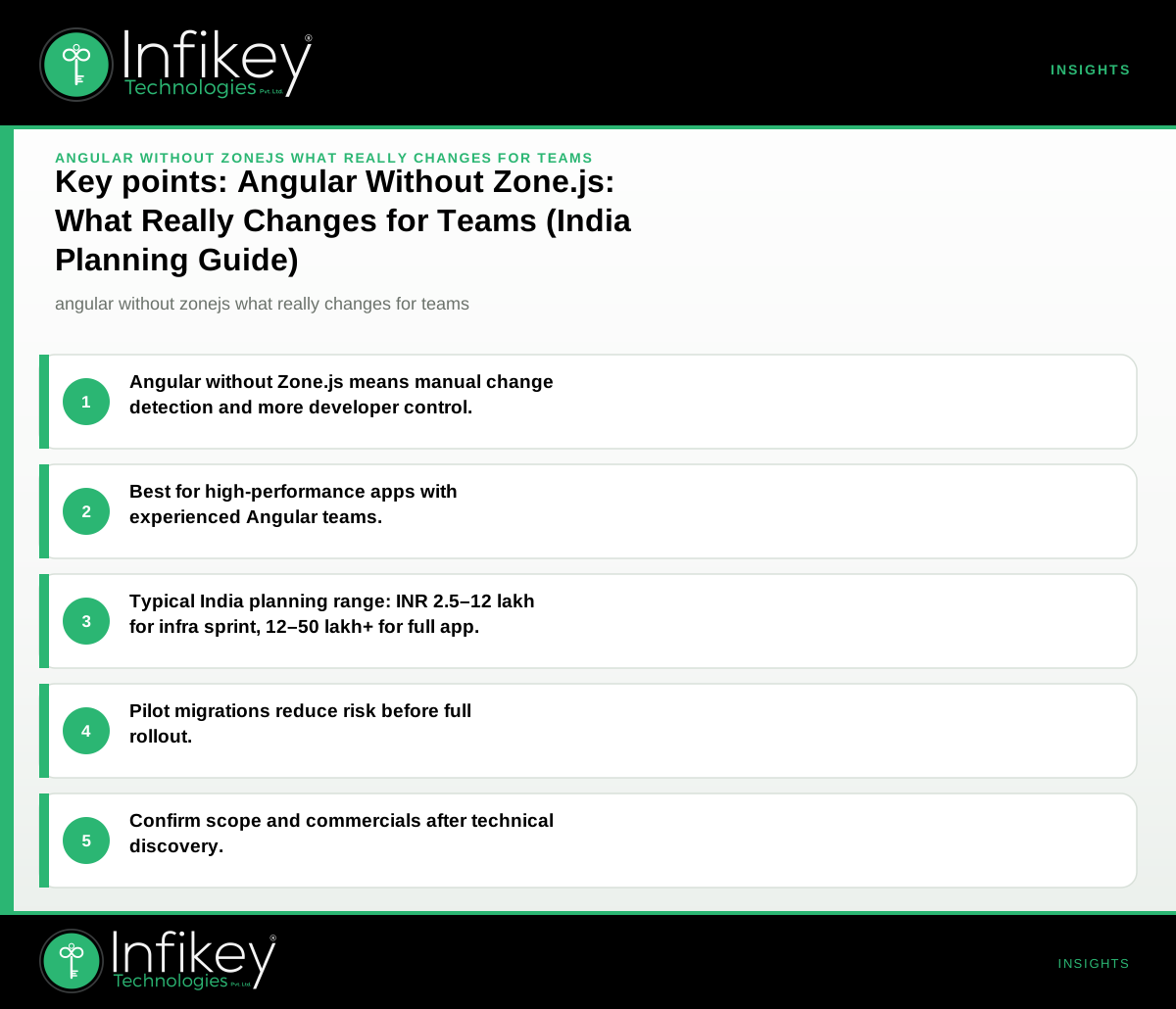
Running Angular without Zone.js means your team must manage change detection manually, rather than relying on Angular’s automatic tracking. This gives you more control and can improve performance, but it requires deeper framework knowledge and changes to team workflow. Businesses should consider this if they need high performance or fine-grained UI updates.
How Angular Without Zone.js Works: Key Steps
To run Angular without Zone.js, teams must:
- Remove Zone.js dependency from the project (usually by editing `polyfills.ts` and module imports).
- Switch to manual change detection using Angular APIs like `ChangeDetectorRef`, `NgZone.run()`, or signal-based approaches.
- Audit all async operations (HTTP, timers, events) to ensure UI updates occur as intended, since Angular will no longer auto-detect changes.
- Refactor code to trigger change detection where needed, often at the component or service level.
- Test thoroughly for missed UI updates, especially after async actions or external library integrations.
On projects like this, we usually see a learning curve for teams new to manual change detection, but experienced Angular developers adapt quickly after a few sprints.
Options for Angular Change Detection (with/without Zone.js)
| Approach | Best For | Trade-off |
|---|---|---|
| Default (with Zone.js) | Most business apps, rapid delivery | Less control, possible perf. overhead |
| Manual (without Zone.js) | High-perf apps, complex UI, expert teams | More code, steeper learning, risk of UI bugs |
| Hybrid (partial Zone.js use) | Gradual migration, legacy codebases | Mixed complexity, inconsistent behaviour |
Decision rule:
- If your app is standard CRUD, stick with Zone.js.
- If you need fine-grained control or are hitting performance bottlenecks, consider going without Zone.js—but only with experienced Angular engineers.
Typical Budget and Timeline: India Planning Ranges
Migrating to Angular without Zone.js is usually part of a broader cloud or infrastructure upgrade, not a standalone task. For Indian SMEs or mid-market firms, planning ranges are:
| Project Shape | Planning Range (INR, excl. GST) | Timeline |
|---|---|---|
| Cloud/infrastructure hardening sprint | 2.5–12 lakh | 2–6 weeks |
| Custom web app/portal (Angular, cloud, etc.) | 12–50 lakh+ | 8–20 weeks |
*Final scope and commercials are confirmed after discovery. Hybrid on-site + remote delivery is common in India. For GST, expect 18% on top of services.*
How to Get Started: 6 Steps for Indian Teams
- Assess your app’s performance needs. If you’re not hitting Angular’s limits, Zone.js is usually fine.
- Review your team’s Angular experience. Manual change detection needs deeper framework skill.
- Plan a pilot migration. Start with a non-critical module to test the impact.
- Update your CI/CD and testing. Manual change detection often exposes hidden async bugs—automate regression checks.
- Budget for discovery and refactoring. Use the planning ranges above. Confirm scope after a technical assessment.
- Engage a partner with Angular and cloud expertise. For a tailored plan, contact Infikey or see our Cloud and infrastructure services.
Angular Without Zone.js: Questions to Ask Before You Decide
- Does your team have experience with manual change detection in Angular?
- Are you facing real-world performance issues, or is this a theoretical optimisation?
- How much of your codebase relies on third-party libraries expecting Zone.js?
- What is your tolerance for short-term delivery risk (missed UI updates, longer QA)?
- Can you allocate budget for a technical discovery phase and initial pilot?
Example Project Scenarios: Ballpark Ranges for India
- Cloud / infrastructure hardening sprint: For teams modernising Angular apps and considering Zone.js removal as part of a performance/security review. *Planning range: INR 2.5–12 lakh, 2–6 weeks.*
- Custom web application/portal: For businesses building new Angular-based portals with manual change detection from the outset. *Planning range: INR 12–50 lakh+, 8–20 weeks.*
- Pilot module migration: For SMEs trialling Zone.js-free Angular in a single module, expect a smaller slice of the above ranges, confirmed after discovery.
When Should Indian Businesses Consider Angular Without Zone.js?
Choose Angular without Zone.js if:
- You have a high-traffic, interactive app with measurable performance bottlenecks.
- Your team is experienced with Angular internals and can own manual change detection.
- You are planning a broader cloud/infrastructure upgrade and can bundle this change into the scope.
Otherwise, the default Zone.js setup remains the safest and most cost-effective path for most Indian SMEs and mid-market buyers.
For a tailored assessment or to discuss your cloud and Angular options, contact Infikey or see our Cloud and infrastructure services. You can also estimate your cloud migration savings with our cloud migration cost savings calculator.