
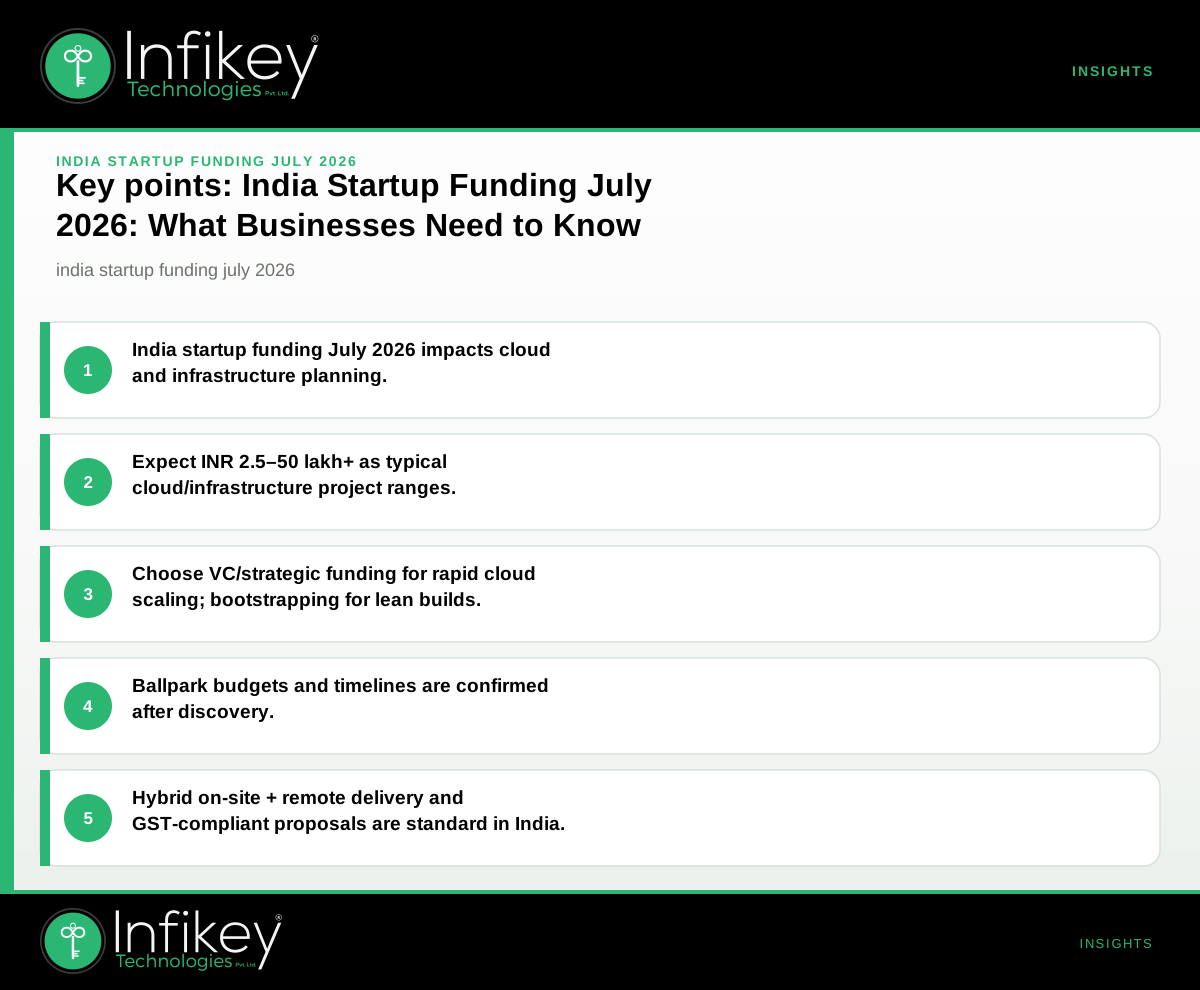
India startup funding July 2026 refers to the investment activity, funding rounds, and capital availability for Indian startups during July 2026. If your business is planning cloud or infrastructure investments, understanding this funding climate helps you time your spend, align with investor expectations, and choose the right approach for scaling technology.
How India Startup Funding Works: Step-by-Step
- Startup prepares for funding: Founders assess product-market fit, traction, and financials.
- Investor outreach: Startups pitch to VCs, angels, or institutional funds active in India.
- Due diligence: Investors review business models, tech stack (including cloud/infrastructure), and compliance.
- Term sheet and negotiation: Funding terms are agreed, often with input on technology spend.
- Fund disbursement: Capital is released, usually in tranches tied to milestones.
- Execution: Startups use funds for hiring, product development, cloud infrastructure, and go-to-market.
Tip: In July 2026, founders and technology buyers should expect close scrutiny on cloud cost efficiency and scalability, as funding rounds are increasingly tied to clear infrastructure roadmaps.
Startup Funding Options in India: What Founders Need to Know
The landscape for startup funding options India continues to evolve. In July 2026, founders can choose from several established and emerging routes, each with its own implications for technology planning and growth:
- Bootstrapping: Self-funding remains popular for early-stage ventures, especially when founders want to retain control. However, this approach often limits the scale and speed at which you can invest in cloud infrastructure or advanced technology.
- Angel Investment: Individual investors or syndicates provide early funding, usually in exchange for equity. Angels may be more flexible on technology spend but expect rapid validation.
- VC Funding for Indian Startups: Venture capital is the main driver of high-growth tech businesses. VCs in India are increasingly sector-focused and expect robust cloud and infrastructure plans as part of the pitch. VC funding can enable aggressive scaling, but comes with expectations on governance, reporting, and technology choices.
- Corporate/Strategic Funding: Large companies or industry partners may invest in startups that align with their ecosystem. This route is common in sectors like fintech, healthcare, and logistics, where integration with partner platforms may be required.
- Government Grants and Schemes: Indian government programs support startups in areas like social impact, deep tech, and compliance-heavy industries. While the process can be slower, grant funding is non-dilutive and often requires detailed technology and impact documentation.
Decision Point: When evaluating startup funding options India, consider how each route affects your ability to invest in and scale cloud infrastructure. VC and strategic funding are typically best for startups where technology is core to the business model and rapid scaling is required.
Comparing Funding and Infrastructure Approaches
| Approach | Best For | Trade-off |
|---|---|---|
| Bootstrapped (self-funded) | Early-stage, control-focused founders | Limited runway; slower cloud scaling |
| Angel/Seed funding | MVPs, first product launches | Smaller cheques; rapid proof needed |
| Venture Capital (VC) | High-growth, tech-driven businesses | Dilution; investor input on infra choices |
| Corporate/Strategic funding | B2B, regulated or niche sectors | May require alignment with partner platforms |
| Government/Grant funding | Social impact, compliance-heavy fields | Slower process; reporting requirements |
Decision rule: If your cloud/infrastructure spend is central to your value proposition or scale, VC or strategic funding is often preferred. For lean builds or tight control, bootstrapping or seed rounds may be enough.
Planning Startup Technology Spend: Aligning Funding and Cloud Budgets
A critical part of the funding journey is planning startup technology spend. Investors in July 2026 expect founders to demonstrate:
- A clear breakdown of how funds will be allocated to technology, cloud, and infrastructure
- A roadmap for scaling cloud resources in line with user growth
- Cost controls and monitoring to avoid overruns
- Security and compliance readiness, especially for regulated sectors
When planning your technology budget, consider the following steps:
- Map business goals to technology needs: Identify which features or infrastructure investments are critical for your next phase of growth.
- Prioritise spend: Allocate budget to core systems first—such as cloud platforms, security, and data infrastructure—before investing in non-essential tools.
- Build in flexibility: Cloud infrastructure budget India should allow for scaling up or down based on actual user demand and funding milestones.
- Engage technology partners early: Providers like Infikey Technologies can help you scope, estimate, and optimise your technology spend.
Typical Budget and Timeline for Cloud & Infrastructure Projects
On projects like this, we usually see Indian startups and SMEs planning for cloud and infrastructure spend as part of their funding round. Here are realistic ballpark ranges:
| Project Type | Planning Range (INR, excl. GST) | Timeline |
|---|---|---|
| Cloud/infrastructure hardening sprint | ₹2.5–12 lakh | 2–6 weeks |
| Custom web application/portal (cloud-based) | ₹12–50 lakh+ | 8–20 weeks |
| AI feature on existing product (cloud-native) | ₹6–28 lakh | 6–14 weeks |
*Final scope and commercials are confirmed after discovery. These are planning ranges for India in 2026, suitable for VC-backed and bootstrapped startups alike.*
Timeline for Cloud Projects India: What to Expect
The timeline for cloud projects India depends on project complexity, team experience, and integration requirements. For most startups:
- Cloud hardening sprints can be completed in 2–6 weeks, focusing on security, CI/CD, and monitoring.
- Custom web or mobile applications typically take 8–20 weeks, especially if you require role-based access, dashboards, and third-party integrations.
- AI feature development on an existing cloud product generally requires 6–14 weeks, including prompt engineering, evaluation, and human oversight.
Early planning and clear milestones help ensure your cloud and infrastructure investments align with funding disbursements and go-to-market timelines.
How to Get Started: Funding and Cloud Planning in 5 Steps
- Assess funding readiness: Review your business case, traction, and technology roadmap.
- Estimate cloud/infrastructure needs: Use a planning tool or consult a provider like Infikey Technologies to scope requirements.
- Align funding approach: Decide if you will bootstrap, seek angel/VC funds, or apply for grants based on your growth and tech needs.
- Prepare documentation: Build a clear pitch deck, financial model, and cloud/infrastructure plan for investors.
- Book a discovery call: Shortlist providers; in India, expect hybrid on-site + remote delivery, INR pricing, and GST-compliant proposals. Contact Infikey to discuss your project.
Choosing the Right Funding and Infrastructure Mix (Checklist)
- Is your technology core to your business model or a supporting function?
- Do investors expect a scalable, secure cloud platform from day one?
- What is your realistic runway (months of operation) with current and planned funding?
- Are you prepared for due diligence on cloud costs and security?
- Have you compared bootstrapped vs. investor-backed timelines for delivery?
- Does your technology stack meet the compliance requirements for your sector?
- Can your cloud infrastructure budget India accommodate unexpected growth or delays in funding?
Example Project Scenarios and Ballpark Ranges
- Seed-funded SaaS startup: Needs cloud hardening and CI/CD pipelines before demoing to VCs. *Plan for ₹2.5–12 lakh, 2–6 weeks.*
- VC-backed B2B platform: Building a custom web portal with role-based access and integrations. *Budget ₹12–50 lakh+, 8–20 weeks.*
- AI-driven fintech MVP: Adding an AI feature to an existing cloud product. *Estimate ₹6–28 lakh, 6–14 weeks.*
These ranges reflect typical Indian startup engagements in 2026. Final commercials depend on scope, integrations, and compliance needs.
VC Funding for Indian Startups: What Investors Look For
Venture capitalists in India are increasingly focused on:
- Scalable cloud architecture: Demonstrating that your platform can handle growth without major rework
- Cost transparency: Clear tracking and reporting of cloud spend
- Security and compliance: Especially for fintech, healthcare, and regulated industries
- Alignment with market trends: Using AI, automation, and digital transformation to differentiate
Startups that can show a well-planned cloud infrastructure budget India and a credible timeline for cloud projects India are better positioned to secure VC funding for Indian startups.
Questions to Ask Before Spending on Cloud or Infrastructure
- What funding round (if any) will cover this spend?
- Does your provider offer GST-compliant invoicing and hybrid delivery?
- Can you scale down (or up) cloud costs if funding is delayed?
- How will you measure ROI on infrastructure investments?
- Is your tech stack aligned with investor or grant requirements?
- What is your backup plan if funding is delayed or reduced?
- Are you leveraging all available startup funding options India for your sector?
Next Step
If you’re planning cloud or infrastructure investments as part of your India startup funding round in July 2026, contact Infikey or see our Cloud and infrastructure services for a discovery call and tailored proposal.
For more insights on startup technology planning, funding options, and project timelines, explore our blog or reach out to discuss your requirements in detail.