Choosing between in-house vs outsourced graphic design comes down to your volume, speed, and control needs: in-house suits brands with ongoing, confidential or high-volume needs; outsourcing is best for project-based, variable, or cost-sensitive work. Use decision rules and planning ranges below to budget and act confidently.
In-house vs Outsourced Graphic Design: Side-by-Side Comparison
| Option | Cost (USD, planning) | Speed | Control | Risk | Best For |
|---|---|---|---|---|---|
| In-house | $40,000–90,000+/yr* | Fast (internal) | Full | Hiring, retention | High volume, confidential, always-on |
| Outsourced | $4,000–60,000+/proj | Fast (scalable) | Scoped by brief | Delivery, alignment | Projects, campaigns, scaling |
*Estimate: full-time designer, salary + benefits. Outsourced: see project shapes below.
Decision Rules: When to Choose Each Option
Choose in-house if:
- You need daily or rapid-turnaround design work.
- Brand control, confidentiality, or design consistency is critical.
- You have enough ongoing volume to justify a full-time salary.
Choose outsourced if:
- You have project-based, seasonal, or unpredictable design needs.
- You want access to specialist skills or broader creative input.
- You need to scale up/down without long-term hiring risk.
Cost Comparison: Planning Ranges for Graphic Design
On projects like this, we usually see:
- Marketing website (brochure/service site): USD 4,000–12,000 (4–8 weeks)
- Custom web application/portal (UI/UX, assets): USD 15,000–60,000+ (8–20 weeks)
- Mobile app (UI/UX, branding): USD 12,000–45,000 (10–18 weeks)
These are planning ranges for typical Infikey Technologies Pvt. Ltd. engagements. Final scope and commercials are confirmed after discovery. For ongoing in-house roles, expect $40,000–90,000+ per year (salary, taxes, benefits, tools).
Checklist: Questions to Decide In-house vs Outsourced Graphic Design
- How much design do you need per month?
- If >60 hours/month, in-house may be justified.
- Is design output predictable or project-based?
- Predictable = in-house; variable = outsource.
- Do you need specialist skills (animation, UI/UX, branding)?
- Outsourcing offers broader talent.
- Is brand/IP confidentiality a concern?
- In-house gives more control.
- What is your budget flexibility?
- Outsourcing is easier to scale up/down.
Example Project Shapes: What Global Buyers Actually Spend
- A mid-sized retailer launching a new e-commerce site:
- Full design system, 10–15 pages, assets: USD 4,000–12,000 (4–8 weeks)
- A SaaS startup needing app UI/UX and branding:
- App screens, logo, style guide: USD 12,000–45,000 (10–18 weeks)
- A [professional services](/industries/professional-services) firm updating all marketing collateral:
- Brochures, templates, digital assets: USD 4,000–12,000 (4–8 weeks)
All figures are planning ranges; final scope is confirmed after discovery. See Graphics designing for more.
Hybrid Approaches: When Mixing Makes Sense
A hybrid model (small in-house team + outsourced partners) works when:
- You need core brand control but face periodic spikes (campaigns, launches).
- Specialist skills are needed occasionally (e.g., animation, UI/UX for new products).
- You want to test new creative directions without permanent hires.
On projects, we often see global brands keep a lead designer in-house, outsourcing overflow or specialist work to agencies like Infikey Technologies Pvt. Ltd..
Key Takeaways for Global Buyers
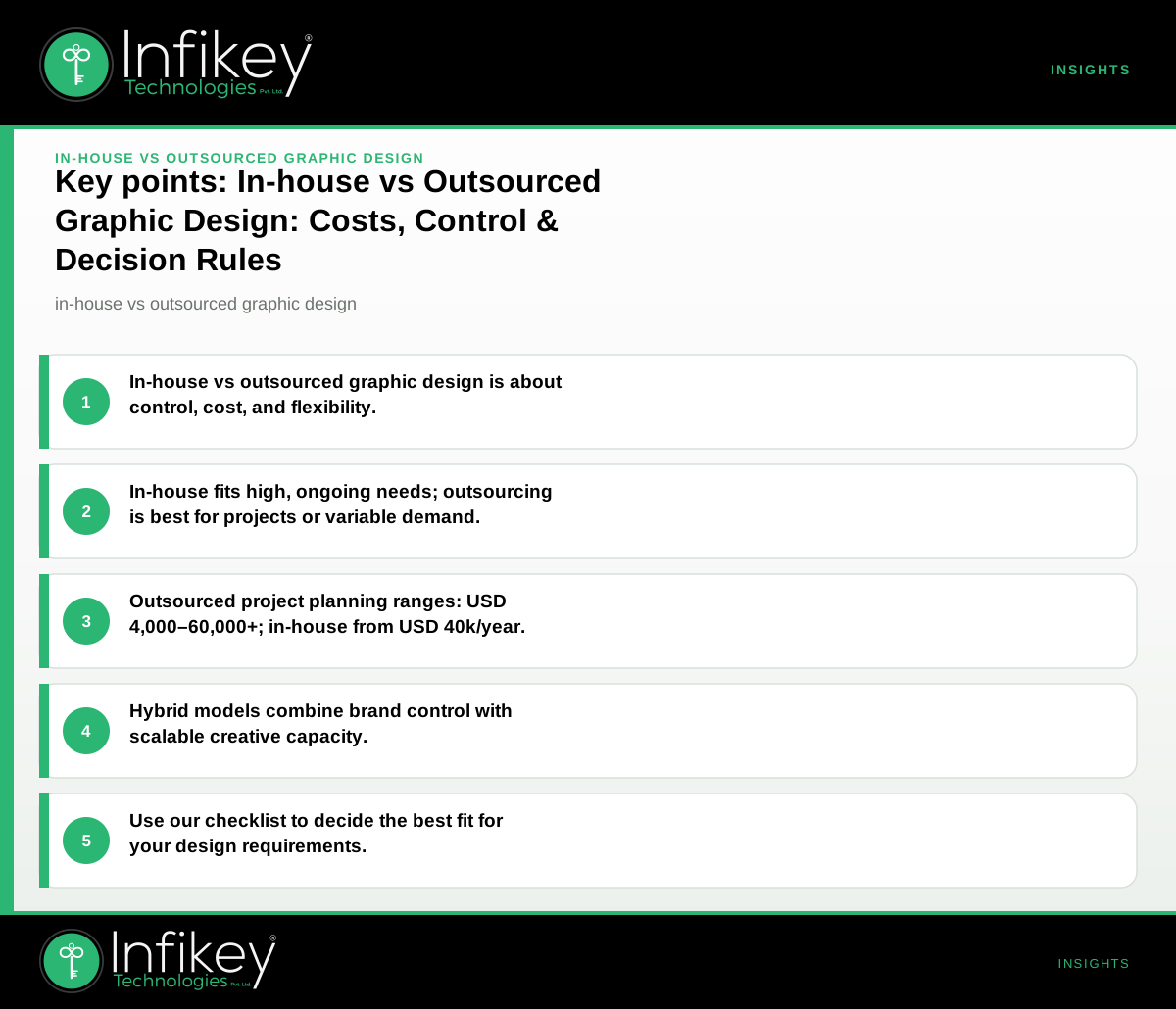
- In-house vs outsourced graphic design is a trade-off between control, cost, and flexibility.
- In-house suits high, predictable volume; outsourcing fits projects and variable needs.
- Budget for in-house from $40k/year; outsource projects from $4k–60k+ (planning ranges).
- Hybrid models offer control plus scalability for campaigns or specialist work.
- Use our checklist and planning ranges to scope your next design engagement.
For a tailored estimate or to discuss your design needs, see Graphics designing or [[Contact Infikey]({{contact](/contact))}}.