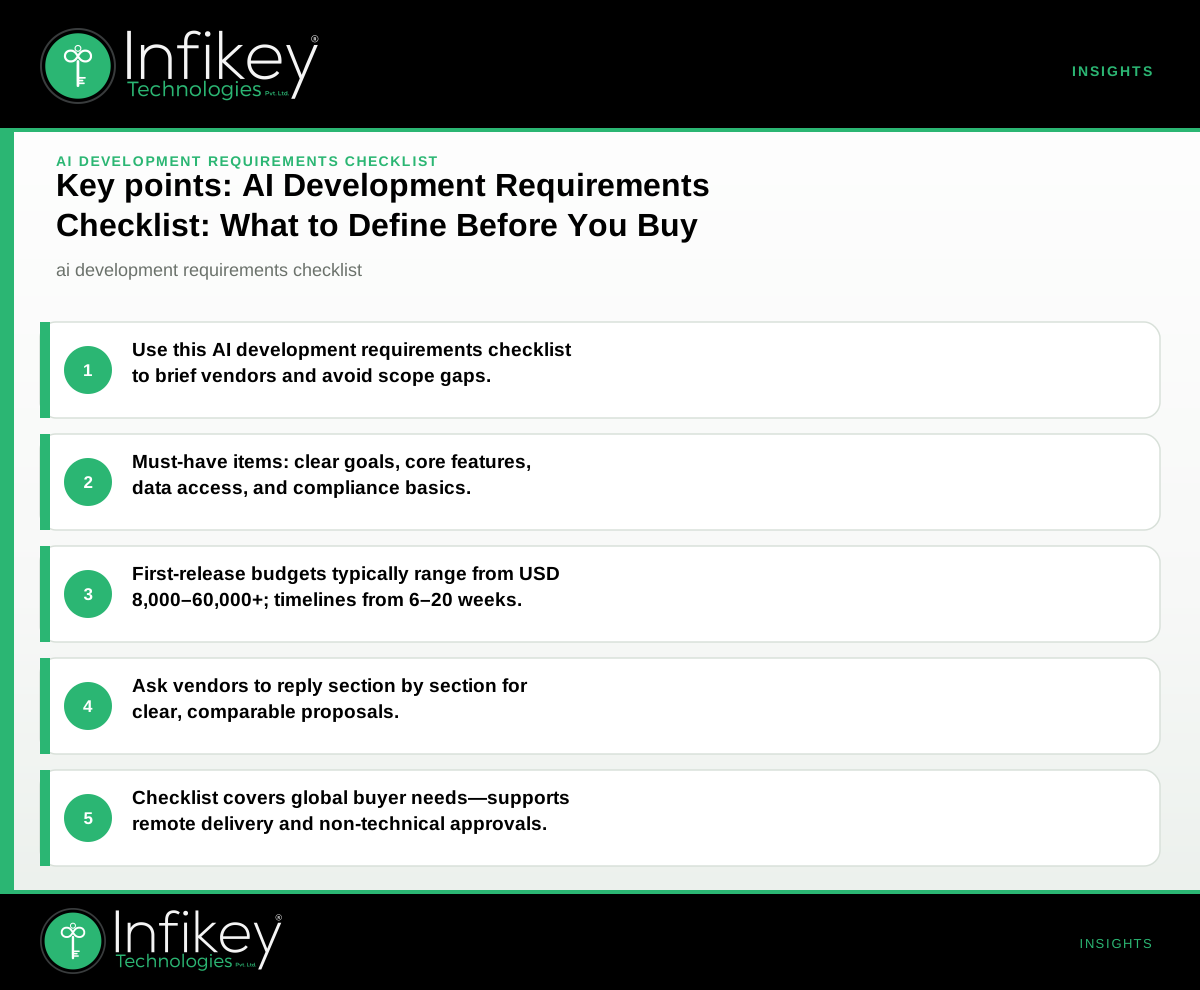
If you’re planning to invest in AI, this AI development requirements checklist covers every detail you should specify for vendors: goals, scope, technical needs, data, compliance, budget, and timeline. Copy these points into your brief to get accurate proposals and avoid scope gaps.
How to Use This Checklist with Vendors
Share this checklist with your shortlisted vendors. Ask each to reply section by section, confirming what’s included, what’s assumed, and where they need more detail. This approach leads to clear, comparable proposals and fewer surprises during delivery. It also helps you assess the vendor’s understanding of your needs and their ability to communicate clearly—both critical for a successful AI project.
Before you start, consider these steps:
- Clarify your internal priorities: Know which outcomes are non-negotiable and where you have flexibility.
- Ask vendors to highlight risks: Request that vendors flag any areas where requirements are ambiguous or dependencies exist.
- Request references or case studies: See if they’ve solved similar AI project requirements for other clients.
AI Development Requirements Checklist
1. Project Goals & Outcomes
- Define the business problem or opportunity the AI will address.
- State the measurable outcomes you expect (e.g., reduce manual processing time by 30%).
- List success metrics and how they’ll be measured.
- Identify key stakeholders and decision-makers.
- Ask: What will success look like in 3, 6, and 12 months?
2. Scope & Features
- List the main features or use cases (e.g., chatbot, document analysis, recommendation engine).
- Specify which AI capabilities are in scope (e.g., NLP, image recognition, forecasting).
- Note any integrations required (existing systems, APIs, databases).
- Define user roles and access levels.
- Describe the expected user journey or workflow.
- Clarify which features are essential for launch versus those that can be phased in later.
- Ask: Are there any features that must be excluded for compliance or security reasons?
3. Technical Requirements
- Preferred technology stack (if any) or open to vendor recommendation.
- Deployment preference: cloud, on-premises, or hybrid.
- Data sources: what data is available, in what format, and how it will be accessed.
- Performance requirements (e.g., response time, scalability).
- Security requirements (encryption, access controls, audit logging).
- Interoperability with existing IT infrastructure.
- Ask: Will the solution need to scale for future users or data volumes?
4. Data & Content
- Who owns the input and output data?
- Is training data available, or does it need to be sourced/created?
- Data privacy and retention policies.
- Data labelling or annotation needs.
- Any third-party data or content to be used?
- Consider: Is your data clean and structured, or will it require preprocessing?
- Ask: Does the vendor have experience with similar data types and volumes?
5. Compliance & Ethics
- Relevant regulations (GDPR, HIPAA, local data laws).
- Bias, fairness, and explainability requirements.
- Accessibility standards (WCAG, language support).
- Required documentation for audit or certification.
- Ask: What steps will be taken to ensure ethical use of AI and prevent bias?
- Consider: Will the solution need to be certified or audited by a third party?
6. Budget & Commercials
- Target budget range (USD 8,000–35,000 for a feature on an existing product; USD 15,000–60,000+ for a custom web application; see table below).
- Payment preferences (milestones, fixed price, time & materials).
- Any preferred currency or invoicing requirements.
- Ongoing support/maintenance expectations.
- Ask: What is included in the quoted price? Are there any potential extra costs (e.g., data labelling, third-party APIs)?
- Consider: Does the vendor offer flexible engagement models to suit your AI project budget?
7. Timeline & Delivery
- Desired launch date or timeline (6–14 weeks for an AI feature; 8–20 weeks for a custom application).
- Key milestones (MVP, UAT, go-live).
- Stakeholder availability for feedback and sign-off.
- Time zone preferences for meetings and support.
- Ask: What dependencies could impact the timeline (e.g., data readiness, integration with legacy systems)?
- Consider: Is there a contingency plan if key milestones slip?
Must-Have vs Nice-to-Have Items for First Release
A clear distinction between must-have and nice-to-have requirements helps prevent scope creep and keeps your AI implementation checklist focused on delivering value quickly. Use this table to prioritise features for your MVP (Minimum Viable Product) and plan future enhancements.
| Requirement | Must-Have (MVP) | Nice-to-Have (Future) |
|---|---|---|
| Clear business goal | Yes | |
| Core AI feature (e.g., chatbot) | Yes | |
| Data access/integration | Yes | |
| User authentication | Yes | |
| Advanced analytics/dashboard | Yes | |
| Multi-language support | Yes | |
| Explainability tools | Yes | |
| API for third-party integration | Yes | |
| Custom branding | Yes | |
| Automated retraining | Yes |
Example: Filled-In Entry for an Anonymous Project
Project: AI-powered support chatbot for a mid-sized SaaS provider
- Goals: Reduce support ticket volume by 40%; improve first-response time.
- Scope: Chatbot for website and app; integrates with existing helpdesk; English only; basic analytics.
- Technical: Cloud deployment; integrates with Zendesk API; data from existing ticket logs.
- Data: Company owns all data; provides anonymised training set; no third-party data.
- Compliance: GDPR-compliant; basic audit log; accessibility for screen readers.
- Budget: USD 18,000 (planning range, confirmed after discovery); milestone payments.
- Timeline: 10 weeks to MVP; 2 weeks for UAT and go-live.
How Vendors Should Respond to Each Section
- Project Goals: Confirm understanding; suggest refinements if needed.
- Scope & Features: Map requested features to deliverables; flag assumptions or exclusions.
- Technical: Recommend stack or validate client’s preference; highlight security and performance trade-offs.
- Data & Content: Assess data readiness; clarify any gaps or extra work needed.
- Compliance: List compliance measures; ask for any specific audit or reporting needs.
- Budget: Provide a detailed estimate with assumptions; clarify what’s included/excluded.
- Timeline: Propose a delivery plan with milestones; identify dependencies on client input.
AI Project Budget and Timeline Planning Ranges
On projects like this, we usually see these planning ranges (final commercials confirmed after discovery):
| Project Type | Ballpark USD | Timeline |
|---|---|---|
| AI feature on existing product | 8,000–35,000 | 6–14 weeks |
| Custom web application | 15,000–60,000+ | 8–20 weeks |
| Mobile app (iOS + Android) | 12,000–45,000 | 10–18 weeks |
For a detailed estimate, see the AI service page or [[Contact Infikey]({{contact](/contact))}}.
Example Project Shapes with Ballpark Budgets and Timelines
Understanding the AI development scope and budget early on helps you plan resources and set realistic expectations. Here are two common project shapes based on Infikey Technologies Pvt. Ltd.’s experience:
AI Feature on an Existing Product
- Scope: Add a recommendation engine to an e-commerce site, using historical purchase and browsing data.
- Budget: USD 8,000–35,000 (planning range)
- Timeline: 6–14 weeks, depending on data readiness and integration complexity
- Key Considerations: Vendor selection should focus on proven experience with similar features and data types. Confirm if existing infrastructure can support the new AI module.
Custom Web Application with AI Capabilities
- Scope: Build a new web portal for document classification and workflow automation, including user authentication and dashboards.
- Budget: USD 15,000–60,000+ (planning range)
- Timeline: 8–20 weeks, influenced by requirements discovery and feedback cycles
- Key Considerations: Ensure your AI project requirements include detailed user stories and integration points. Assess if the vendor can provide ongoing support post-launch.
For mobile-first use cases, timelines and budgets are similar to custom web applications, but factor in additional testing for iOS and Android platforms.
AI Vendor Selection: What to Look For
Choosing the right partner is critical for a successful AI project. Here’s a quick AI vendor selection checklist:
- Relevant experience: Has the vendor delivered similar AI projects in your industry (e.g., healthcare, retail, manufacturing)?
- Technical depth: Can the team recommend the best-fit technology stack and explain trade-offs?
- Data handling: Do they have expertise in managing, cleaning, and labelling data at scale?
- Security and compliance: Are they familiar with your regulatory environment and able to build compliant solutions?
- Support model: What post-launch support and maintenance options are available?
- Transparent pricing: Does the proposal clearly outline what’s included and excluded?
Ask for detailed responses to your AI development requirements checklist and use these answers to compare vendors objectively.
Next Steps
Use this AI development requirements checklist to brief vendors or compare proposals. For a tailored scope or budget, visit AI services or Contact Infikey for a direct consultation. If you’re unsure where to start, Infikey Technologies Pvt. Ltd. can help clarify your AI project requirements and recommend the best approach for your goals and budget. Reach out to discuss your project specifics and get a clear, actionable plan.