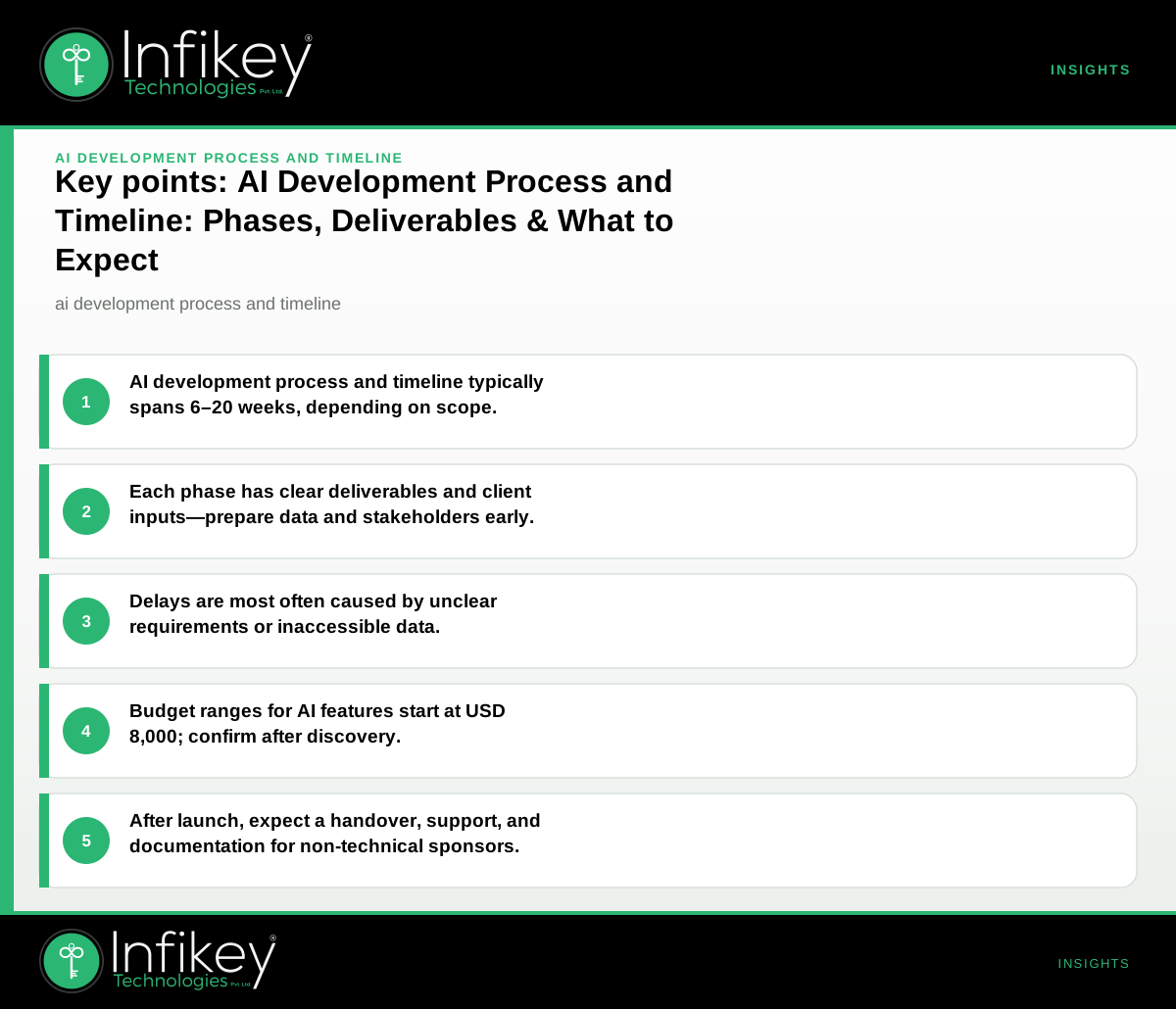
The typical AI development process and timeline includes discovery, data preparation, model development, integration, and launch, taking 6–14 weeks for an AI feature or 8–20 weeks for a custom solution. Each phase has clear deliverables and client inputs, so you can plan budget, resources, and approvals with confidence.
AI Development Phases, What Happens, and Typical Durations
Understanding the phases of the AI development lifecycle is crucial for effective planning and execution. Each phase builds on the previous one, with clear milestones and deliverables that keep your project on track. Here’s how the process typically unfolds:
| Phase | What Happens | Typical Duration | Deliverable | What the Client Provides |
|---|---|---|---|---|
| Discovery & Scoping | Define goals, requirements, success metrics, and constraints | 1–2 weeks | Project brief, roadmap | Use-case, data access, stakeholders |
| Data Preparation | Gather, clean, and label data; set up pipelines | 2–4 weeks | Cleaned dataset, data schema | Raw data, domain knowledge |
| Model Development | Select/build models, train, validate, and iterate | 2–6 weeks | Model prototype, evaluation | Feedback, test cases |
| Integration & Testing | Connect model to product, run UAT, security, and compliance tests | 1–4 weeks | Integrated feature, test logs | APIs, test environment, reviewers |
| Launch & Handover | Deploy to production, train users, document, and support handover | 1–2 weeks | Live AI feature, documentation | Sign-off, user group, IT contacts |
On projects like this, the total timeline depends on project scope, data readiness, and decision turnaround.
The AI Development Lifecycle: What to Expect at Each Stage
- Discovery & Scoping: The first step of the ai development lifecycle focuses on clarifying business objectives, technical constraints, and success metrics. This is when you define what the AI should achieve, who will use it, and how success will be measured. Early stakeholder alignment at this stage helps avoid misunderstandings later.
- Data Preparation: High-quality data is the foundation of any successful AI project. This phase includes data collection, cleaning, normalization, and annotation. Poor data quality or missing data is one of the most common sources of ai project delays, so investing time here pays off downstream.
- Model Development: In this phase, data scientists and engineers select or build machine learning models, train them on your data, and validate performance. Iteration is key—models are refined based on test results and stakeholder feedback.
- Integration & Testing: Once the model is ready, it’s integrated into your existing systems or products. Rigorous testing ensures the AI works as intended and meets security and compliance requirements. User acceptance testing (UAT) is critical for catching issues before launch.
- Launch & Handover: The final phase includes deploying the AI solution to production, training users, and handing over documentation. Ongoing support and monitoring are often included to ensure a smooth transition.
Example AI Project Shapes, Ballpark Budgets, and Timelines
To help you plan, here are two common AI project shapes with typical budgets and timelines, based on Infikey Technologies Pvt. Ltd.’s global experience:
- AI feature on an existing product:
- Timeline: 6–14 weeks - Budget: USD 8,000–35,000 (planning range; scope confirmed after discovery) - Scenario: Adding AI-powered search or recommendations to an established web platform.
- Custom web application with AI:
- Timeline: 8–20 weeks - Budget: USD 15,000–60,000+ (planning range; finalised post-discovery) - Scenario: Building a new portal for document classification or predictive analytics.
If your use-case is well-defined and data is ready, timelines are shorter. For new products or complex integrations, expect the upper end of the range. See AI services for more details.
How Project Scope Affects the AI Implementation Timeline
The ai implementation timeline is highly dependent on:
- Data readiness: Clean, accessible data accelerates the process.
- Requirements clarity: Well-defined goals reduce time spent on revisions.
- Integration complexity: Connecting to legacy systems or multiple APIs can extend timelines.
- Stakeholder availability: Timely feedback and approvals keep the project moving.
Checklist: What to Prepare Before AI Project Kickoff
A successful AI project starts with solid preparation. Use this checklist to avoid common pitfalls and ensure a smooth kickoff:
- Clear business goal: What problem should AI solve? Who owns the outcome?
- Data access: Identify all relevant data sources and ensure you can share them securely.
- Stakeholders: Assign a decision-maker and technical contact for timely feedback.
- Compliance requirements: List any data privacy, security, or regulatory constraints.
- User scenarios: Provide sample workflows or user journeys for the AI feature.
- Budget and timeline expectations: Align internal approvals with planning ranges.
AI Project Deliverables: What You Get at Each Phase
Understanding ai project deliverables at every stage helps set expectations and measure progress:
- Discovery & Scoping: Project brief, solution roadmap, and initial risk assessment.
- Data Preparation: Documented data schema, cleaned and labeled datasets, data quality report.
- Model Development: Model prototypes, performance evaluation reports, and test case results.
- Integration & Testing: Integrated AI feature, user acceptance test logs, compliance and security validation.
- Launch & Handover: Production deployment, user documentation, training materials, and support plan.
Each deliverable is reviewed and approved by your team, ensuring transparency and alignment throughout the ai development lifecycle.
What Usually Causes Delays in AI Projects—and How to Prevent Them
Despite careful planning, ai project delays can occur. Here’s how to spot and mitigate the most common issues:
- Unclear requirements: Prevent by investing time in discovery and documenting use-cases up front.
- Data issues: Delays often stem from missing, poor-quality, or inaccessible data. Solution: Audit data sources before kickoff and allocate time for cleaning.
- Slow feedback cycles: Delays occur when stakeholders are unavailable for reviews. Solution: Nominate a primary contact and schedule review windows in advance.
- Late compliance or security checks: Regulatory surprises can halt progress. Solution: Involve compliance/IT teams from the start and clarify requirements early.
- Scope creep: Adding features mid-project stretches timelines. Solution: Agree on a minimum viable scope and manage changes through formal requests.
Proactive Steps to Reduce AI Project Delays
- Schedule regular check-ins with decision-makers.
- Use collaborative project management tools to track deliverables.
- Set clear deadlines for feedback and approvals.
- Involve compliance and IT early to surface hidden requirements.
What Happens After Launch? Support, Iterations, and Handover
After launch, a typical AI engagement includes:
- Hypercare period: 2–4 weeks of close monitoring, bug fixes, and minor adjustments.
- Knowledge transfer: Handover of code, documentation, and admin tools to your team.
- Support options: Ongoing support or iterative improvements can be scoped as a new phase or retainer.
- User training: Sessions for business users and IT, with Q&A and best practices.
You retain full ownership of code and models, with documentation suitable for non-technical sponsors.
Questions to Ask Your AI Partner Post-Launch
- What metrics will be tracked to measure ongoing performance?
- How are bugs and incidents reported and resolved?
- What options are available for future enhancements or retraining?
- Who provides user support and for how long?
Decision Rules for Budgeting and Timeline Planning
- If your data is clean and your use-case is specific, use the lower end of the timeline and budget ranges.
- For new products, unclear requirements, or regulated sectors, plan for the upper end.
- Always confirm final scope and commercials after discovery—planning ranges are for initial budgeting.
Example: Planning an AI Project in the Healthcare Industry
Suppose a healthcare provider wants to automate appointment scheduling with AI. If they have structured appointment data and clear user workflows, the project could fit the 6–14 week, USD 8,000–35,000 range for an AI feature. If integration with legacy systems or compliance reviews are needed, plan for the 8–20 week, USD 15,000–60,000+ range. Early stakeholder engagement and data audits are critical to avoid delays.
For a tailored estimate, [[Contact Infikey]({{contact](/contact))}} or use our AI readiness assessment to check your project’s starting point.
Ready to move forward? See how Infikey Technologies Pvt. Ltd. delivers AI projects globally: AI development services.