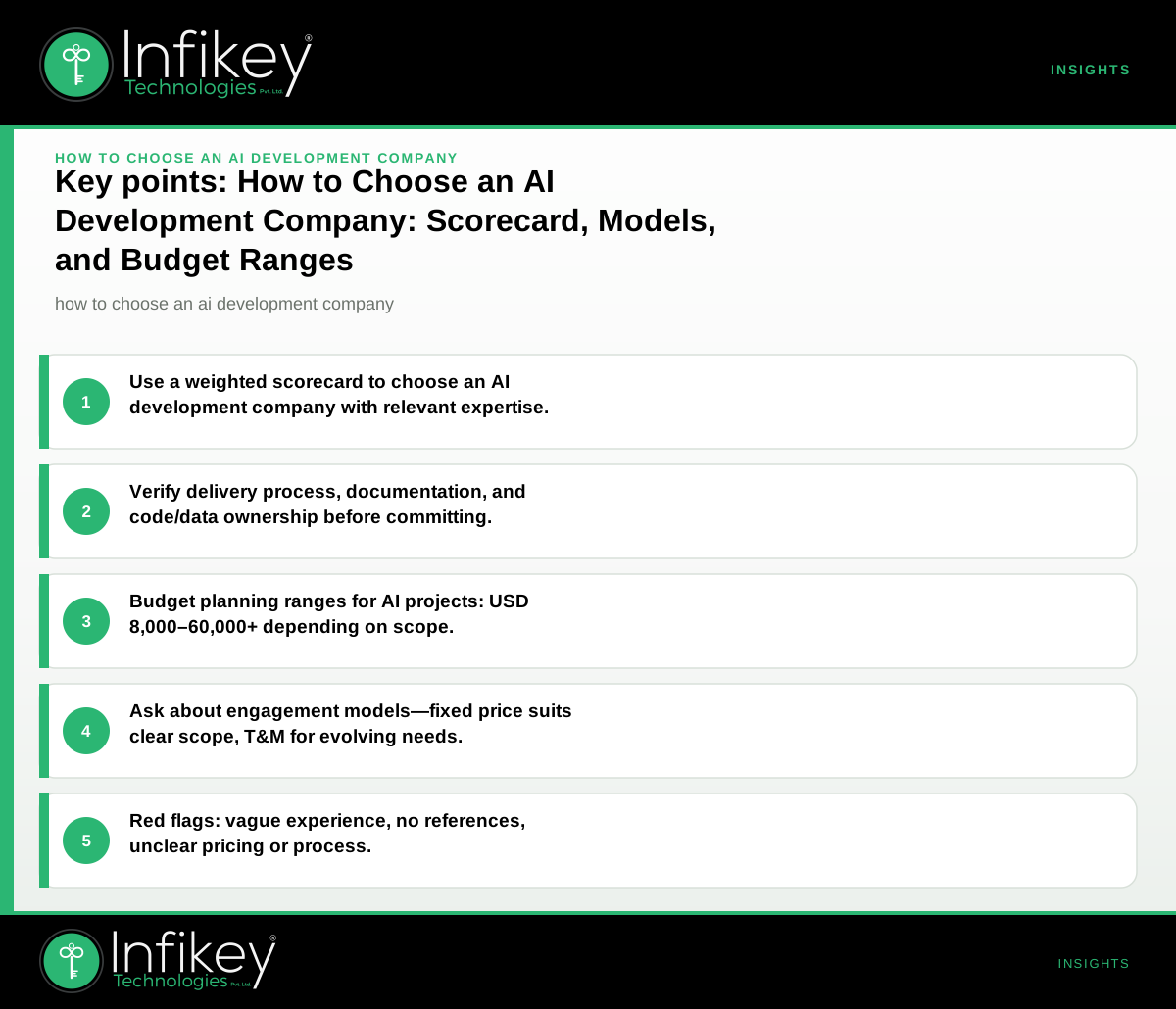
Choosing an AI development company comes down to four essentials: proven technical expertise in relevant AI domains, clear delivery process with documentation, transparent pricing and engagement models, and references or case studies that match your industry or project type. To choose an AI development company, use a weighted scorecard, ask targeted questions, check for red flags, and compare engagement models and proposals before committing.
Why Choosing the Right AI Development Company Matters
The decision of how to choose an AI development company can make or break your digital transformation. The right partner brings not just technical skills, but also a structured approach, commercial transparency, and industry awareness. With AI projects often involving sensitive data, regulatory considerations, and evolving requirements, your choice impacts both project success and long-term maintainability. Whether you’re a startup, mid-market business, or enterprise, aligning with an agency that understands your goals, budget, and technical needs is essential.
Compare AI Vendors with a Practical Scorecard
A practical, objective scorecard is your best tool to compare AI development companies. It helps you avoid bias and ensures you focus on what matters most for your project.
| Criterion | What Good Looks Like | How to Verify | Weight |
|---|---|---|---|
| Technical AI expertise | Demonstrated experience in ML, NLP, or vision relevant to your use case | Review team CVs, sample code, published work | 30% |
| Delivery process & clarity | Documented methodology, clear milestones, and handover steps | Ask for delivery plans, sample docs, project flow | 25% |
| Commercial transparency | Detailed, line-item pricing and clear change management | Review proposal breakdown, ask about overruns | 25% |
| Industry/project relevance | Case studies or references in your sector or project shape | Request anonymised case studies, reference calls | 20% |
Tip: Score each vendor 1–5 on each, multiply by weight, and compare totals. Prioritise technical depth and delivery clarity if you are new to AI.
How to Use the Scorecard
- List your shortlisted AI agencies.
- For each criterion, assign a score from 1 (poor) to 5 (excellent).
- Multiply each score by its weight.
- Add up the totals for each vendor.
- Use the results to guide deeper due diligence and final selection.
Key Questions to Ask on the First Call
Asking the right questions early helps you gauge both the technical and commercial fit of an AI development company. Here are essential questions to cover:
- What AI frameworks, libraries, or platforms do you use most, and why?
- Can you walk me through a recent project similar to ours, including challenges and outcomes?
- How do you handle data privacy, model explainability, and compliance for international clients?
- What is your typical delivery process from discovery to deployment? Who owns the code and models?
- How do you structure pricing and manage changes in scope?
- What documentation and handover do you provide for non-technical stakeholders?
- Can you provide references or anonymised case studies in our industry?
Pro tip: Take notes on how clearly and confidently each company answers. Hesitation or vagueness can signal inexperience or lack of process.
Red Flags That Should End the Conversation
Be alert for these warning signs when you hire an AI agency:
- Vague or generic answers about AI experience (“we do everything” with no specifics)
- No clear delivery process or project documentation
- Unwillingness to discuss code ownership, data handling, or compliance
- No references or relevant case studies
- Overly optimistic timelines or “guaranteed” outcomes
- Pricing that is opaque or only quoted as a single lump sum
If you encounter any of these, it’s best to move on and continue your search.
Engagement Models for AI Projects: Compare Your Options
Understanding engagement models is crucial for controlling your AI development cost and ensuring the right fit for your project’s complexity and timeline.
| Model | Best For | Risk | Budget Control |
|---|---|---|---|
| Fixed price | Well-defined, short projects with stable scope | Scope creep, change costs | High (if scope stable) |
| Time & materials | Evolving requirements, R&D, early-stage AI work | Budget overrun risk | Medium |
| Dedicated team | Ongoing AI product development, multiple phases | Team underutilisation | Medium–Low (flexible) |
Rule of thumb: If your AI use case is clear and requirements are fixed, fixed price works. For evolving or research-heavy projects, time & materials or a dedicated team is safer.
Deciding Which Model Fits Your Needs
- Fixed price: Best when you have a clear, documented scope and want predictable costs. Works well for proof-of-concept AI features or tightly defined automation.
- Time & materials: Ideal for projects where discovery, experimentation, or changing requirements are expected. Gives you flexibility but requires active budget tracking.
- Dedicated team: Suited for ongoing AI product development or when you need a long-term partner to iterate and scale solutions. Provides continuity but needs strong backlog management.
Example AI Project Shapes and Planning Ranges
On projects like these, we usually see:
- AI feature on an existing product: Planning range USD 8,000–35,000, 6–14 weeks (scoped use-case, prompts/tools, evaluation, launch)
- Custom web application with AI: Planning range USD 15,000–60,000+, 8–20 weeks (auth, dashboards, integrations)
- Mobile app with AI features: Planning range USD 12,000–45,000, 10–18 weeks (MVP, API, store submission)
Final scope and commercials are always confirmed after discovery. These ranges reflect typical AI development company pricing for global markets, but your specific ai development cost will depend on project complexity, data requirements, integrations, and ongoing support needs.
For a more tailored estimate, [talk to Infikey](/contact) or see our [AI development services](/services/ai).
Factors That Influence AI Development Cost
When you hire an AI agency, several factors shape the final cost:
- Project scope: More features, integrations, or custom models increase cost.
- Data complexity: Cleaning, labeling, or acquiring data can be resource-intensive.
- Model type: Off-the-shelf models are cheaper than fully custom architectures.
- Deployment: Integrating AI into web, mobile, or cloud environments adds effort.
- Compliance: Projects in regulated industries (like healthcare or finance) require extra documentation, testing, and security.
- Support and maintenance: Ongoing model tuning, monitoring, and updates may be included or billed separately.
Understanding these drivers helps you assess proposals and avoid surprises. Always ask for a detailed breakdown and clarify what’s included in the quoted price.
What a Good AI Proposal Must Include
A strong proposal from the best AI development company will be transparent, detailed, and tailored to your needs. Look for:
- Clear project scope, deliverables, and acceptance criteria
- Milestones with timelines and payment schedules
- Detailed pricing (line items, assumptions, change process)
- Team structure and named roles
- Approach to data handling, security, and compliance
- Handover plan with documentation and support
- Reference projects or case studies relevant to your sector
If any of these are missing or unclear, ask for clarification before signing.
How to Evaluate AI Development Company Pricing
Comparing AI development company pricing goes beyond looking at the bottom line. Consider:
- Transparency: Are all costs itemized? Are assumptions and exclusions clear?
- Flexibility: Can the agency adapt if your requirements change?
- Value: Does the proposal include support, training, or post-launch tuning?
- Risk management: Are there provisions for overruns or scope changes?
Use your scorecard to weigh pricing against technical and delivery criteria. The lowest price isn’t always the best value if it comes with hidden costs or unclear deliverables.
The Infikey Approach: What Sets Us Apart
[Infikey Technologies](/) Pvt. Ltd. is an Ahmedabad-based company serving a global market. Our AI development services are built on transparency, documented processes, and deep technical expertise. We deliver AI projects for businesses that value:
- End-to-end ownership, from discovery to launch
- Transparent documentation and clear handover
- Flexible engagement models to match your needs and budget
- Industry experience across sectors like financial services, healthcare, retail, manufacturing, technology, education, logistics, energy, public sector, startups, professional services, and media/hospitality
Our services include: Website development, Mobile app development, Software engineering, Cloud and infrastructure, Cybersecurity, AI, Digital transformation, Managed engineering, Digital marketing and SEO, and Graphics designing.
We are a fit for organizations seeking a partner that can:
- Deliver complex AI features or standalone tools
- Work with both technical and non-technical stakeholders
- Support remote, timezone-aligned delivery
We may not be the right fit if you:
- Only need individual developers or staff augmentation
- Require deep domain expertise in sectors outside our industries
- Want an off-the-shelf AI solution with no customization
Next Steps: How to Choose an AI Development Company with Confidence
- Shortlist 2–4 agencies using the scorecard above.
- Schedule intro calls and ask the key questions listed.
- Request detailed proposals with itemized pricing and delivery plans.
- Check references and review anonymized case studies.
- Compare engagement models and clarify all terms before signing.
Ready to compare proposals or need a planning call? Visit our AI service page or Contact Infikey to get started.
---
*For more insights on AI, digital transformation, and technology services, explore our blog.*