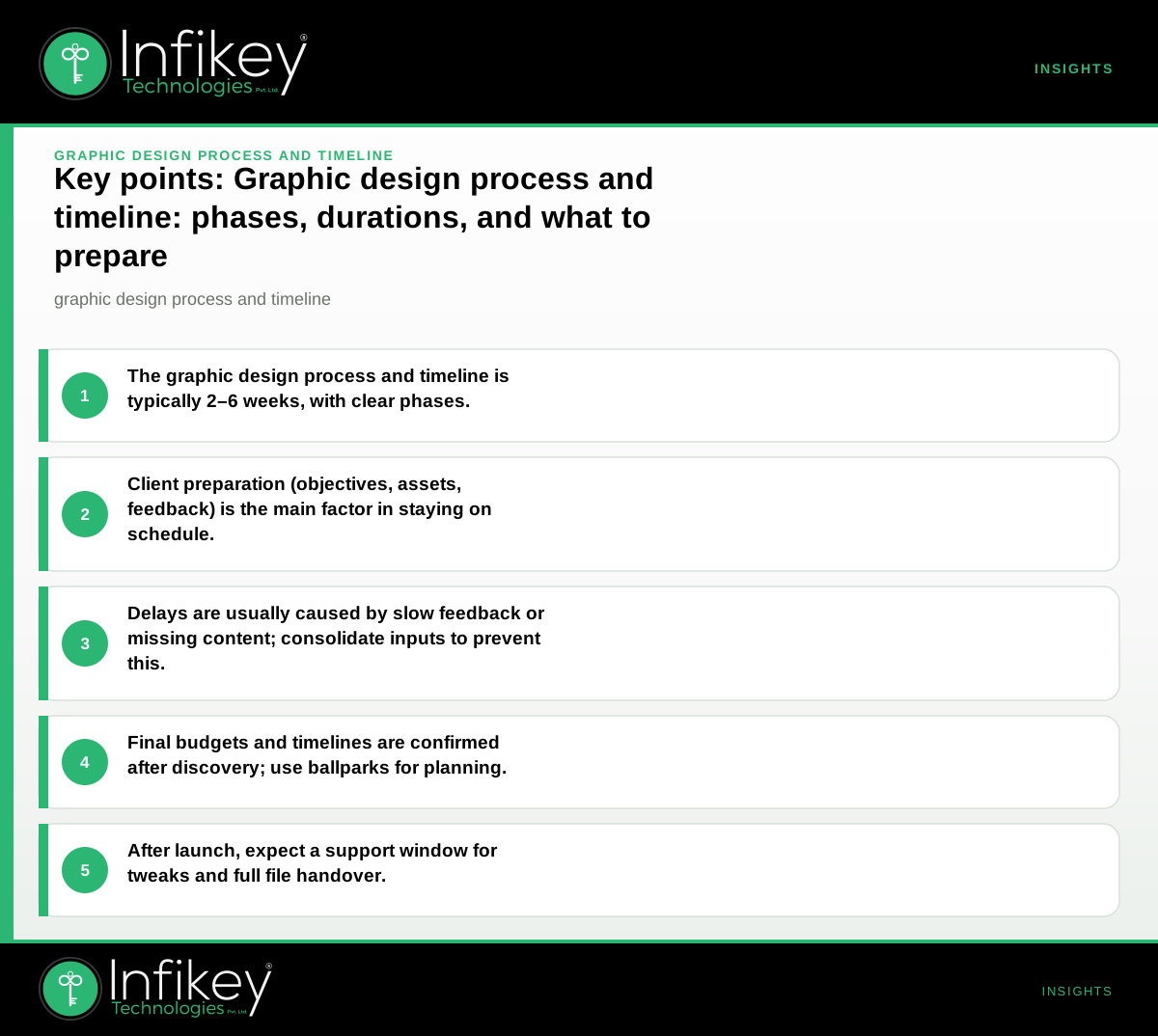
The graphic design process and timeline typically runs from 2 to 6 weeks for most business projects, covering briefing, research, concept, revisions, and delivery. Each phase has clear deliverables and client inputs. Understanding this process helps you budget, avoid delays, and ensure your graphics designing project stays on track.
Graphic design process phases and typical timeline
A well-defined graphic design workflow ensures clarity, efficiency, and creative alignment between client and designer. Here’s a breakdown of the typical phases, their deliverables, and what you as a client should prepare at each stage:
| Phase | What happens | Typical duration | Deliverable | What the client provides |
|---|---|---|---|---|
| 1. Briefing | Define goals, audience, requirements | 1–3 days | Project brief | Objectives, brand assets, references |
| 2. Research & Mood | Market, industry, and style research; mood boards | 2–4 days | Mood board, style direction | Competitor info, preferences |
| 3. Concept Design | Initial concepts, layout, and visual exploration | 4–7 days | 2–3 concept options | Feedback on direction |
| 4. Revisions | Refine chosen concept based on feedback | 3–7 days | Finalised design | Consolidated feedback |
| 5. Delivery & Handover | Prepare final files, documentation, export assets | 1–3 days | Source + export files | Approval, usage requirements |
For larger or multi-asset projects, the timeline may extend to 6–8 weeks. For single assets (e.g., logo), 2–3 weeks is common. Final scope and timeline are confirmed after discovery — use these as planning ranges only.
How long does graphic design take?
The answer depends on project scope, number of deliverables, and feedback cycles. For a logo, expect 2–3 weeks. For a full marketing website design, plan for 4–8 weeks. Multi-asset campaigns or branding packs may require 3–6 weeks or more. Complex projects with multiple stakeholders, custom illustrations, or multilingual needs can extend timelines further. Timely feedback and clear requirements are the biggest factors in keeping your graphic design project timeline on track.
The graphic design workflow: what to expect at each stage
A transparent graphic design workflow helps both clients and designers stay aligned. Here’s what typically happens at each phase:
1. Briefing
- Purpose: Establish project objectives, target audience, and key requirements.
- Questions to ask:
- What problem are we solving? - Who is the design for? - Are there must-have elements (logos, taglines, colors)?
- Client’s role: Provide all available brand guidelines, references, and decision-maker contacts.
2. Research & Moodboarding
- Purpose: Explore industry trends, competitors, and visual directions.
- Designer’s tasks: Compile mood boards, color palettes, and style references.
- Client’s role: Share competitor examples, likes/dislikes, and any inspiration.
3. Concept Design
- Purpose: Translate brief and research into 2–3 initial design options.
- What you receive: Concept presentations with rationale for each direction.
- Client’s role: Review and provide consolidated feedback, indicating preferred direction or elements.
4. Revisions
- Purpose: Refine the chosen concept based on feedback, making adjustments to layout, color, typography, and imagery.
- Best practices: Limit revision rounds (typically 2–3) to stay on schedule.
- Client’s role: Gather all stakeholder input before submitting feedback to avoid conflicting requests.
5. Delivery & Handover
- Purpose: Prepare final files in all required formats (print, web, social, etc.), along with usage documentation.
- What you receive: Source files (e.g., AI, PSD), exports (JPG, PNG, PDF), brand guidelines, and usage rights.
- Client’s role: Confirm all requirements are met and approve final deliverables.
Graphic design deliverables: what to expect
Deliverables vary by project type, but commonly include:
- Logos: Variations (full color, mono, icon only), vector and raster formats
- Brand guidelines: Color codes, typography, usage rules
- Web assets: Responsive images, banners, UI elements
- Print assets: Business cards, brochures, packaging, high-res print-ready files
- Campaign graphics: Social media posts, ads, email banners
- Documentation: File usage instructions, licensing notes
Always clarify deliverables at the start. For example, if you need layered source files or editable templates, specify this in the brief.
What to prepare before kickoff: graphic design client checklist
A smooth kickoff sets the tone for the entire project. Here’s a comprehensive checklist to help you prepare:
- Clear objectives: Define the purpose, target audience, and desired outcomes.
- Brand guidelines: Provide logos, color palettes, fonts, and any existing style guides.
- Content: Supply all text, slogans, product images, or data to be featured.
- Reference materials: Gather examples of designs you like (and dislike), competitor assets, and inspiration.
- Decision-makers: Identify who will review and approve designs, and ensure their availability.
- Timeline expectations: Share any fixed launch dates, milestones, or events.
- File requirements: Specify formats, sizes, and platforms where designs will be used (e.g., print, web, social).
- Budget range: Have a planning range in mind (see below for ballparks).
- Legal/licensing needs: Note any copyright, trademark, or licensing considerations.
Having these items ready at kickoff prevents most common delays and ensures your designer can hit the ground running.
What usually causes delays — and how to prevent them
Delays in the graphic design process and timeline are almost always related to feedback cycles or missing inputs. Here’s how to avoid common pitfalls:
1. Slow or unclear feedback:
- Assign a single point of contact for feedback.
- Set internal deadlines for reviews.
- Consolidate feedback from all stakeholders before submitting.
2. Missing assets or content:
- Prepare all required text, images, and brand assets before concept work begins.
- Confirm all files are high-resolution and properly licensed.
3. Scope changes mid-project:
- Finalize requirements and sign-off before design starts.
- Document any changes and agree on timeline/budget impact before proceeding.
4. Decision bottlenecks:
- Identify all stakeholders early.
- Involve them from the start to avoid late-stage surprises.
5. Time zone or communication gaps (for remote/global projects):
- Agree on regular check-ins and preferred communication channels (email, project tools).
- Set expectations for response times.
By following these best practices, you can keep your graphic design project timeline predictable and avoid unnecessary back-and-forth.
How Infikey approaches the graphic design process and timeline
At Infikey Technologies Pvt. Ltd., our graphics designing service emphasizes transparency, collaboration, and clear communication throughout the project lifecycle. We work with clients in Ahmedabad, across India, and globally, adapting our workflow to suit remote and multi-stakeholder projects. Our process is tailored for businesses in industries such as financial services, healthcare, retail, manufacturing, technology, and more.
Key features of our approach:
- Discovery-first: Every project starts with a discovery call to clarify needs and confirm scope.
- Documented workflow: Each phase, from briefing to delivery, is documented and tracked.
- Flexible communication: We adapt to your preferred tools and time zones.
- Transparent timelines: You receive a detailed project plan, including milestones and review points.
- Comprehensive handover: Final files, documentation, and a short support window are standard.
Learn more about our Graphics designing services or talk to Infikey for a tailored proposal.
Example project shapes: budgets and timelines for global buyers
Below are typical project types, with planning ranges for budget and timeline. Final scope and commercials are confirmed after discovery.
- Logo & branding pack: 2–3 weeks, USD 1,000–3,000 planning range
- Marketing website design (8–15 pages): 4–8 weeks, USD 4,000–12,000 planning range
- Multi-asset campaign (web + print): 3–6 weeks, USD 2,500–8,000 planning range
For larger or more complex projects (such as custom web applications or mobile apps), see our Website development or Mobile app development services for additional ballpark ranges and timelines.
Questions to ask your graphic design partner
To ensure your project runs smoothly, consider asking:
- What is your typical graphic design workflow?
- How do you handle feedback and revisions?
- What are the standard graphic design deliverables?
- How long does graphic design take for projects like mine?
- Can you provide a detailed graphic design project timeline?
- What should I prepare as a client?
- How do you manage delays or scope changes?
- What support is available after delivery?
A transparent partner will welcome these questions and provide clear answers.
What happens after launch: support, iterations, and handover
After final approval, you receive:
- All agreed file formats (source files, exports for print/web, etc.)
- Documentation for usage (colour codes, font names, usage rights)
- A short support window (typically 1–2 weeks) for minor tweaks or file adjustments
If further changes are needed after handover, these are usually scoped and billed separately. For ongoing needs (e.g., campaign graphics), consider a retainer or package arrangement.
Ready to start your graphics designing project?
A clear understanding of the graphic design process and timeline helps you budget, prepare, and avoid common pitfalls. For a detailed proposal or to discuss your requirements, visit Graphics designing or [[Contact Infikey]({{contact](/contact))}}.