
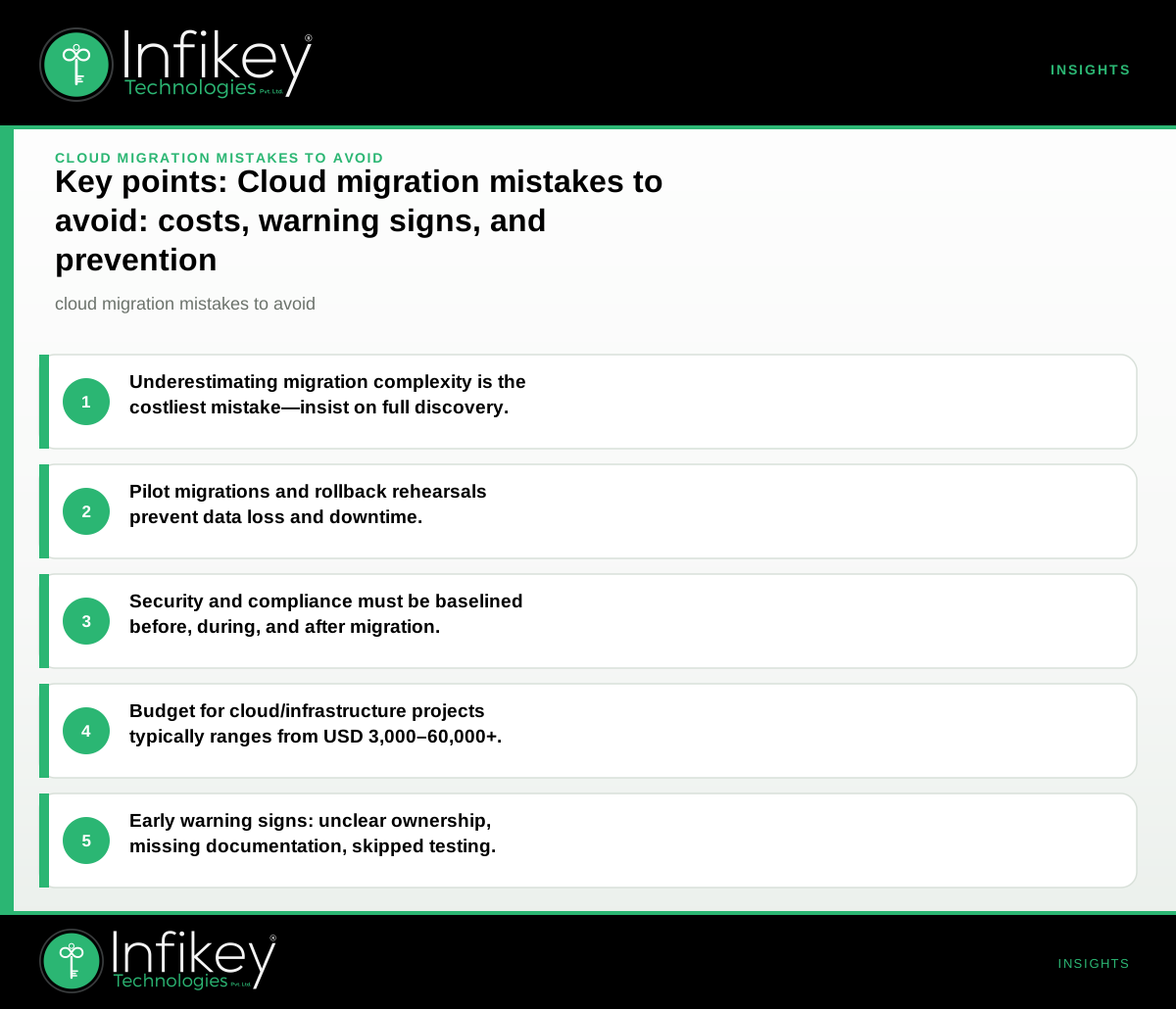
The most expensive cloud migration mistake is underestimating complexity—leading to spiralling costs, missed deadlines, and business disruption. To avoid this, insist on a detailed discovery phase with clear mapping of dependencies, stakeholder sign-off, and a fallback plan before committing to timelines or budgets.
Table: Cloud migration mistakes to avoid, costs, and prevention
| Mistake | Why it happens | What it costs you | How to avoid it |
|---|---|---|---|
| Underestimating complexity | Incomplete discovery, missing dependencies | Cost overruns, delays, outages | Full assessment, involve all teams, phased approach |
| Poor data migration planning | Rushed mapping, lack of test migrations | Data loss, integrity issues, downtime | Pilot migrations, robust testing, validation scripts |
| Ignoring security and compliance | Assuming cloud is secure by default | Breaches, fines, reputational damage | Security baseline, compliance checks, audit trails |
| Insufficient stakeholder alignment | IT-only planning, unclear ownership | Rework, resistance, missed requirements | Cross-functional workshops, clear roles |
| No rollback or fallback plan | Overconfidence, skipping contingency planning | Extended outages, business disruption | Documented rollback, dry runs, staged cutover |
| Vendor lock-in unaddressed | Not planning for portability or future exit | High switching costs, limited flexibility | Use open standards, clarify exit strategy |
| Inadequate post-migration monitoring | Treating migration as "done" after cutover | Missed issues, slow incident response | Set up monitoring, alerts, and support handover |
Understanding Cloud Migration Risks
Cloud migration risks are multi-faceted, impacting cost, security, compliance, and business continuity. Ignoring these risks can lead to unexpected downtime, data breaches, or runaway expenses. Common cloud migration risks include:
- Data loss or corruption during transfer due to poor planning or lack of validation.
- Security vulnerabilities introduced by misconfigured cloud services or insufficient access controls.
- Compliance failures if regulatory requirements (such as GDPR, HIPAA, or industry-specific standards) are not addressed.
- Operational disruption if critical systems are not properly sequenced or tested.
- Budget overruns from underestimated migration effort or unplanned cloud consumption.
Mitigating these risks requires a structured approach to cloud migration planning, including thorough assessment, stakeholder engagement, and a robust cloud migration checklist.
Early warning signs during a cloud migration project
On projects like this, we usually see trouble early if:
- Discovery phase is rushed or skipped, with unclear application inventory.
- Key business users are not involved in mapping requirements or testing.
- There is no clear owner for data migration or security.
- Migration timelines are set before technical assessment is complete.
- No test migrations or rollback rehearsals are scheduled.
- Documentation is missing or out of date.
If you spot any of these, pause and insist on a review before proceeding. Early detection of these warning signs can prevent costly missteps and ensure a smoother transition.
Prevention checklist: avoid cloud migration mistakes
A comprehensive cloud migration checklist is essential for reducing risk and ensuring a successful outcome. Here are the critical steps:
- Complete a full discovery and dependency mapping—include all systems, integrations, and data sources. Document application interdependencies and legacy system touchpoints.
- Involve business, security, and compliance stakeholders from the start. Secure buy-in and clarify responsibilities across IT, operations, and business units.
- Run a pilot migration with test data and validate results. Use pilot phases to uncover hidden issues and refine your migration runbook.
- Document rollback and contingency plans—and rehearse them. Ensure that you can revert to the previous state if issues arise.
- Baseline security and compliance—review controls before, during, and after migration. Include regular audits and update policies as needed.
- Set up monitoring and support handover for post-migration stability. Implement dashboards, alerts, and escalation procedures.
- Review vendor lock-in risks and clarify your exit strategy. Use open standards and document data portability options.
Following this checklist reduces the likelihood of encountering the most common cloud migration mistakes to avoid.
Cloud Infrastructure Migration: Key Considerations
Cloud infrastructure migration is more than just moving applications to a new environment. It involves rethinking architecture, optimizing for scalability, and ensuring ongoing manageability. Key considerations include:
- Assessment of current infrastructure: Inventory all assets, including servers, databases, storage, and network configurations.
- Selection of migration strategy: Decide between rehosting (lift-and-shift), refactoring, rearchitecting, or replacing. The right approach depends on application complexity, business goals, and cloud capabilities.
- Network and security configuration: Redesign network topology for the cloud, implement identity and access management, and set up firewalls and encryption.
- Performance benchmarking: Establish baseline performance metrics to compare pre- and post-migration states.
- Cost optimization: Right-size resources and leverage cloud-native features to control ongoing expenses.
A well-executed cloud infrastructure migration ensures that systems are resilient, secure, and cost-effective in the long run.
Cloud Migration Planning: Steps for Success
Effective cloud migration planning is the foundation for a successful project. Here’s a step-by-step approach:
- Define business objectives: Align migration goals with business outcomes, such as agility, cost savings, or improved security.
- Conduct a readiness assessment: Evaluate technical, operational, and organizational readiness for cloud adoption.
- Prioritize workloads: Identify which applications and data should move first based on complexity, dependencies, and business impact.
- Develop a detailed migration plan: Create a timeline with milestones, resource assignments, and risk mitigation strategies.
- Communicate with stakeholders: Keep all relevant parties informed and engaged throughout the process.
- Execute pilot migrations: Test the plan with non-critical workloads to validate processes and tooling.
- Monitor and optimize: Continuously track progress, resolve issues, and adjust the plan as needed.
Comprehensive planning reduces uncertainty and helps avoid common cloud migration mistakes to avoid.
Managing Cloud Migration Cost
Cloud migration cost is a critical factor in project success. Unanticipated expenses can erode the business case for migration. Key cost considerations include:
- Discovery and assessment costs: Time and resources required for initial analysis and planning.
- Licensing and tooling: Expenses for migration tools, temporary dual-running environments, and third-party services.
- Data transfer and storage: Costs associated with moving large volumes of data and storing backups.
- Training and change management: Investment in upskilling staff and managing organizational change.
- Post-migration optimization: Ongoing costs for monitoring, support, and rightsizing cloud resources.
To control cloud migration cost, create a detailed budget, track actuals against estimates, and regularly review cloud consumption. Use tools and calculators to project savings and identify cost drivers. For tailored estimates, consider using a cloud migration cost savings calculator or talk to Infikey for a consultation.
Example project shapes and planning ranges
For global buyers, cloud migration and infrastructure hardening projects typically fall into these planning ranges:
- Cloud / infrastructure hardening sprint: USD 3,000–15,000, 2–6 weeks. Includes review, CI/CD, monitoring, backups, and security baseline. Final scope and commercials are always confirmed after discovery.
- Custom web application / portal migration: USD 15,000–60,000+, 8–20 weeks. Covers authentication, dashboards, integrations, staging and production environments.
These ranges reflect international delivery with clear documentation and USD-friendly quoting. For a tailored estimate, use the cloud migration cost savings calculator or [[Contact Infikey]({{contact](/contact))}}.
Questions to ask your migration partner
Selecting the right migration partner is crucial. Use these questions to evaluate expertise and approach:
- How will you map all application and data dependencies before migration?
- What is your process for pilot migrations and rollback rehearsals?
- How do you baseline and test security and compliance controls?
- What documentation will you provide for non-technical sponsors?
- How do you manage post-migration monitoring and support?
- How do you address vendor lock-in and ensure future flexibility?
- What is your approach to managing cloud migration cost and avoiding overruns?
A transparent, methodical partner will have clear, detailed answers to each of these.
When to escalate or pause
If you see unclear ownership, missing documentation, or skipped testing, escalate to project sponsors or pause the migration. Early intervention saves far more than late-stage firefighting. Insist on a checkpoint review if:
- Migration steps are unclear or undocumented
- Stakeholders are not engaged or informed
- Testing and rollback plans are incomplete
- Security or compliance gaps are identified
Pausing to address these issues can prevent larger failures down the line.
Next steps
To avoid costly cloud migration mistakes, insist on a structured discovery, robust testing, and clear documentation. For help planning or reviewing your migration, see our [[Cloud and infrastructure]({{service:cloud-and-infrastructure](/services/cloud-and-infrastructure))}} service or contact Infikey for a consultation. Our team in Ahmedabad supports global clients with end-to-end cloud migration planning, risk assessment, and cost optimization. Whether you’re modernizing core platforms, scaling digital products, or hardening infrastructure, Infikey Technologies Pvt. Ltd. brings proven expertise to help you avoid the most common cloud migration mistakes and realize the full value of your cloud investment.