
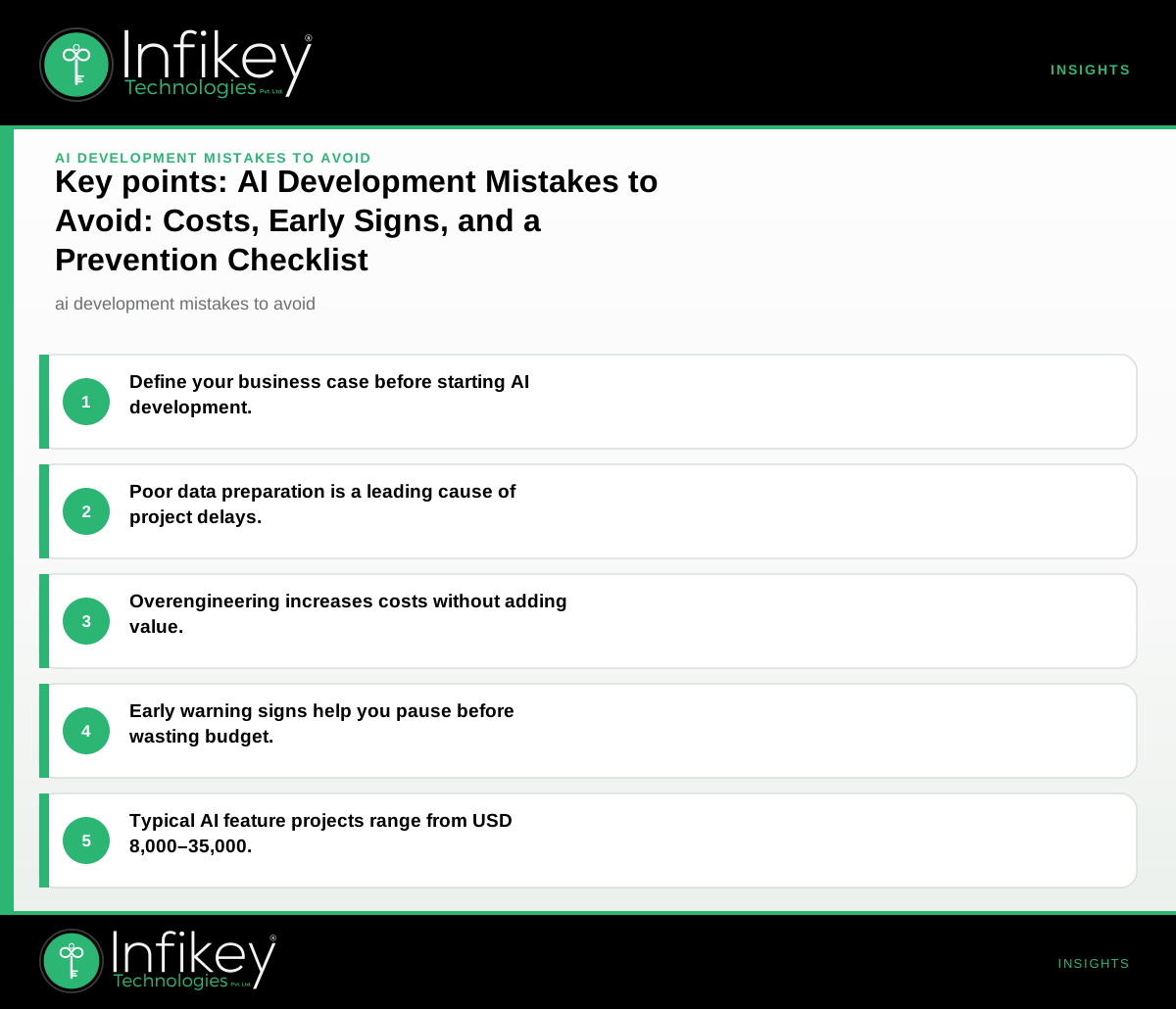
The most expensive AI development mistake is launching without a clear, testable business use case. This leads to wasted investment, missed ROI, and costly rework. To avoid it, define your problem, success metrics, and user journey before any code is written—then validate with a small pilot before scaling.
Common AI Development Mistakes, Costs, and How to Avoid Them
AI projects can unlock tremendous value, but only when approached with discipline. Many organizations fall into common AI project pitfalls that derail progress and inflate costs. Below, we break down the most frequent ai development mistakes to avoid, why they happen, what they cost, and practical steps to prevent them.
| Mistake | Why it Happens | What it Costs You | How to Avoid It |
|---|---|---|---|
| Undefined business case | Rushed to "do AI" without clear value | USD 8,000–35,000+ wasted on pilots that never launch | Start with a problem statement and success criteria |
| Poor data quality/prep | Data is scattered, unlabelled, or out of date | Weeks/months lost to cleaning, unreliable outputs | Audit data sources and invest in data readiness upfront |
| Overengineering | Building a complex model when a simple tool suffices | High costs, slow delivery, hard to maintain | Match solution complexity to the real business need |
| No human oversight | Fully automating without checks | Compliance, safety, or reputational risk | Keep a human-in-the-loop for critical decisions |
| Ignoring change management | Users not trained or workflows not adapted | Low adoption, rework, or project abandonment | Plan for training, feedback, and process updates |
| Weak documentation | Only developers understand the system | Hard to support, scale, or pass audits | Require clear, non-technical documentation for sponsors |
Understanding Common AI Project Pitfalls
Many teams underestimate the complexity of AI implementation. Rushing to deploy AI without a defined business objective is one of the most common ai project pitfalls. This often results in solutions that look impressive on paper but fail to deliver real business impact. Another frequent issue is underestimating the importance of data quality. AI systems are only as good as the data they are trained on, making ai data quality issues a critical risk factor.
Early Warning Signs: Spot AI Project Risks Before They Grow
Recognizing ai project early warning signs can help you intervene before minor issues become expensive failures. Here are some indicators that your AI project may be heading off track:
- The business problem is vague or keeps changing.
- Data sources are not identified or are "to be cleaned later".
- Success is defined as "AI working" rather than measurable business impact.
- Delivery team avoids demos or only shows technical progress, not business outcomes.
- No plan for user training, support, or feedback collection.
- Documentation is missing, or only in code comments.
If you see two or more of these in your project, pause and review scope and readiness with your delivery partner. On projects like this, we usually recommend a checkpoint after discovery to confirm the business case and data readiness before committing the full budget.
How to Respond to Early Warning Signs
- Pause new development: Avoid sinking more resources into a project with unclear foundations.
- Revisit the business case: Validate that the problem, users, and expected outcomes are still relevant.
- Run a data audit: Ensure data sources are accessible, clean, and fit for purpose.
- Schedule a demo: Require the team to show progress in terms of business value, not just technical milestones.
AI Implementation Risks: What to Watch For
AI implementation risks span technical, organizational, and ethical dimensions. Some of the most significant risks include:
- Data privacy and security: Mishandling sensitive data can lead to compliance breaches or reputational damage. Engage cybersecurity experts early, such as those at Infikey Technologies Pvt. Ltd., to review data handling practices.
- Model bias and fairness: Inadequate data or unchecked algorithms may produce biased outcomes. Regularly test models for fairness and accuracy.
- Integration with legacy systems: AI solutions often need to work alongside existing IT infrastructure. Plan for integration challenges and allocate time for testing.
- Change resistance: If users do not trust or understand the AI, adoption will stall. Address this through transparent communication and training.
AI Data Quality Issues: The Hidden Cost Driver
Poor data quality is one of the most underestimated ai development mistakes to avoid. Even the most sophisticated AI models cannot compensate for incomplete, inconsistent, or irrelevant data. Data issues can surface as:
- Missing values: Gaps in data can skew model predictions.
- Inconsistent formats: Data from different sources may not align, requiring extensive cleaning.
- Outdated information: Stale data reduces the relevance and accuracy of AI outputs.
Steps to Address AI Data Quality Issues
- Conduct a data inventory: List all data sources and assess their quality.
- Define data requirements: Specify what data is needed for the AI use case.
- Clean and preprocess data: Remove duplicates, fill gaps, and standardize formats.
- Establish data governance: Assign ownership and set policies for ongoing data quality.
AI Project Budget Planning: Avoiding Surprises
Effective ai project budget planning is crucial to prevent overspending and ensure that resources are allocated where they deliver the most value. Common budgeting mistakes include underestimating the cost of data preparation, integration, and ongoing support. Use realistic planning ranges and build in contingency for unknowns.
Example AI Project Shapes and Planning Ranges
For global buyers, planning budgets for AI projects typically fall into these ranges (final scope and commercials are confirmed after discovery):
- AI feature on an existing product:
- Scope: Use-case, prompts/tools, evaluation, human oversight, launch - Ballpark: USD 8,000–35,000 - Timeline: 6–14 weeks
- Custom web application with AI:
- Scope: Auth, roles, dashboards, integrations, staging + production - Ballpark: USD 15,000–60,000+ - Timeline: 8–20 weeks
These ranges reflect remote delivery with clear documentation and ownership, suitable for non-technical sponsors. For a more precise estimate, contact Infikey or see the AI service overview.
Tips for AI Project Budget Planning
- Start with a discovery phase: This clarifies requirements and reduces the risk of scope creep.
- Allocate budget for data work: Data cleaning and integration often require more effort than model development.
- Plan for post-launch support: AI systems need monitoring, retraining, and user support after go-live.
- Review ballpark ranges: Use Infikey’s published planning ranges as a reference point for your initial budgeting.
Prevention Checklist: AI Development Mistakes to Avoid
- Define the business problem and success metrics in plain language.
- Audit and prepare data sources before model development.
- Match solution complexity to the problem—avoid overengineering.
- Plan for human oversight in any critical process.
- Prepare user training and change management steps.
- Require clear documentation for non-technical sponsors.
Questions to Ask Before You Commit Budget
Before investing in an AI initiative, ask these questions to uncover hidden ai implementation risks and ensure project readiness:
- What is the specific business process or outcome we want to improve?
- Do we have access to the right data, and is it ready for use?
- How will we measure success in business—not just technical—terms?
- Who will use the system, and how will they be trained?
- What is the fallback if the AI fails or produces errors?
- Is the documentation clear enough for a non-technical sponsor to approve?
If you cannot answer these confidently, revisit your project brief or ask your delivery partner for clarity.
Worked Example: AI in Retail Inventory Forecasting
Consider a mid-sized retailer looking to implement AI for inventory forecasting. Here’s how to apply the above principles:
- Define the use case: Reduce stockouts and overstock by predicting weekly demand at each location.
- Data audit: Gather sales, promotions, and seasonal data from the past three years. Identify gaps and clean as needed.
- Pilot project: Launch a pilot at two locations for six weeks. Measure accuracy and business impact.
- Human oversight: Store managers review AI recommendations before finalizing orders.
- Change management: Train staff on new workflows and collect feedback for improvement.
- Documentation: Create a user guide and a non-technical summary for leadership.
By following these steps, the retailer avoids common ai project pitfalls, manages ai implementation risks, and maximizes the value of their investment.
Next Steps
Avoiding these AI development mistakes protects your budget and ensures your investment delivers real value. For a structured discovery and delivery process, see Infikey’s AI services or talk to Infikey about your use case.