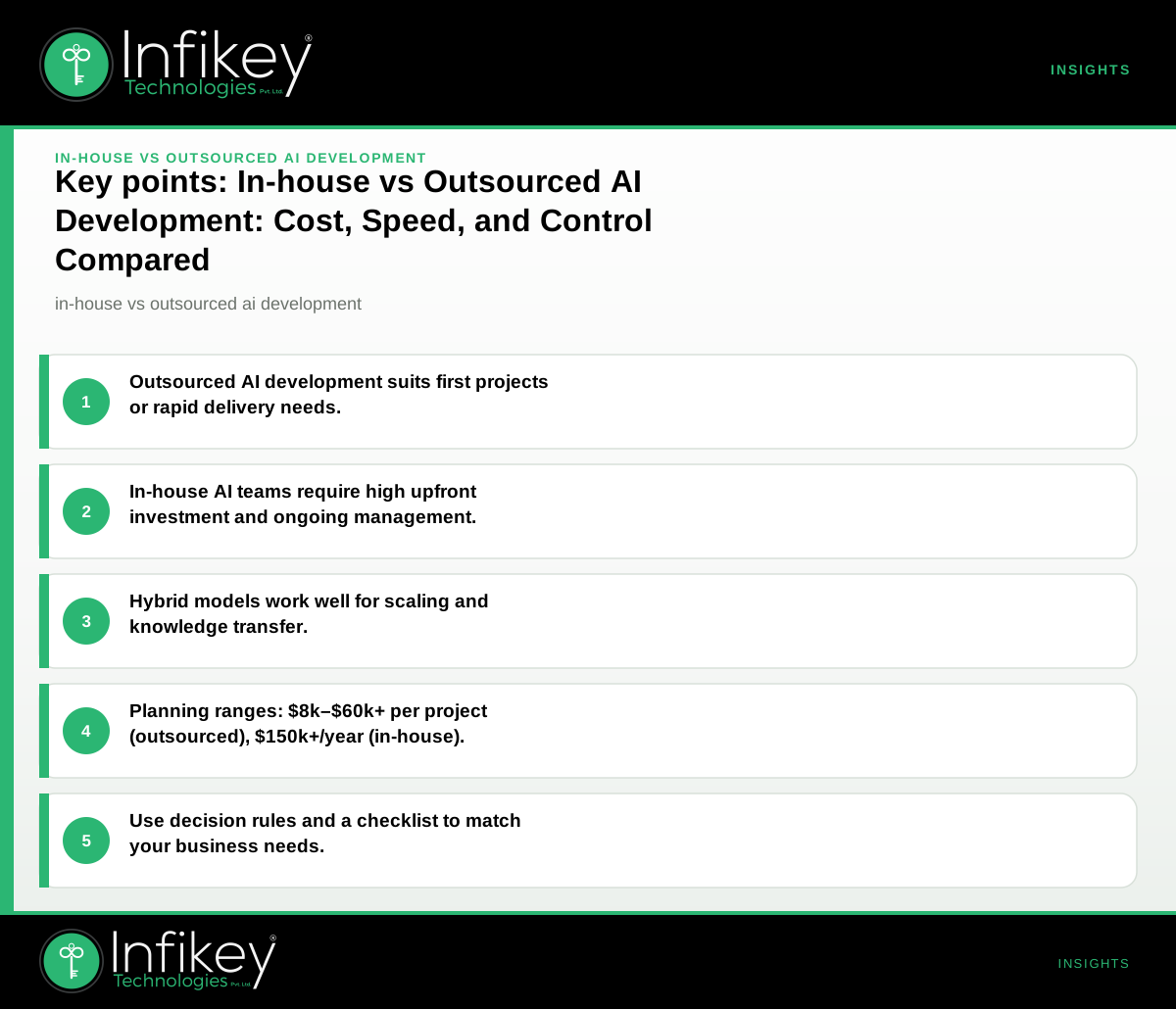
Choosing between in-house vs outsourced AI development comes down to your priorities: in-house teams offer maximum control and long-term capability but require higher upfront investment and time, while outsourcing is faster and more cost-predictable for defined projects. Most global buyers without deep AI expertise or large internal teams start with outsourcing, then build in-house as needs mature.
Quick Comparison: In-house vs Outsourced AI Development
| Option | Cost (USD) | Speed | Control | Risk | Best For |
|---|---|---|---|---|---|
| In-house | $150k–$500k+/yr | Slowest | Highest | Talent, delivery | Large, ongoing AI programmes |
| Outsourced | $8k–$60k+/project | Fastest | Moderate | Vendor, IP | First projects, clear outcomes |
| Hybrid | $8k–$500k+ | Medium | Shared | Integration | Scaling, capability transfer |
Planning ranges: In-house costs reflect annual salaries and overheads for a small AI team. Outsourced ranges follow Infikey's typical project ballparks (see below). Hybrid combines both.
Decision Rules: Should You Build In-house or Outsource?
When evaluating in-house vs outsourced AI development, consider these key decision factors:
- Choose in-house if:
- You need full control over data, IP, and long-term AI capability. - Your AI work is core to your product or business model (e.g., proprietary algorithms, sensitive data). - You can recruit and retain experienced AI engineers, data scientists, and product owners. - You have the resources to invest in ongoing training, infrastructure, and compliance.
- Choose outsourced if:
- You want to validate an AI use case before investing in a team. - The project is well-scoped and outcome-driven (such as an AI feature, chatbot, or automation). - You lack internal AI delivery experience or need to move quickly to market. - You want predictable costs and timelines for a defined deliverable.
- Choose hybrid if:
- You want to build internal capability while delivering near-term results. - Your roadmap includes both quick wins and long-term AI investment. - You need knowledge transfer, process setup, or upskilling from experienced partners.
AI Development Cost Comparison: Planning Ranges for Outsourced AI Projects
Understanding the cost structure is critical when comparing in-house vs outsourced AI development. Here’s how typical outsourced AI project costs compare to building an in-house team:
| Project Type | Planning Range (USD) | Timeline |
|---|---|---|
| AI feature on existing product | $8,000–35,000 | 6–14 weeks |
| Custom web application / portal | $15,000–60,000+ | 8–20 weeks |
| Mobile app with AI (MVP) | $12,000–45,000 | 10–18 weeks |
*Final scope and commercials are always confirmed after discovery. These are ballpark ranges for typical Infikey-style engagements. For in-house, expect a minimum of $150,000/year for a small, permanent AI team (2–3 engineers plus management and overheads).*
If you need a more tailored estimate, you can estimate your AI project costs.
What Drives AI Development Costs?
- Project complexity: More advanced AI models, integrations, or custom data pipelines increase costs.
- Data requirements: Projects needing significant data cleaning, annotation, or privacy controls require more investment.
- Team skills: In-house teams need ongoing training and access to AI research; outsourcing leverages an existing talent pool.
- Infrastructure: In-house AI often requires investment in cloud or on-premise compute resources.
In-house AI Team Advantages
Building an in-house AI team gives you:
- Full control over your data, intellectual property, and security protocols.
- Alignment with your business goals, enabling rapid iteration and deep integration with existing systems.
- Long-term capability to scale AI across multiple products or business units.
- Institutional knowledge that stays within your organization, supporting ongoing innovation.
However, these advantages come with higher upfront costs, longer ramp-up times, and the need to attract and retain highly skilled talent in a competitive market.
Outsourcing AI Projects: Benefits and Considerations
Outsourcing AI projects to a partner like Infikey Technologies Pvt. Ltd. enables you to:
- Accelerate delivery by leveraging proven frameworks, tools, and expertise.
- Reduce risk with fixed-scope, outcome-driven engagements.
- Access specialized skills without long-term hiring commitments.
- Scale up or down based on project needs, without overhead.
When outsourcing, ensure your partner offers:
- Experience in your industry or use case (see Infikey’s AI services).
- Transparent communication, documentation, and handover plans.
- Support for knowledge transfer if you plan to build in-house later.
Hybrid AI Development Model: Combining Speed and Capability
A hybrid AI development model blends the best of both worlds:
- Quick wins: Outsource the MVP or initial build to launch faster.
- Capability transfer: Gradually build your in-house team, with support and training from your partner.
- Scalability: Transition maintenance and further development in-house as your capability matures.
This approach is ideal if you want to reduce risk, accelerate time-to-market, and ensure long-term ownership. Many global buyers start with an outsourced MVP, then bring ongoing development in-house as they upskill and refine their processes.
Example Project Shapes with Ballpark Ranges
To illustrate the range of AI project planning, here are three common engagement types:
- AI-powered chatbot for customer support: $8,000–35,000, delivered in 6–14 weeks. Includes prompt engineering, integration with existing platforms, and human-in-the-loop review for quality assurance.
- Custom analytics portal with AI insights: $15,000–60,000+, 8–20 weeks. Covers authentication, dashboards, data integrations, and tailored AI models for actionable insights.
- Mobile app with AI-based recommendations: $12,000–45,000, 10–18 weeks. Encompasses MVP features, API development, and app store submission support.
All figures are planning ranges for global buyers. Final scope is confirmed after discovery. For more details, see AI services.
AI Project Planning Ranges: What to Expect
When planning your AI project, consider these typical steps and ranges:
- Discovery and scoping: Define goals, data needs, and success metrics (1–3 weeks).
- Design and prototyping: Develop initial models and user flows (2–4 weeks).
- Development and integration: Build, test, and integrate AI features (4–12 weeks, depending on complexity).
- Deployment and handover: Launch, document, and transfer knowledge (2–4 weeks).
Budget and timeline depend on project type, data readiness, and integration needs. For example, a mid-market retailer adding AI-based product recommendations to an existing site may fall in the $8,000–35,000 range over 6–14 weeks, while a custom analytics portal for a healthcare provider could require $15,000–60,000+ over 8–20 weeks.
Key Questions to Decide Your AI Delivery Model
Before choosing between in-house vs outsourced AI development, ask yourself:
- Is AI core to your business or a supporting feature?
- Do you have (or can you attract) experienced AI engineers and product owners?
- How quickly do you need results and market feedback?
- What is your budget for the first 6–12 months?
- How will you manage IP, data security, and compliance requirements?
- Are you prepared to handle delivery process and technical debt in-house?
- Do you need knowledge transfer or process setup from an external partner?
Outsourcing AI: What to Look For in a Partner
When outsourcing AI projects, prioritize partners who:
- Demonstrate proven delivery in your industry or use case.
- Offer clear project scope, milestones, and documentation.
- Provide transparent communication and structured handover.
- Support knowledge transfer for future in-house development.
Explore Infikey’s AI services for details on our delivery approach, documentation standards, and engagement models.
In-house vs Outsourced AI Development: The Bottom Line
For most global buyers, outsourced AI development offers the fastest, lowest-risk route to working solutions, especially when starting out or validating new use cases. In-house teams are best suited for organizations with mature AI needs, proprietary data, and the resources to invest in talent, process, and infrastructure. The hybrid AI development model lets you combine the speed of outsourcing with the long-term advantages of building internal capability.
If you’re weighing in-house vs outsourced AI development, contact Infikey to discuss your priorities, or see our AI services for delivery models, documentation, and next steps.