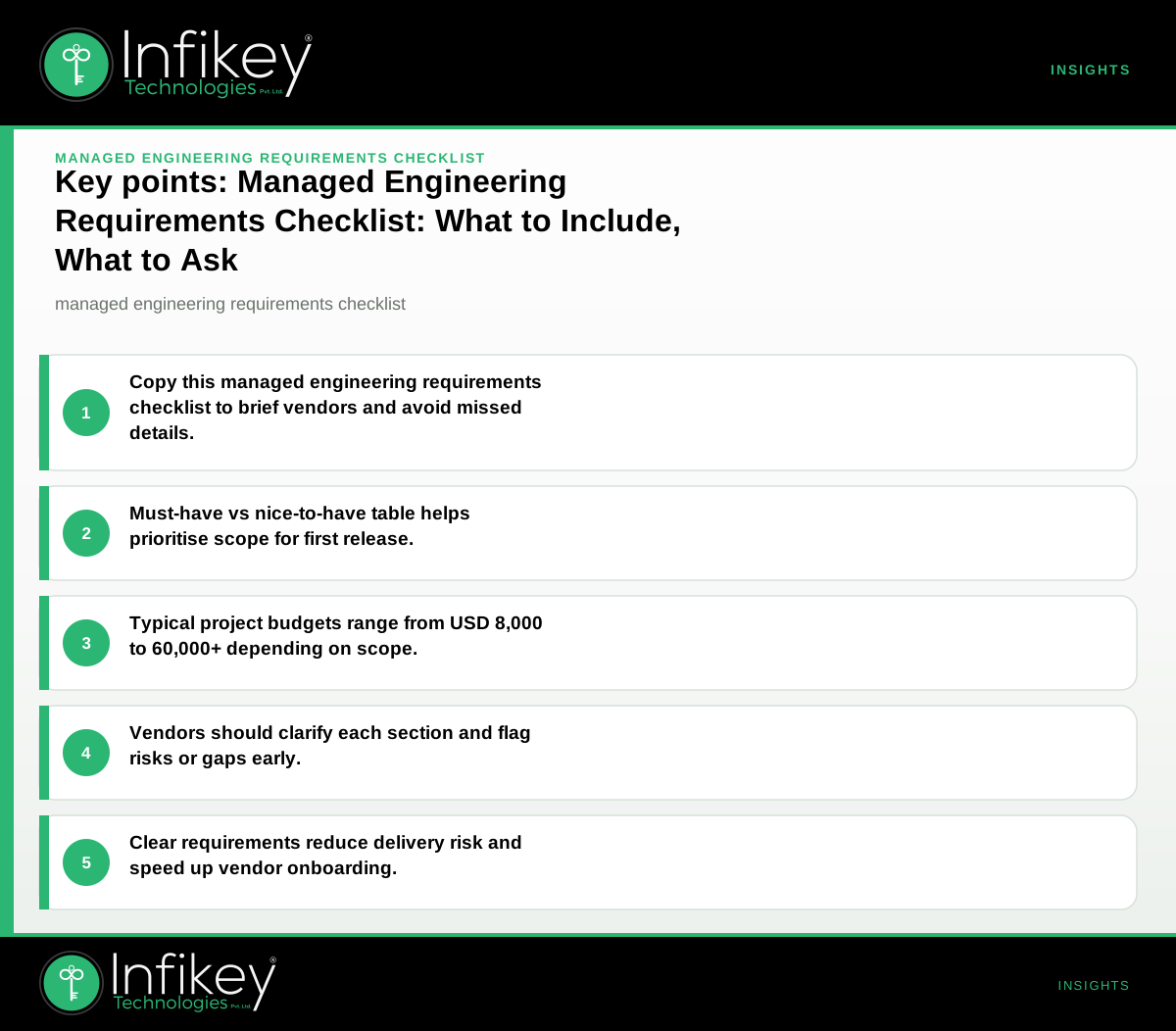
A managed engineering requirements checklist covers all the essential information a business must provide to vendors for accurate proposals, clear delivery, and risk reduction. Use this checklist to brief managed engineering providers, compare responses, and ensure nothing critical is missed—especially when working with remote or international teams.
Managed Engineering Requirements Checklist: Copy and Use
A complete managed engineering requirements checklist is the foundation for successful project delivery. It helps businesses communicate expectations, minimize risk, and streamline the vendor selection process. Whether you are preparing a managed engineering RFP checklist or simply scoping a new initiative, following this structure ensures clarity from day one.
1. Project Goals & Success Criteria
- State the business problem or opportunity the project addresses. For example, are you seeking to automate a manual workflow, improve user experience, or launch a new digital product?
- Define measurable success criteria (e.g., reduce manual steps by 50%, support 10,000 users, achieve 99.9% uptime).
- List key stakeholders and their roles, including decision-makers, technical leads, and end users.
- Specify any non-negotiable outcomes such as compliance requirements, go-live dates, or integration dependencies.
Decision Tip: The more specific your goals and criteria, the easier it is for vendors to propose realistic solutions and for your team to evaluate success post-launch.
2. Scope & Features
- Describe the core features or modules required for the first release. Use your managed engineering scope template to break down requirements into must-have and nice-to-have features.
- Prioritise features as must-have vs nice-to-have. For example, user authentication and reporting may be essential, while advanced analytics can be phased in later.
- Note any integrations (e.g., CRM, payment gateway, ERP, or third-party APIs).
- Identify platforms (web, mobile, desktop) and operating systems to be supported.
- List user roles and permissions needed for secure access and workflow separation.
Pro Tip: A well-defined scope reduces the risk of scope creep and unexpected costs. Use a managed engineering scope template to structure this section for clarity.
3. Technical & Infrastructure
- Preferred technology stack (if any), such as .NET, Node.js, Python, or Flutter.
- Hosting/cloud requirements (e.g., AWS, Azure, on-premises, hybrid cloud).
- Data migration needs, including legacy systems, data formats, and volume.
- API requirements (internal/external), including documentation and security protocols.
- Performance targets (e.g., response time, uptime, scalability expectations).
Checklist Tip: If you are unsure about the tech stack, ask vendors to recommend options based on your requirements and future scalability.
4. Content & Assets
- List content types (text, images, video, documents) and volume.
- Note who provides content (client or vendor). For example, will your team supply all product images, or should the vendor source stock assets?
- Identify branding or design guidelines, including color palettes, logos, and accessibility standards.
- Accessibility requirements (e.g., WCAG compliance, language support).
Best Practice: Early clarity on content ownership and branding prevents delays during design and development phases.
5. Compliance & Security
- List relevant regulations (GDPR, HIPAA, PCI DSS, or local data protection laws).
- Data privacy expectations (storage, retention, encryption, data residency).
- Security requirements (penetration testing, audit logging, role-based access control).
- Required certifications or standards (ISO 27001, SOC 2, etc.).
Security Note: If your project involves sensitive data or operates in regulated industries, flag these requirements upfront. This impacts vendor selection, timeline, and budget.
6. Budget & Commercials
- State your planning budget or expected range. Refer to the managed engineering budget range examples below for realistic ballparks.
- Preferred pricing model (fixed price, time & materials, retainer, or hybrid).
- Payment terms (milestones, monthly, on delivery, or as per contract).
Budgeting Rule: Always provide a budget range, not a single figure. This helps vendors tailor proposals and flag where trade-offs may be necessary.
7. Timeline & Delivery
- Target launch date or key milestones (MVP, pilot, full rollout).
- Phased delivery required? Indicate if you want a minimum viable product (MVP) first, followed by additional releases.
- Availability for project meetings (time zone, hours, preferred communication tools).
- Required documentation (user guides, technical docs, training materials).
Timeline Tip: Be realistic about internal review cycles and dependencies on third-party vendors or teams.
Must-Have vs Nice-to-Have: First Release Table
| Requirement | Must-Have for First Release | Nice-to-Have / Later Phase |
|---|---|---|
| Core user flows | Yes | — |
| Third-party integrations | If critical | If optional |
| Custom branding | Yes | — |
| Advanced analytics | — | Yes |
| Multi-language support | If required | If optional |
| Automated testing | Yes | More later |
| Compliance features | If regulated | If optional |
| API for partners | If needed | If future |
How to Use: This table is a practical managed engineering must-have features checklist. Use it to align stakeholders and set expectations with vendors.
Example: Filled-In Requirements Entry
Project: Internal operations dashboard for a mid-sized logistics company
- Goals: Real-time tracking of shipments, reduce manual updates by 70%
- Scope: Web dashboard, user roles (admin, dispatcher), integration with existing TMS
- Technical: Cloud hosting (AWS), REST API for data sync, uptime >99%
- Content: Vendor to provide UI design, client provides logo and branding
- Compliance: GDPR data handling
- Budget: Planning for USD 25,000–40,000 (final scope after discovery)
- Timeline: 12–16 weeks, MVP in 8 weeks
This example illustrates how to fill out your managed engineering project requirements using the checklist. It also sets a clear baseline for vendor proposals and project planning.
Managed Engineering RFP Checklist: What to Include
When preparing a managed engineering RFP checklist, ensure you cover:
- Executive summary and project background
- Detailed requirements (use the checklist above)
- Evaluation criteria (technical fit, experience, support, price)
- Submission format and deadline
- Contact point for clarifications
RFP Tip: A clear RFP template streamlines vendor comparison and speeds up the selection process. For more on drafting RFPs, see Managed Engineering.
Managed Engineering Scope Template: Structuring Your Requirements
A managed engineering scope template helps you organize requirements for both internal alignment and vendor communication. Key sections include:
- Project overview and objectives
- Functional requirements (features, integrations, user roles)
- Non-functional requirements (performance, security, compliance)
- Deliverables and acceptance criteria
- Project constraints and assumptions
Template Advice: Use bullet points and tables for clarity. Attach diagrams or user journey maps where helpful.
How Vendors Should Respond to Each Section
- Goals & Success: Confirm understanding, suggest clarifications, flag risks or dependencies.
- Scope & Features: Map requirements to deliverables, highlight dependencies, and suggest phased approaches.
- Technical: Recommend technology stack or validate client’s choice, confirm feasibility, and suggest alternatives if needed.
- Content: Specify what is included in the proposal, what is needed from client, and any identified gaps.
- Compliance: Detail approach to security and regulatory needs, note any extra costs or timelines.
- Budget: Provide itemised estimate, clarify inclusions/exclusions, and propose options for cost optimization.
- Timeline: Offer a delivery plan with milestones, state assumptions, and resource allocation model.
Vendor Evaluation Rule: Look for vendors who ask clarifying questions and propose options, not just those who accept requirements at face value.
Planning Budget & Timeline: Example Project Shapes
| Project Type | Scope Summary | Ballpark (USD) | Timeline |
|---|---|---|---|
| Custom web application / portal | Auth, roles, dashboards, integrations | 15,000–60,000+ | 8–20 weeks |
| Mobile app (iOS + Android, Flutter) | MVP: auth, core flows, API, store submission | 12,000–45,000 | 10–18 weeks |
| AI feature on existing product | Scoped use-case, prompt/tools, evaluation | 8,000–35,000 | 6–14 weeks |
Decision rule: If your project is a new web portal with integrations, plan for USD 15,000–60,000+ and 8–20 weeks. Final quote is confirmed after discovery. For Indian projects, typical ranges are INR 12–50 lakh+ for similar scopes.
Managed Engineering Project Requirements: Steps to Prepare
- Gather input from all stakeholders—business, IT, compliance, and end users.
- Use the checklist and scope template to draft requirements.
- Prioritise features and clarify must-have vs nice-to-have.
- Define your managed engineering budget range and timeline.
- Review with internal teams before sharing with vendors.
- Use the managed engineering RFP checklist for formal vendor selection.
Preparation Tip: Early alignment reduces rework and accelerates vendor onboarding.
Managed Engineering Requirements Checklist: Quick Questions
- What is the single most important outcome?
- Which features are essential for launch?
- Are there any hard compliance or security requirements?
- What is your planning budget and timeline?
- Who will provide content and assets?
- What is the preferred way to communicate and share updates?
- What are the key risks or unknowns?
- Are there internal deadlines or dependencies to consider?
For a full managed engineering engagement, use this checklist to brief providers like Infikey Technologies and compare responses. For help scoping your project, [[contact Infikey]({{contact](/contact))}} for a requirements review.
Why Choose Infikey for Managed Engineering?
Infikey Technologies Pvt. Ltd., based in Ahmedabad and serving the Global, delivers managed engineering services that cover the full project lifecycle—from requirements gathering to delivery and support. Our experience spans industries including financial services, healthcare, retail, manufacturing, technology, education, logistics, energy, public sector, startups, professional services, and media. Explore our Managed Engineering page for more details or talk to Infikey about your next project.