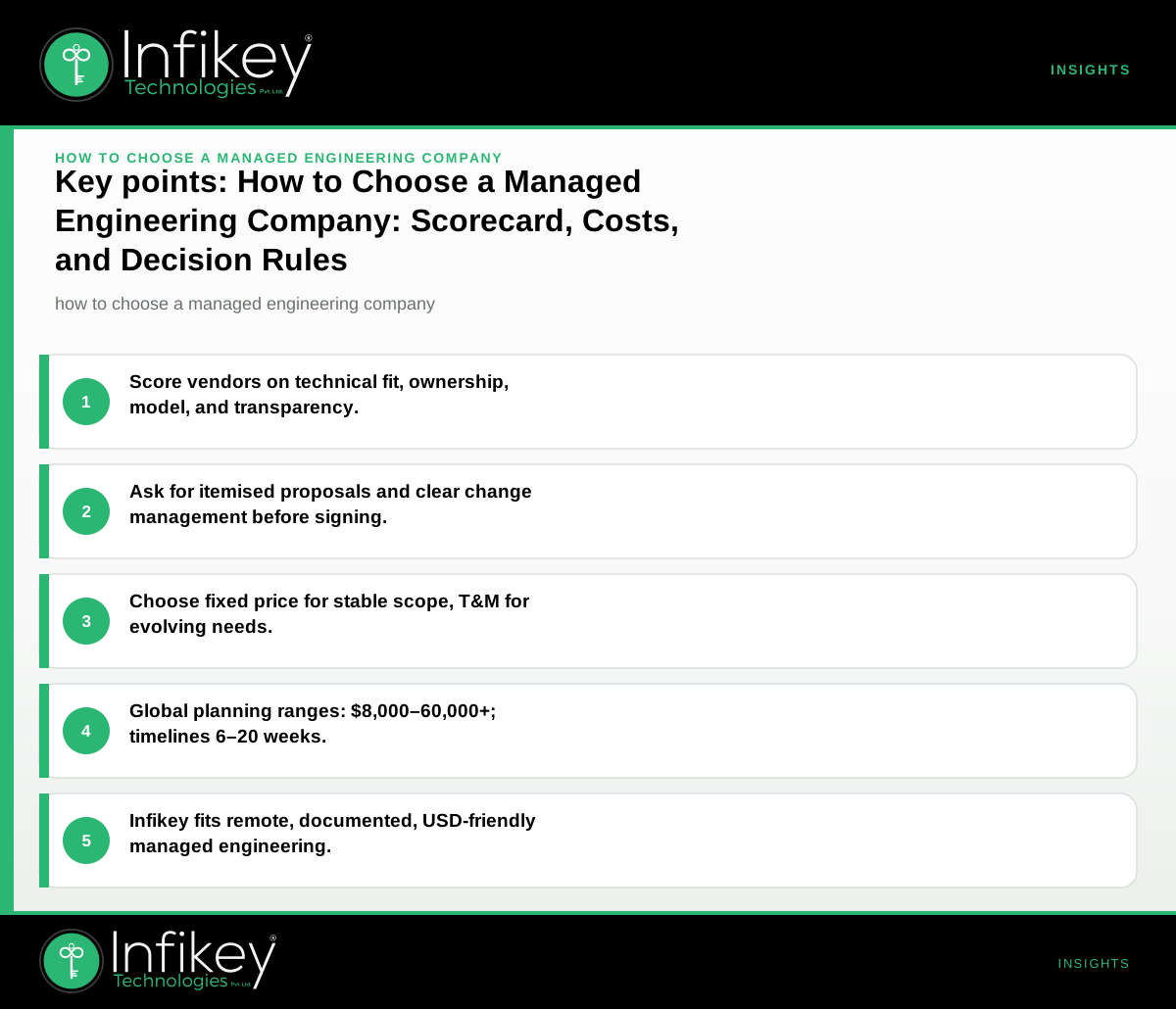
Choosing a managed engineering company comes down to four essentials: proven technical capability, clear ownership and communication, a delivery model that fits your risk/budget, and transparency on costs and documentation. To choose well, score each vendor against these, verify claims, and use concrete decision rules to avoid costly mistakes.
What is a Managed Engineering Company?
A managed engineering company is a technology partner that takes full responsibility for delivering your digital products, platforms, or features—handling everything from planning and architecture to development, deployment, and ongoing support. Unlike staff augmentation or freelance models, a managed engineering agency provides end-to-end ownership, structured processes, and predictable outcomes. This makes it a preferred choice for organizations seeking reduced risk, clear accountability, and scalable technical capacity.
Scorecard: Compare Managed Engineering Companies Side by Side
| Criterion | What Good Looks Like | How to Verify | Weight |
|---|---|---|---|
| Technical expertise | Demonstrated delivery of similar solutions, up-to-date stack, certifications | Review case studies, ask for team CVs, technical Q&A | 30% |
| Communication & ownership | Single point of contact, proactive updates, clear escalation path | Request sample status reports, meet delivery lead | 25% |
| Delivery model fit | Engagement model matches your budget and risk appetite | Walk through scenarios, check contract flexibility | 25% |
| Transparency | Clear, itemised proposal with assumptions, timeline, and change process | Review proposal, ask about change management | 20% |
Tip: Weightings can be adjusted based on your project’s priorities.
Questions to Ask on Your First Call
- What similar projects have you delivered, and can you walk us through one?
- Who will be my main point of contact, and how often will we get progress updates?
- Which engagement models do you offer, and which do you recommend for our scope?
- How do you handle changes in requirements or scope during delivery?
- What documentation and handover do we receive at project close?
- Can you provide a sample proposal or contract for review?
- What is your approach to security, compliance, and data privacy?
- How do you onboard new clients and transition from discovery to delivery?
- Can you share references from similar industries or project types?
Red Flags: When to End the Conversation
- Vague or generic answers about delivery process or technical stack.
- No direct access to a delivery lead or unclear escalation path.
- Reluctance to share sample proposals, contracts, or documentation standards.
- Overpromising on timeline or cost without discovery.
- No itemised pricing or unclear change management process.
- Inflexible engagement models or unwillingness to adapt to your needs.
- Lack of clarity on intellectual property, code ownership, or exit process.
Engagement Models: Which to Choose and Why
| Model | Best For | Risk (Client) | Budget Control |
|---|---|---|---|
| Fixed Price | Well-defined scope, minimal change expected | Low (scope risk) | High |
| Time & Materials | Evolving requirements, discovery still ongoing | Medium (cost risk) | Medium |
| Dedicated Team | Long-term, flexible needs, ongoing roadmap | High (utilisation) | Low–Medium |
Decision rule: If your requirements are stable and detailed, fixed price is safest. For evolving or uncertain projects, time & materials gives flexibility. Dedicated teams suit ongoing product work but require strong oversight.
Managed Engineering Agency Pricing: What to Expect
Pricing for managed engineering services depends on several factors:
- Project complexity: More integrations, custom features, or regulated industries increase cost.
- Team composition: Seniority, skill mix, and location of the engineering team impact rates.
- Engagement model: Fixed price offers predictability; time & materials provides flexibility but can vary month-to-month. Dedicated teams are typically billed monthly.
- Support and maintenance: Ongoing support, SLAs, and post-launch enhancements may be included or separate.
Typical Managed Engineering Cost Ranges
For planning, here are typical managed engineering project shapes with USD ballparks (final quotes follow detailed discovery):
| Project Type | Scope Summary | Ballpark (USD) | Timeline |
|---|---|---|---|
| Custom web application / portal | Auth, roles, dashboards, integrations, staging+prod | $15,000–60,000+ | 8–20 weeks |
| Mobile app (iOS + Android) | MVP: auth, core flows, API, store submission | $12,000–45,000 | 10–18 weeks |
| AI feature on existing product | Use-case, prompts/tools, evaluation, launch | $8,000–35,000 | 6–14 weeks |
These are planning ranges for global buyers; final scope and commercials are confirmed after discovery. For India-based projects, INR equivalents are available, and billing models can be tailored to your market.
How to Choose a Managed Engineering Company: Step-by-Step
- Define your goals and constraints. Clarify what success looks like, your timeline, and your budget ceiling.
- Shortlist companies with relevant experience. Look for a managed engineering company with case studies in your industry or technology stack. For example, Infikey Technologies Pvt. Ltd. has delivered projects in financial services, healthcare, retail, manufacturing, and more.
- Use the scorecard. Rate each vendor on technical expertise, communication, delivery model fit, and transparency.
- Request detailed proposals. Insist on itemised pricing, clear scope, and a documented change management process.
- Interview the delivery lead. This person will be your main contact—ensure they are proactive, experienced, and responsive.
- Check references and documentation samples. Ask for anonymized project summaries, sample status reports, and contract templates.
- Compare managed engineering agency pricing and cost models. Evaluate not just the headline price, but also how changes, support, and handover are handled.
- Align on engagement model. Choose fixed price for certainty, time & materials for flexibility, or a dedicated team for ongoing needs.
- Clarify support and exit terms. Ensure you understand handover, documentation, and intellectual property rights.
What a Good Proposal Must Include
- Clear scope of work, deliverables, and exclusions
- Timeline with milestones and dependencies
- Itemised pricing in your preferred currency (USD, EUR, GBP, INR)
- Engagement model and contract terms
- Change management process and rates
- Team structure, roles, and escalation contacts
- Documentation, handover, and support commitments
If any of these are missing, request clarification before proceeding.
Example Project Shapes and Budget Ranges
For planning, here are typical managed engineering project shapes with USD ballparks (final quotes follow detailed discovery):
| Project Type | Scope Summary | Ballpark (USD) | Timeline |
|---|---|---|---|
| Custom web application / portal | Auth, roles, dashboards, integrations, staging+prod | $15,000–60,000+ | 8–20 weeks |
| Mobile app (iOS + Android) | MVP: auth, core flows, API, store submission | $12,000–45,000 | 10–18 weeks |
| AI feature on existing product | Use-case, prompts/tools, evaluation, launch | $8,000–35,000 | 6–14 weeks |
These are planning ranges for global buyers; final scope and commercials are confirmed after discovery.
Managed Engineering Company Global: What to Look For
When you hire a managed engineering company with global delivery capability, consider:
- Timezone overlap: Ensure working hours support collaboration across regions.
- Cultural fit: The best managed engineering agency will adapt to your communication style and business culture.
- Security and compliance: For industries like financial services or healthcare, global providers must meet regional data privacy and compliance requirements.
- Scalability: A managed engineering company global in reach can scale teams up or down as your needs evolve.
Infikey Technologies Pvt. Ltd., based in Ahmedabad, operates globally with delivery centers and clients across multiple continents. Our experience spans industries such as financial services, healthcare, retail, manufacturing, and technology, ensuring we understand both local and international delivery nuances.
Why Infikey for Managed Engineering?
[Infikey Technologies](/) delivers managed engineering for web, mobile, AI, cloud, and more, with remote teams experienced in global delivery. We are a fit if you need:
- Transparent proposals with itemised costs and clear documentation
- A single point of contact and regular, proactive communication
- Flexible engagement models (fixed price, T&M, or dedicated team)
- USD-friendly billing, and documentation suitable for non-technical sponsors
- Experience across sectors including financial services, healthcare, retail, manufacturing, technology, and more
We may not be right if you require:
- On-site-only delivery in a restricted geography
- Ultra-low-budget, one-off tasks with no ongoing relationship
- Niche technology stacks outside our published expertise
See our Managed engineering service for details, or talk to Infikey about your project.
Next Steps: Shortlisting and Decision
Ready to shortlist? Use the scorecard, questions, and proposal checklist above to compare vendors. For a transparent proposal and a delivery model that fits your risk and budget, see Managed engineering or [[Contact Infikey]({{contact](/contact))}}.