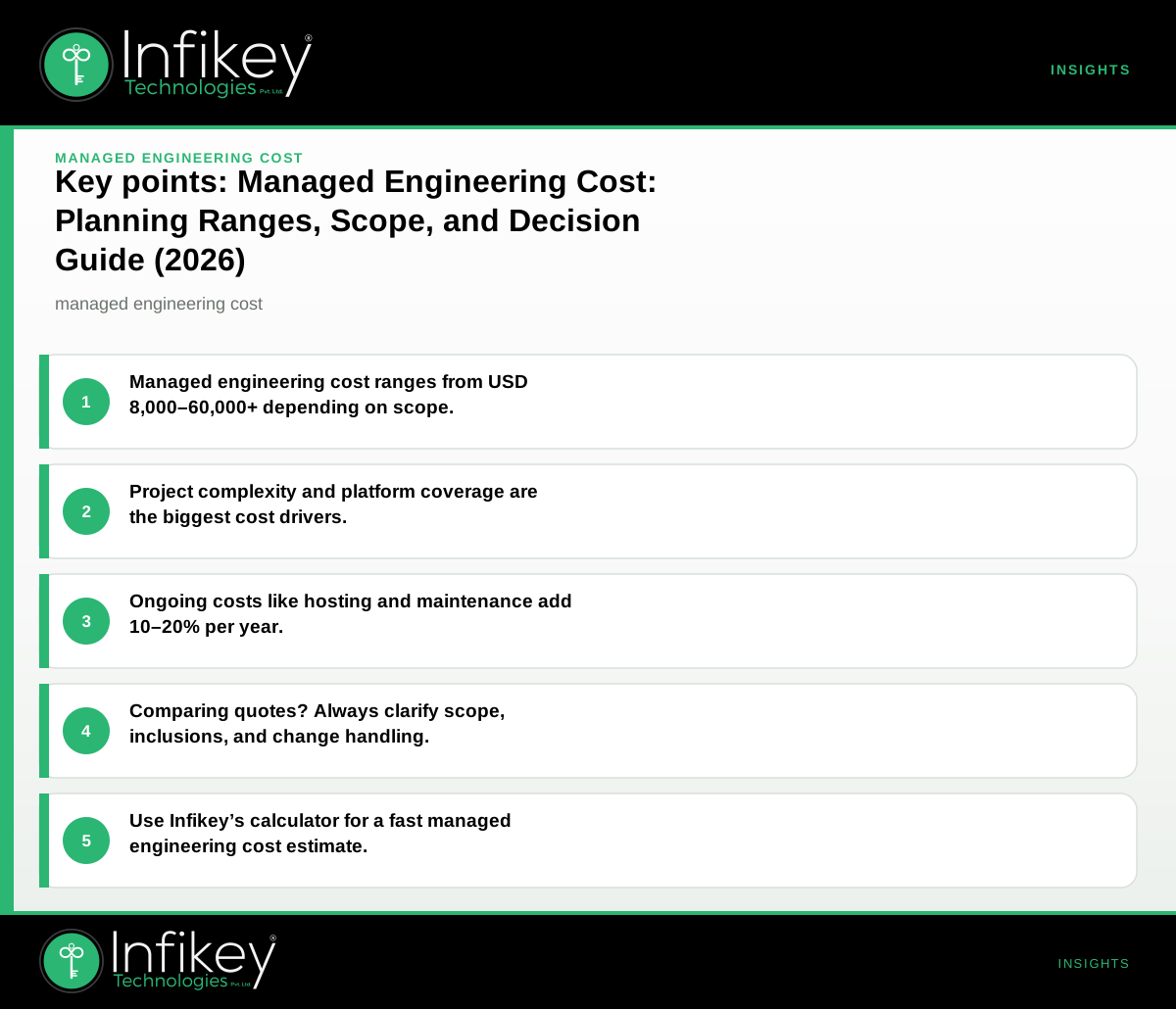
The managed engineering cost for a typical project with [Infikey Technologies](/) falls in these planning ranges: USD 8,000–60,000+ depending on scope, with timelines from 6 to 20 weeks. The biggest single factor affecting cost is the complexity and breadth of your requirements—more features, integrations, or platforms mean higher investment.
Managed Engineering Cost by Scope: Table of Planning Ranges
| Scope Tier | What is Included | Planning Range (USD) | Typical Timeline |
|---|---|---|---|
| AI feature on existing product | Scoped use-case, prompts/tools, evaluation, launch | 8,000–35,000 | 6–14 weeks |
| Mobile app (iOS + Android) | MVP: auth, core flows, API, store submission | 12,000–45,000 | 10–18 weeks |
| Custom web application / portal | Auth, roles, dashboards, integrations, staging + production | 15,000–60,000+ | 8–20 weeks |
*All figures are planning ballparks. Final pricing is confirmed after discovery and detailed scoping.*
What Drives Managed Engineering Cost Up or Down?
- Project Complexity: More features, advanced user roles, or custom integrations increase cost. A focused MVP or single workflow keeps costs lower.
- Platform Coverage: Building for web, iOS, and Android together is more expensive than a single platform.
- Third-party Integrations: Connecting to external APIs, payment gateways, or legacy systems adds effort and risk.
- Design and UX Requirements: Custom UI/UX, branding, or accessibility compliance can add to the budget.
- Security and Compliance: Regulated industries (finance, healthcare) may require extra security, audits, or documentation.
- Delivery Model: Fixed-price projects may include a buffer for risk; time-and-materials can flex but requires clear scope control.
- Change Requests: Frequent changes after sign-off or during build will increase both cost and timeline.
Managed Engineering Pricing Models: What to Expect
When comparing managed engineering pricing, it’s important to understand the two most common engagement models:
- Fixed-Price: You agree on a defined scope and cost upfront. This model is best for projects with clear requirements and minimal expected changes. It includes a risk buffer, so costs may be slightly higher to cover unknowns. It’s ideal when you want predictable managed engineering cost and timeline.
- Time-and-Materials (T&M): You pay for actual hours worked, with more flexibility to adjust scope as you go. This model is well-suited for evolving requirements or when discovery is still in progress. However, costs can rise if the project expands, so it requires close management and transparent reporting from your managed engineering company.
Some clients opt for a hybrid approach: fixed-price for core deliverables, with T&M for enhancements or integrations. Infikey recommends a discovery phase to clarify requirements and select the best pricing model for your needs.
Example Project Shapes and Managed Engineering Cost Ballparks
1. AI Feature Integration
A SaaS provider wants to add a machine learning recommendation engine to their web platform. The engagement covers use-case scoping, prompt engineering, tool selection, evaluation, and launch support.
- Ballpark: USD 8,000–35,000
- Timeline: 6–14 weeks
2. Mobile App MVP
A retail startup needs a cross-platform (iOS + Android) app for customer ordering and loyalty. The scope includes authentication, core user flows, API integration, and store submission.
- Ballpark: USD 12,000–45,000
- Timeline: 10–18 weeks
3. Custom Web Portal for Operations
A mid-market manufacturer requires an internal portal with dashboards, role-based access, and two external integrations (ERP and analytics). The build includes staging and production environments.
- Ballpark: USD 15,000–60,000+
- Timeline: 8–20 weeks
*These are typical managed engineering pricing ranges for Infikey-style projects. Final quotes depend on detailed discovery and scope alignment.*
Managed Engineering Company vs. Freelancers: Why It Matters for Cost
Choosing a managed engineering agency like Infikey versus hiring freelancers affects both cost and outcome. Agencies provide structured processes, dedicated teams, and established delivery practices. This often means a higher upfront managed engineering cost, but with greater predictability, risk management, and long-term support.
Freelancers may offer lower initial rates, but hidden costs can arise from lack of project management, inconsistent quality, or missed deadlines. For regulated industries or complex integrations, a managed engineering company is better equipped to handle compliance, documentation, and security.
How to Hire a Managed Engineering Team: Step-by-Step
- Define Your Objectives: List core business goals, must-have features, and target users.
- Shortlist Agencies: Look for a managed engineering agency with relevant industry experience and transparent pricing.
- Request a Managed Engineering Quote: Share your requirements and ask for a detailed proposal, including scope, timeline, and exclusions.
- Review Project Approach: Assess the agency’s delivery model, communication process, and risk management practices.
- Align on Pricing Model: Decide between fixed-price, T&M, or hybrid based on your project’s clarity and flexibility needs.
- Clarify Support and Handover: Ensure post-launch support, documentation, and knowledge transfer are included.
To discuss your project or hire a managed engineering team, talk to Infikey for a tailored consultation.
Managed Engineering Quote: What Should Be Included?
When you request a managed engineering quote, ensure it covers:
- Detailed Scope: Features, platforms, integrations, and deliverables.
- Timeline: Key milestones and expected delivery dates.
- Pricing Model: Fixed, T&M, or hybrid, with clear payment schedules.
- Assumptions and Exclusions: What’s not included (e.g., content, third-party fees).
- Change Management: How scope changes are handled and billed.
- Support Terms: Duration and extent of post-launch support.
- Risk Factors: Dependencies or uncertainties that could affect cost.
A comprehensive managed engineering quote helps you compare agencies on a like-for-like basis and avoid surprises.
Example: Managed Engineering Cost Breakdown by Phases
A mid-sized company wants a custom web application with dashboards, admin roles, and two external integrations.
Phase 1: Discovery & Design
- Workshops, requirements, UX/UI prototypes
- Ballpark: USD 3,000–8,000 (2–4 weeks)
Phase 2: Core Build
- User auth, roles, dashboard, main workflows, staging environment
- Ballpark: USD 8,000–25,000 (4–8 weeks)
Phase 3: Integrations & Testing
- Connect to two third-party APIs, UAT, security checks
- Ballpark: USD 4,000–12,000 (2–4 weeks)
Phase 4: Launch & Handover
- Production setup, documentation, go-live support
- Ballpark: USD 2,000–5,000 (1–2 weeks)
Total Planning Range: USD 17,000–50,000 (9–18 weeks)
Ongoing and Hidden Costs to Plan For
- Hosting & Infrastructure: Cloud hosting, databases, backups (often USD 50–500/month, depending on scale).
- Licences & APIs: SaaS tools, paid APIs, or platform fees—review these early.
- Maintenance & Support: Bug fixes, updates, security patches (plan 10–20% of build cost per year).
- Change Requests After Launch: New features or regulatory changes are typically billed separately.
How to Lower Managed Engineering Cost Without Sacrificing Quality
- Prioritise Core Features: Start with an MVP; defer nice-to-haves to later phases.
- Limit Platforms: Launch on web or a single mobile OS first if possible.
- Reuse Components: Use proven libraries and frameworks instead of custom-building everything.
- Clear Scope and Sign-off: Invest time upfront in requirements to avoid costly changes later.
- Automate Testing and Deployment: Reduces manual effort and post-launch issues.
Questions to Ask for Comparable Managed Engineering Quotes
- What is included and excluded in the quoted scope?
- Are third-party fees (APIs, hosting, licences) included or estimated separately?
- How are change requests after sign-off handled and billed?
- What is the delivery timeline, and what assumptions is it based on?
- Is post-launch support included, and for how long?
- How will you document handover for a non-technical sponsor?
- What risks or dependencies could affect the cost?
Managed Engineering Agency Services at Infikey
As a global managed engineering agency based in Ahmedabad, Infikey Technologies delivers end-to-end engineering solutions across industries such as financial services, healthcare, retail, manufacturing, technology, and more. Our managed engineering services include:
- Website Development: From corporate sites to complex portals (Website development)
- Mobile App Development: Cross-platform and native apps (Mobile app development)
- Software Engineering: Custom business applications (Software engineering)
- Cloud and Infrastructure: Secure, scalable deployments (Cloud and infrastructure)
- Cybersecurity: Risk assessment, compliance, and protection (Cybersecurity)
- AI and Digital Transformation: Automation and intelligence (AI, Digital transformation)
- Digital Marketing and SEO: Growth and visibility (Digital marketing and SEO)
- Graphics Designing: UI/UX and branding (Graphics designing)
Infikey’s managed engineering team brings structured delivery, transparent pricing, and post-launch support to every engagement. To hire a managed engineering team or request a managed engineering quote, [[contact Infikey]({{contact](/contact))}}.
Estimate Your Managed Engineering Cost Instantly
You can get an initial cost estimate for your managed engineering project using Infikey’s custom software cost calculator. For a tailored proposal, contact our managed engineering team.
---
Ready to take the next step? See how Infikey delivers managed engineering with clear ownership and global delivery. Visit our Managed Engineering service page or contact us for a detailed discussion.