The most expensive managed engineering mistake is unclear ownership—when neither your team nor your provider takes full responsibility for outcomes. To avoid it, define decision rights, escalation paths, and acceptance criteria in writing before work begins. This prevents confusion, delays, and budget overruns.
Table: Managed Engineering Mistakes to Avoid
| Mistake | Why it Happens | What it Costs You | How to Avoid It |
|---|---|---|---|
| Unclear ownership and accountability | Vague contracts, missing RACI, no escalation | Delays, rework, finger-pointing | Document roles, escalation, and acceptance early |
| Incomplete or shifting requirements | Rushed discovery, poor stakeholder input | Scope creep, budget blowouts | Insist on written, signed-off requirements |
| Underestimating integration complexity | Overlooking legacy systems, API gaps | Hidden costs, missed deadlines | Require technical due diligence before start |
| Inadequate documentation | Focus on delivery speed, not maintainability | Hard handovers, support issues | Set documentation as a deliverable |
| Poor communication cadence | No set check-ins, timezone mismatches | Surprises, missed risks | Lock in weekly/biweekly reviews and status notes |
| Lack of clear exit or transition plan | No plan for handover or support | Lock-in, high switching costs | Define exit, IP, and support terms in contract |
Understanding Common Managed Engineering Pitfalls
Many organizations—whether in financial services, healthcare, retail, or technology—encounter similar managed engineering pitfalls during outsourced or hybrid engineering projects. Recognizing these early can save significant time and money.
1. Unclear Ownership and Accountability
This is the root of many managed engineering failures. Without a single point of accountability, decisions stall, deliverables slip, and blame is passed around. To counter this, insist on a RACI (Responsible, Accountable, Consulted, Informed) matrix for every phase and deliverable. Make sure both your internal team and your managed engineering partner sign off on these roles before work begins.
2. Incomplete or Shifting Requirements
A rushed discovery phase or lack of comprehensive stakeholder input leads to incomplete requirements. This is a classic managed engineering project risk—scope creep, missed features, and budget overruns follow. The solution: run structured requirements workshops, capture every assumption in writing, and get sign-off from all business and technical stakeholders. Use change control for any adjustments.
3. Underestimating Integration Complexity
Integration with legacy systems, third-party APIs, or external data sources is often more complex than anticipated. This pitfall leads to hidden costs and missed deadlines. To avoid it, require a technical due diligence phase before finalizing scope. Map out every integration touchpoint, document dependencies, and validate with both your technical team and the provider.
4. Inadequate Documentation
Rushing to deliver features without proper documentation results in painful handovers and support headaches. Make documentation a contractual deliverable, with interim milestones for architecture, process flows, and APIs. Insist on documentation reviews as part of sprint or phase sign-off.
5. Poor Communication Cadence
Lack of regular check-ins or mismatched time zones can cause surprises and missed risks. Establish a fixed communication schedule—weekly or biweekly reviews, with written status notes and risk logs. Use collaborative tools for transparency.
6. Lack of Clear Exit or Transition Plan
Not planning for handover, support, or provider transitions can result in lock-in and high switching costs. Define exit criteria, intellectual property rights, and support terms in the contract from day one.
Early Warning Signs During a Managed Engineering Project
- Repeatedly unclear on who owns a deliverable. If you find yourself asking, “Who is responsible for X?” more than once, ownership is not defined.
- Key requirements are ‘to be confirmed’ weeks into the project. This signals discovery was rushed or stakeholders are not aligned.
- Integration or data migration tasks are glossed over. If the provider cannot explain how systems will connect, expect hidden costs.
- Project updates are inconsistent or skip critical risks. Missed check-ins or vague status reports mean issues may be hidden.
- Documentation is always ‘coming soon’. If you cannot see architecture, process, or API documentation by mid-project, support and handover will be painful.
Prevention Checklist: Managed Engineering Mistakes to Avoid
- [ ] Assign clear owners for every deliverable and decision.
- [ ] Insist on a written, signed-off requirements document.
- [ ] Require a technical due diligence phase for integrations.
- [ ] Make documentation a contractual deliverable.
- [ ] Set a fixed communication schedule (weekly or biweekly).
- [ ] Define exit, IP, and support terms up front.
Managed Engineering Best Practices for Project Success
Following best practices is the most reliable way to avoid common managed engineering pitfalls and ensure project outcomes. Here are actionable steps:
Establish Clear Governance
- Use a RACI matrix for every phase.
- Assign a single point of contact from both your organization and your managed engineering provider.
- Set up escalation paths for issues that cannot be resolved at the team level.
Prioritize Requirements Management
- Run structured workshops to gather requirements.
- Document every requirement, assumption, and constraint.
- Use version control for requirements documents and change logs.
Insist on Technical Due Diligence
- Map all integrations and dependencies before finalizing scope.
- Validate technical feasibility with both internal and provider architects.
- Identify potential bottlenecks or risks early.
Make Documentation a Deliverable
- Define documentation standards (architecture, process, API, user guides).
- Review and approve documentation at each milestone.
- Ensure documentation is updated as the solution evolves.
Lock in a Communication Rhythm
- Schedule regular status meetings.
- Use collaborative tools for sharing updates, risks, and decisions.
- Maintain a transparent risk log accessible to all stakeholders.
Plan for Transition and Support
- Define handover criteria and support terms in the contract.
- Ensure all documentation and credentials are transferred at project close.
- Include knowledge transfer sessions in the project plan.
Managed Engineering Project Risks: What to Watch For
Every managed engineering engagement carries risks, but proactive management reduces their impact. Key risks include:
- Scope Creep: Uncontrolled changes to requirements, leading to budget and timeline overruns.
- Integration Failures: Incompatible systems or missing APIs causing delays.
- Resource Turnover: Changes in key personnel on either side disrupting continuity.
- Vendor Lock-In: Lack of exit planning making it hard to switch providers or bring work in-house.
- Budget Overruns: Underestimated effort or hidden costs surfacing late in the project.
Mitigate these risks by:
- Insisting on detailed requirements and technical due diligence.
- Setting clear change control processes.
- Including transition planning and documentation as deliverables.
- Using ballpark budgets and timelines for realistic planning.
How to Avoid Managed Engineering Failures: Step-by-Step
- Start with Discovery and Alignment
- Run stakeholder workshops to gather requirements and expectations. - Align on project goals, constraints, and success metrics.
- Define Roles and Responsibilities
- Create a RACI matrix for each deliverable. - Assign escalation paths and decision rights.
- Document Requirements and Scope
- Capture every requirement in writing. - Get sign-off from all stakeholders before development begins.
- Conduct Technical Due Diligence
- Map integration points, data flows, and dependencies. - Validate with technical leads from both sides.
- Set Up Communication and Reporting
- Lock in a schedule for progress reviews and risk updates. - Use collaborative tools for transparency.
- Make Documentation and Handover Part of the Contract
- Define what documentation will be delivered, and when. - Plan for knowledge transfer and support.
- Monitor and Adapt
- Watch for early warning signs (unclear ownership, missing documentation). - Adjust processes as needed to stay on track.
Managed Engineering Budgeting: Planning for Success
Budgeting is a critical part of managed engineering best practices. Underestimating costs is a common managed engineering pitfall. Use ballpark ranges to set realistic expectations and avoid surprises.
Example Project Shapes and Budget Ranges
On projects like these, we typically see the following planning ranges (final scope and commercials are confirmed after discovery):
| Project Type | Scope Summary | Ballpark (USD) | Timeline |
|---|---|---|---|
| Custom web application / portal | Auth, dashboards, integrations | USD 15,000–60,000+ | 8–20 weeks |
| Mobile app (iOS + Android) | MVP, core flows, API, store submission | USD 12,000–45,000 | 10–18 weeks |
| AI feature on existing product | Scoped use-case, evaluation, launch | USD 8,000–35,000 | 6–14 weeks |
These ranges are for global buyers working with Infikey Technologies Pvt. Ltd. via remote delivery, with documentation and decision points suitable for non-technical sponsors. Always confirm final scope and commercials after a discovery phase. For India-based buyers, INR planning ranges are available on request.
Budgeting Tips
- Use ballparks as planning guides, not fixed quotes.
- Include contingency for scope changes and integration surprises.
- Budget for documentation, handover, and support—not just build.
- Confirm commercials only after technical due diligence and requirements sign-off.
Questions to Ask Before You Sign
- Who is the single point of accountability for each deliverable?
- How will requirements be documented, approved, and changed?
- What technical due diligence will you perform before starting integration?
- What documentation will be delivered, and when?
- How often will we review progress, and what will be reported?
- What happens if we need to transition support or switch providers?
- How are budget overruns or scope changes handled?
- What are the exit and IP terms?
Managed Engineering Mistakes to Avoid: Key Takeaways
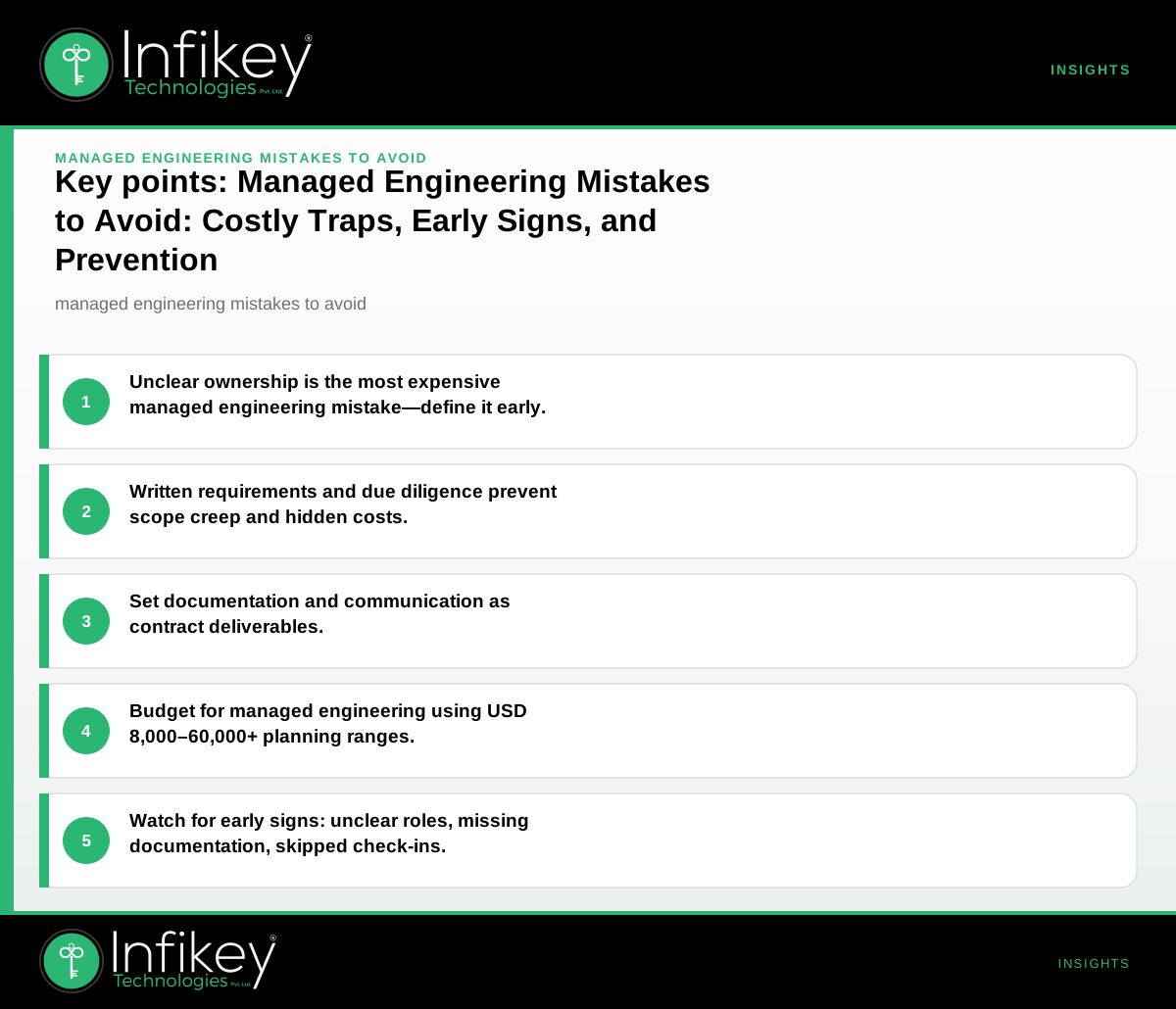
- Unclear ownership is the costliest managed engineering mistake—fix it before you start.
- Insist on written requirements and technical due diligence to prevent scope creep.
- Set documentation and communication as contractual deliverables.
- Use planning ranges (USD 8,000–60,000+) to budget realistically for global managed engineering projects.
- Early warning signs: unclear roles, missing documentation, and skipped check-ins.
- Proactively manage integration, handover, and support to avoid common managed engineering pitfalls.
For international buyers, Infikey Technologies Pvt. Ltd. provides remote managed engineering with clear ownership, USD-friendly ballparks, and documentation that non-technical sponsors can approve. See our Managed engineering service for details, or contact us to discuss your project and avoid these mistakes.