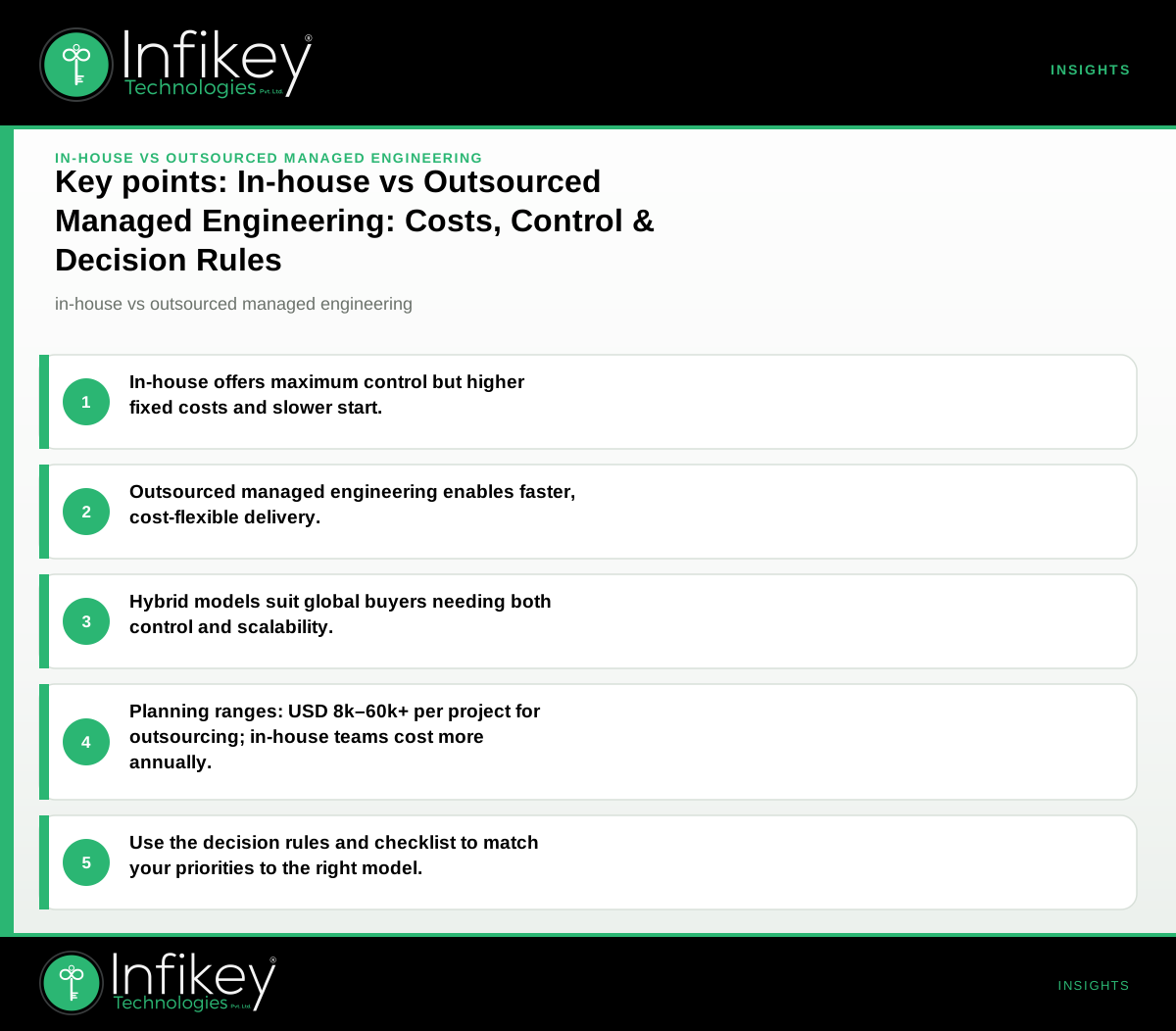
Choosing between in-house and outsourced managed engineering hinges on your need for control, speed, and cost efficiency. In-house suits firms needing tight oversight and long-term teams; outsourcing fits those seeking rapid delivery, cost flexibility, and proven processes. Hybrid models can offer the best of both, especially for global buyers with shifting priorities.
Comparison Table: In-house vs Outsourced Managed Engineering
| Option | Cost (USD, planning range) | Speed to Start | Control Level | Risk Profile | Best For |
|---|---|---|---|---|---|
| In-house | $150k–$400k+/year (team) | Slow | High | Talent, overhead | Regulated, IP-sensitive, large orgs |
| Outsourced Managed | $8k–$60k+/project | Fast | Moderate | Delivery, vendor | Fast launches, cost-sensitive, scaling quickly |
| Hybrid | Mix of above | Medium | Medium-High | Integration | Complex/global, phased transitions |
Note: Outsourced ranges reflect Infikey's typical managed engineering planning ballparks for custom web/mobile projects (see below for examples).
Decision Rules: Choose In-house or Outsourced Managed Engineering If…
- Choose In-house if:
- You require full control over staff, process, and IP. - Regulatory or data residency rules restrict third-party access. - You have ongoing, high-volume engineering needs. - Budget for recruitment, retention, and infrastructure is available.
- Choose Outsourced Managed if:
- You need to deliver quickly without building internal teams. - Predictable costs and clear deliverables are a priority. - You want access to specialised skills not present internally. - Scaling up or down is likely over time.
- Choose Hybrid if:
- You want to keep core IP or product management in-house but need delivery scale. - Project phases require different team compositions. - You operate across regions or time zones.
Cost Comparison: Planning Ranges for Managed Engineering
On projects like custom web applications, mobile apps, or AI features, here’s how ballpark costs compare:
- In-house team:
- For a typical 3–5 person engineering team (developers, QA, PM), annual costs (salary + benefits + overhead) often reach USD 150,000–400,000+. - Add recruitment, onboarding, and ongoing management time.
- Outsourced managed engineering (Infikey planning ranges):
- Custom web application/portal: USD 15,000–60,000+; 8–20 weeks - Mobile app (iOS+Android): USD 12,000–45,000; 10–18 weeks - AI feature on existing product: USD 8,000–35,000; 6–14 weeks - Final scope and commercials are confirmed after discovery.
- Hybrid:
- Combine internal product owners/architects with outsourced delivery pods. Budget for core staff + managed engagements.
For a detailed estimate, try the Offshore team vs in-house cost calculator.
Which Option Is Faster to Start?
- Outsourced managed engineering typically enables project kickoff within 2–4 weeks after contract, leveraging ready teams and frameworks.
- In-house hiring and onboarding can take 2–6 months, especially for global or specialised roles.
- Hybrid models can accelerate delivery by pairing a small internal lead group with outsourced squads.
Control, Risk, and Documentation: What to Expect
- In-house: Maximum control over process, security, and team culture. Risks include attrition, recruitment delays, and higher fixed costs.
- Outsourced: Control via contracts, SLAs, and documentation. Risks shift to vendor performance and integration. On Infikey projects, we provide detailed specs, weekly reporting, and clear handover.
- Hybrid: Retain oversight of core decisions, outsource execution. Useful for regulated industries or where internal product ownership is critical.
Example Project Shapes and Planning Ranges
Here are three typical managed engineering scenarios with ballpark costs and timelines:
| Project Shape | Planning Range (USD) | Timeline |
|---|---|---|
| Mid-market retailer: custom catalogue portal | $15,000–60,000+ | 8–20 weeks |
| SaaS startup: mobile MVP (iOS+Android) | $12,000–45,000 | 10–18 weeks |
| Healthcare provider: AI scheduling feature | $8,000–35,000 | 6–14 weeks |
All figures are planning ranges; final commercials are confirmed after a discovery phase.
When Hybrid Approaches Make Sense
Hybrid models—where some functions stay in-house and others are outsourced—work best when:
- You want to keep product management or architecture internal, but outsource build and test.
- You’re phasing out legacy systems and need both support and new builds running in parallel.
- You operate globally and need a blend of local compliance and offshore delivery.
On Infikey projects, hybrid teams often pair a client-side product owner with our managed engineering squads for delivery and support. This balances control, speed, and cost.
Checklist: Questions to Decide In-house vs Outsourced Managed Engineering
- What is your required speed to launch? (Weeks or months?)
- How critical is direct team control and IP ownership?
- Are there regulatory or compliance constraints on outsourcing?
- What is your available budget for engineering (annual or per project)?
- Do you have access to the required technical skills internally?
- How variable is your demand for engineering capacity?
- Who will own documentation, handover, and ongoing support?
If you answer "need speed, flexible budget, and skills not in-house," managed outsourcing is likely the better fit. If "control, compliance, and long-term team" are your priorities, in-house or hybrid is safer.
Next Steps: Get Clarity on Your Managed Engineering Options
If you’re weighing in-house vs outsourced managed engineering, start by mapping your must-haves against the table and checklist above. For a tailored planning range and delivery model, contact Infikey or explore our Managed engineering service page.