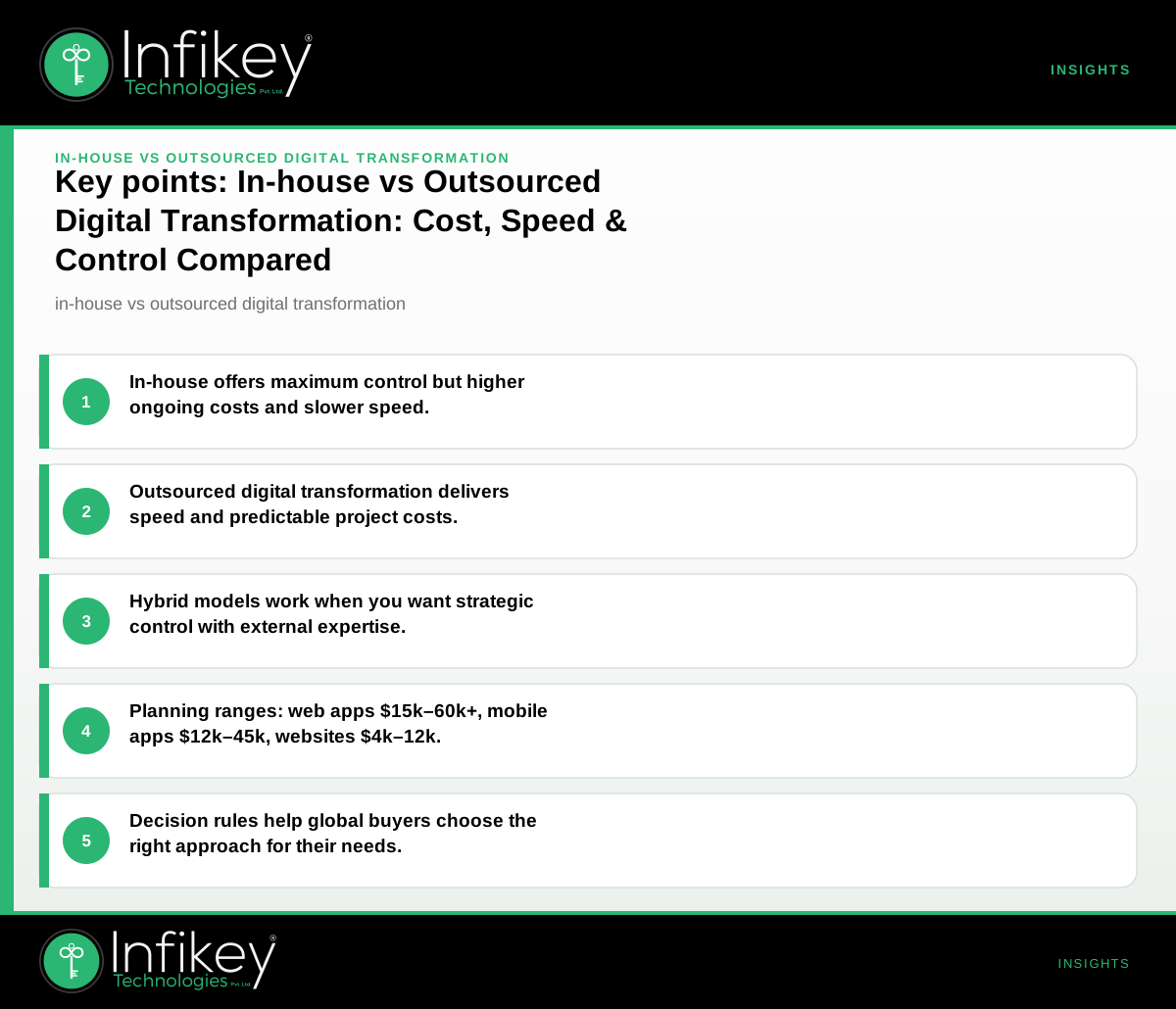
Choosing between in-house vs outsourced digital transformation comes down to your priorities: in-house suits organisations with strong digital talent and a need for tight control, while outsourcing is best for speed, access to expertise, and predictable costs—especially when internal capacity is limited or time-to-market matters.
In-house vs Outsourced Digital Transformation: At-a-Glance Comparison
| Option | Cost (planning range) | Speed | Control | Risk | Best for |
|---|---|---|---|---|---|
| In-house | High (ongoing salaries, infra) | Slow–Medium | Maximum | Talent, delivery | Firms with mature IT, long-term needs |
| Outsourced | Predictable (project-based) | Fast–Medium | Shared | Vendor, IP | Fast change, limited internal capability |
How to use this table:
- If you need maximum control and already have a strong digital team, in-house may fit.
- If you need speed, expertise, and cost certainty, outsourcing is usually more effective.
Decision Rules: When to Choose Each Approach
Choose in-house if:
- You have (or can attract) digital talent and leadership.
- You want to build long-term internal capability.
- Data sensitivity or compliance requires strict internal control.
- You are prepared for higher up-front and ongoing costs.
Choose outsourced if:
- You need to deliver results quickly.
- Internal bandwidth or expertise is lacking.
- Predictable, project-based budgets are important.
- You want to access specialist skills or proven frameworks.
- You’re open to remote or global delivery models.
Cost Comparison: Planning Ranges for Digital Transformation Projects
Project costs vary by scope, but here are typical planning ranges for global buyers working with a partner like Infikey Technologies Pvt. Ltd. (final scope and commercials are always confirmed after discovery):
| Project Type | Outsourced Ballpark (USD) | In-house Cost Factors |
|---|---|---|
| Marketing website (8–15 pages) | $4,000–12,000 | Team salaries, design, infra, tools |
| Custom web application / portal | $15,000–60,000+ | Full-stack devs, PM, QA, infra, overhead |
| Mobile app (iOS + Android, MVP) | $12,000–45,000 | App devs, backend, infra, app stores |
Outsourced costs are project-based and predictable. In-house costs are ongoing and include recruitment, salaries, benefits, tools, and infrastructure.
For a mid-sized transformation (e.g., a new customer portal), outsourcing typically delivers faster results for a similar or lower total investment, especially if you lack a ready internal team.
Example Project Shapes and Timelines (Outsourced)
On projects like this, we usually see:
- Marketing website: $4,000–12,000, 4–8 weeks
- Custom portal: $15,000–60,000+, 8–20 weeks
- Mobile app MVP: $12,000–45,000, 10–18 weeks
These are planning ranges for global delivery, with documentation and ownership suitable for non-technical sponsors. For a tailored estimate, see our Digital transformation service or use our custom software cost calculator.
Hybrid Approaches: When to Mix In-house and Outsourced
Hybrid models combine in-house leadership with outsourced delivery. This makes sense when:
- You want to retain strategic control but need external delivery muscle.
- Internal teams handle core systems, while partners deliver new apps or integrations.
- You require knowledge transfer and upskilling for long-term self-sufficiency.
Tip: Define clear ownership, documentation standards, and handover plans from the start.
Questions to Ask Before Deciding
- What digital skills and capacity do we have internally?
- How urgent is the transformation? What’s the business impact of delay?
- Are there regulatory or data residency requirements?
- Can we attract and retain the talent needed for in-house delivery?
- What is our risk tolerance for vendor dependency or IP transfer?
Control, Risk, and Global Delivery: What Global Buyers Should Know
For international buyers, remote delivery is standard. Outsourced partners like Infikey Technologies Pvt. Ltd. provide clear documentation, project management, and USD-friendly contracts. Control is shared—define your priorities up front, and insist on transparent reporting, code access, and staged delivery. For regulated industries, clarify compliance and data handling early.
In-house vs Outsourced Digital Transformation: Final Checklist
- Map your internal digital capability and gaps.
- Estimate total cost of ownership (not just project fees).
- Decide if speed or control matters more for this initiative.
- Choose partners with global delivery experience and clear documentation.
- For hybrid models, set clear boundaries and handover plans.
For a clear, scoped proposal or to discuss your digital transformation options, contact Infikey or review our Digital transformation service page.