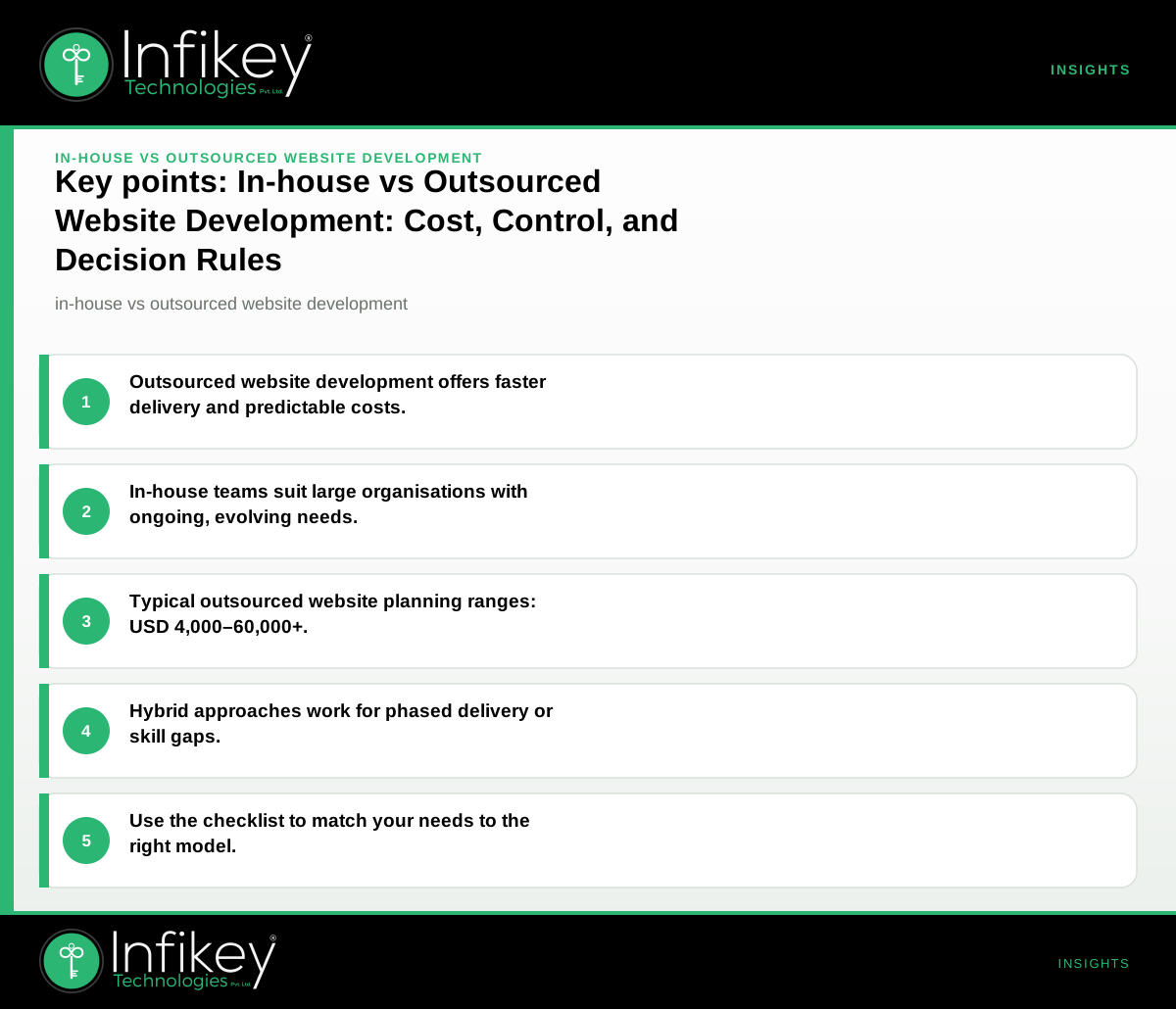
For most businesses, outsourced website development offers faster delivery and broader expertise at a predictable cost, while in-house teams suit organisations needing full control and ongoing iteration. Choose in-house if you have a skilled team and long-term needs; outsource if you want speed, defined budgets, and access to specialist skills.
In-house vs Outsourced Website Development: Direct Comparison Table
| Option | Cost (Planning Range) | Speed | Control | Risk | Best For |
|---|---|---|---|---|---|
| In-house | High, ongoing (salaries, tools) | Slow to medium | Full | Hiring, retention | Large orgs, complex, evolving needs |
| Outsourced | Fixed/project (see below) | Fast to medium | Shared (contract) | Vendor, handover | SMEs, defined scope, rapid launch |
| Hybrid | Mix of both | Varies | Balanced | Integration | Scale-ups, phased builds, skill gaps |
Decision Rules: When to Choose Each Approach
Choose in-house if:
- You have (or can build) a dedicated web team with all required skills.
- The website is core to your business and will change frequently.
- You need absolute control over technology, security, and processes.
Choose outsourced if:
- You want to launch quickly without hiring or training staff.
- The project has a clear scope and timeline.
- You prefer predictable costs and access to a wider talent pool.
Hybrid makes sense if:
- You want your team to own product direction but need external delivery muscle.
- Certain skills (e.g., UX, integrations) are missing internally.
- You plan phased delivery or ongoing support post-launch.
In-house Web Development Pros and Cons
Pros:
- Full control: Direct oversight of priorities, technology stack, and processes.
- Alignment: In-house teams can deeply understand your brand, culture, and evolving needs.
- Immediate access: Quick adjustments and iterations without external dependencies.
- IP retention: All knowledge and code remain within your organisation.
Cons:
- High cost: Salaries, benefits, ongoing training, and software tools add up quickly.
- Recruitment challenges: Sourcing and retaining skilled developers, designers, and project managers can be difficult, especially outside major tech hubs.
- Skill gaps: Hard to cover all specialist areas (e.g., security, SEO, integrations) with a small team.
- Slower start: Building or ramping up an in-house team often delays project kickoff.
Website Development Outsourcing: Advantages and Considerations
Outsourcing website development lets you tap into global talent, accelerate timelines, and keep costs predictable. It’s especially useful for:
- SMEs needing rapid launches.
- Projects with a defined scope and timeline.
- Organisations lacking specialist skills in-house.
Advantages:
- Speed: Established agencies like Infikey Technologies Pvt. Ltd. can mobilise teams quickly and deliver to tight deadlines.
- Expertise: Access to a broad skill set—design, development, QA, SEO, security—without hiring each role.
- Cost efficiency: Pay only for the project scope; no ongoing employment overheads.
- Scalability: Easily adjust team size as project needs change.
Considerations:
- Vendor selection: Quality and reliability vary—vet portfolios, references, and delivery processes.
- Communication: Time zones and remote workflows require clear communication and documentation.
- Handover: Ensure code, assets, and documentation are delivered for future updates or transitions.
Outsourced Website Development Cost: What to Expect
Website development outsourcing costs are typically project-based, with clear milestones and deliverables. At Infikey Technologies Pvt. Ltd., planning ranges for global clients are:
| Project Type | Planning Range (USD) | Typical Timeline |
|---|---|---|
| Marketing website (8–15 pages, CMS) | USD 4,000–12,000 | 4–8 weeks |
| Custom web application / portal | USD 15,000–60,000+ | 8–20 weeks |
- In-house: Factor in annual salaries (developer, designer, PM), benefits, tools, and overheads. Even a small team can exceed USD 100,000/year.
- Outsourced: Pay only for the agreed project scope. No ongoing employment costs.
Final scope and commercials are confirmed after discovery. For a tailored estimate, see Website development or [[Contact Infikey]({{contact](/contact))}}.
Project Examples: What Each Option Looks Like in Practice
- SME launching a marketing site:
- Outsourced to a specialist agency or partner like Infikey Technologies Pvt. Ltd.. - Planning range: USD 4,000–12,000; timeline: 4–8 weeks.
- Enterprise with ongoing platform needs:
- In-house team builds and maintains the site, with possible specialist contractors for spikes. - Annual cost: Salaries + tools; timeline: ongoing.
- Scale-up with phased delivery:
- Hybrid: Internal product owner, outsourced delivery for build, then handover. - Mix of project fee and internal time; timeline: phased.
Example Project Shapes with Ballpark & Timeline
#### Marketing Website for a Mid-Market Retailer
- Scope: 10-page brochure site, CMS, SEO foundations, contact forms.
- Ballpark: USD 4,000–12,000
- Timeline: 4–8 weeks
- Model: Outsourced or hybrid (internal product owner, external delivery)
#### Custom Web Portal for a Healthcare Provider
- Scope: Role-based access, dashboards, integrations, staging + production environments.
- Ballpark: USD 15,000–60,000+
- Timeline: 8–20 weeks
- Model: Hybrid or in-house (with contractors for integrations)
#### Ongoing SEO & Digital Marketing Retainer
- Scope: Technical SEO, content plan, reporting (excludes media spend)
- Ballpark: USD 800–3,000/month
- Timeline: Ongoing; first signals in 8–12 weeks
- Model: Outsourced or hybrid (in-house content, external technical SEO)
Control, Risk, and Documentation: What to Expect
- In-house: You set priorities, choose tech, and control access. Risks: hiring delays, skill gaps, retention.
- Outsourced: Control is managed via contracts, SOWs, and regular reviews. Risks: vendor reliability, handover, IP protection. Require clear documentation and code handover.
- Hybrid: Balance control and flexibility; integration and communication are key.
Hybrid Website Development Team: Best of Both Worlds?
A hybrid website development team combines internal ownership with external expertise. This approach is ideal if:
- Your product vision is clear, but you lack delivery bandwidth.
- You want to bring in specialists for UX, SEO, or integrations.
- You’re phasing delivery (e.g., MVP by partner, scale-up in-house).
- You want to reduce risk by combining internal oversight with external skills.
Infikey Technologies Pvt. Ltd. often collaborates with client teams, providing delivery, documentation, and structured handover. Hybrid models are common in scale-ups and enterprises managing complex builds or ongoing marketing needs.
How to Choose Website Development Model: Step-by-Step
- Define your website’s core purpose: Is it a brochure, portal, or product platform?
- Assess internal capabilities: Do you have design, development, QA, and PM in-house?
- Clarify priorities: Is speed to launch or long-term flexibility more important?
- Set a realistic budget: Consider both upfront and ongoing costs for the next 12 months.
- Plan for support and scaling: Who will handle updates, security, and future enhancements?
- Identify specialist needs: Do you require skills like SEO, security, or third-party integrations?
- Evaluate risk tolerance: Are you comfortable with vendor reliance, or do you prefer total in-house control?
- Consider hybrid options: Would a blend of internal and external resources address your needs?
Checklist: Questions to Decide In-house vs Outsourced Website Development
- What is the core purpose of the website? (Brochure, portal, product?)
- Do you have internal capacity for design, development, QA, and project management?
- Is speed to launch or long-term flexibility more important?
- What is your realistic budget for the next 12 months?
- How will you handle support, updates, and scaling after launch?
- Do you need specialist skills (SEO, security, integrations) not present in-house?
Hybrid Approaches: When Mixing Makes Sense
Hybrid models work well when you want to:
- Own product vision but lack delivery bandwidth.
- Bring in specialists for UX, SEO, or integrations.
- Phase delivery (e.g., MVP by partner, scale-up in-house).
- Reduce risk by combining internal oversight with external expertise.
On projects with complex integrations or ongoing marketing needs, Infikey Technologies Pvt. Ltd. often works alongside client teams to deliver, document, and hand over.
Next Steps: Plan Your Website Development with Confidence
Use these decision rules and cost ranges to clarify your approach. For a planning session or to scope your website, see Website development or Contact Infikey for a tailored estimate and delivery plan.