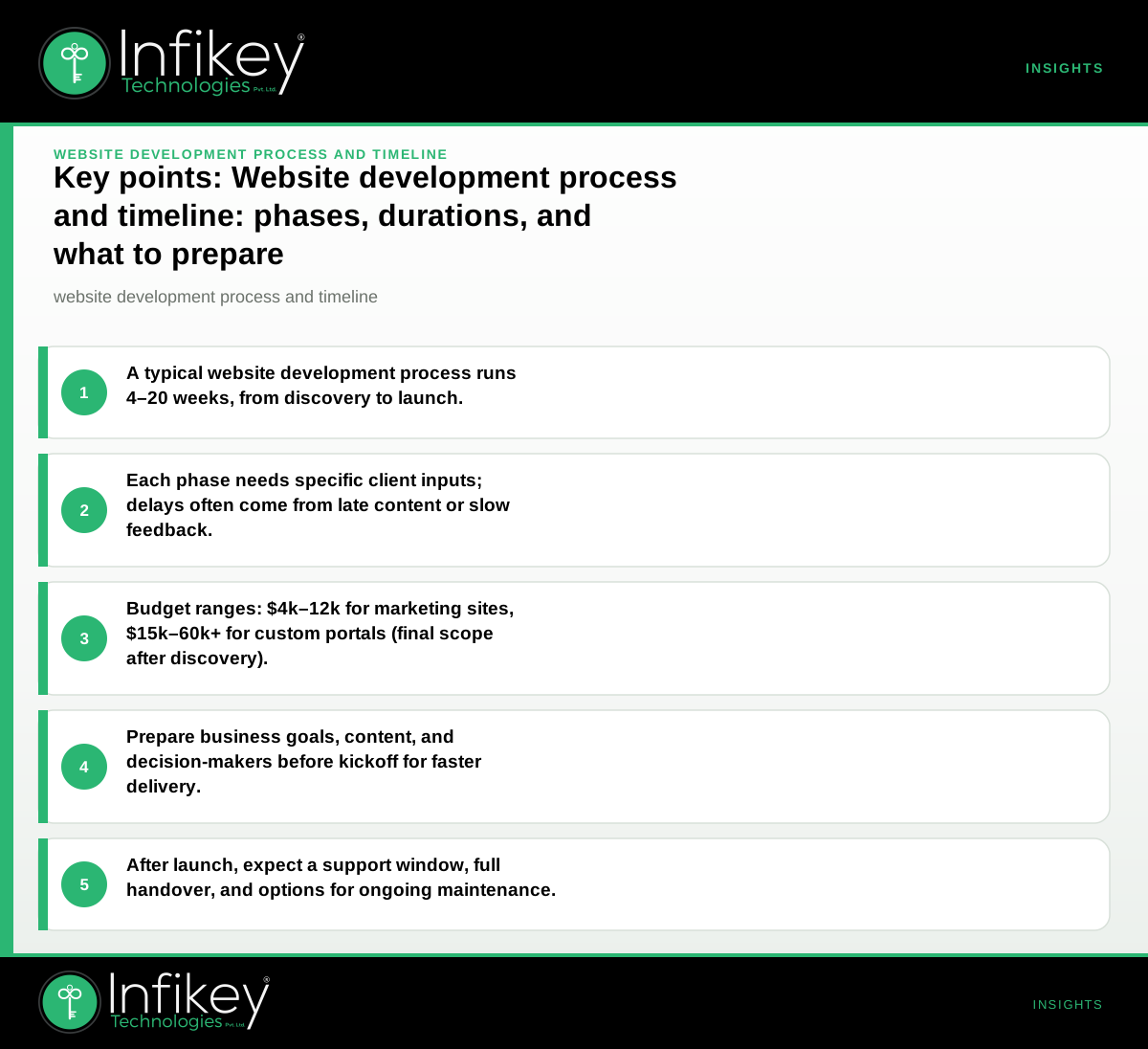
The website development process and timeline usually spans 4–20 weeks, depending on project size and complexity. It includes discovery, design, development, testing, and launch phases. Each phase has clear deliverables and requires specific client inputs. Planning and timely feedback are critical to stay on track and within budget.
Understanding the Website Development Process and Timeline
A well-structured website development process and timeline ensures your project stays on course, delivers value, and meets your business goals. Whether you are building a marketing website, a custom web application, or a portal, understanding each step helps you make informed decisions and avoid common pitfalls. At Infikey Technologies Pvt. Ltd., we guide clients in Ahmedabad and globally through a transparent, collaborative process that balances speed, quality, and flexibility.
Website Development Phases and Typical Durations
The website development process is typically divided into five main phases. Each phase plays a crucial role in shaping the final product and directly impacts the overall website development timeline.
| Phase | What happens | Typical duration | Deliverable | What the client provides |
|---|---|---|---|---|
| Discovery | Goals, scope, requirements, site map, tech choices | 1–2 weeks | Requirements, project plan | Business goals, reference sites, content |
| Design | Wireframes, mockups, UI/UX, branding alignment | 1–3 weeks | Design prototypes | Brand assets, feedback, approvals |
| Development | Coding, CMS setup, integrations, responsive layouts | 2–10 weeks | Staging site, functional modules | Content, user data, integration details |
| Testing & QA | Functional, device, browser, and user acceptance tests | 1–2 weeks | Tested, bug-fixed site | Test cases, review feedback |
| Launch | Go-live, DNS, hosting, final checks | 1–2 days | Live website | Domain, hosting access, launch sign-off |
- Marketing website (8–15 pages): 4–8 weeks
- Custom web application/portal: 8–20 weeks
Final scope and commercials are confirmed after discovery. For global buyers, USD ballparks are standard, and timelines account for remote collaboration and documentation.
Discovery Phase
This phase sets the foundation for the entire project. The team and client collaborate to clarify business objectives, define the project scope, and select the right technologies. Deliverables include a requirements document, a sitemap, and a project plan. The discovery phase is critical to avoid misunderstandings later and to set realistic expectations for the website development timeline.
Design Phase
During design, the focus shifts to user experience and visual identity. Wireframes and mockups are created to visualize page layouts, navigation, and branding. Early feedback and approvals from stakeholders help prevent costly design changes during development. This phase typically lasts 1–3 weeks, depending on the number of unique templates and the speed of feedback cycles.
Development Phase
This is where the website comes to life. Developers build the site based on approved designs, set up the content management system (CMS), and integrate required third-party tools or APIs. Responsive layouts are implemented to ensure the site works on all devices. The development phase is often the longest, especially for custom web applications, and can last from 2 to 10 weeks.
Testing & QA Phase
Thorough testing is essential to deliver a high-quality product. This phase covers functional testing, device and browser compatibility, and user acceptance testing (UAT). Clients are asked to review and sign off on the final product, ensuring it meets requirements before launch. Addressing bugs and making final tweaks usually takes 1–2 weeks.
Launch Phase
The launch process involves final technical checks, DNS updates, hosting setup, and deployment. This phase is typically quick—1–2 days—but requires careful coordination to avoid downtime or issues. Clients provide domain and hosting access, and give final sign-off before the site goes live.
How Long Does Website Development Take?
The answer depends on project type, scope, and client readiness. Here are typical website development timelines for common project shapes at Infikey Technologies Pvt. Ltd.:
- Marketing website (8–15 pages): 4–8 weeks
- Custom web application/portal: 8–20 weeks
- SEO/digital marketing retainer: Ongoing, with first results in 8–12 weeks
Factors that influence the timeline include:
- Number of unique page templates
- Complexity of features (e.g., user logins, dashboards, integrations)
- Volume and readiness of content
- Number of stakeholders and feedback cycles
- Third-party integrations or compliance requirements
For a tailored estimate, try the website cost calculator or talk to Infikey for a detailed project assessment.
Website Project Checklist: What to Prepare Before Kickoff
A comprehensive website project checklist helps ensure a smooth start and minimizes delays. Here’s what you should have ready:
- Clear business objectives and project goals
- List of must-have features and integrations
- Reference websites (what you like/dislike)
- Brand guidelines (logo, colours, fonts)
- Initial content or content plan
- Key decision-makers and their roles
- Access to domain, hosting, and existing platforms
- Budget range and timeline expectations
- Legal or compliance requirements (if any)
- Preferred communication tools and contact points
Having these items ready speeds up discovery, reduces rework, and helps keep the website development process and timeline on track. If you need help scoping, try the website cost calculator for a tailored estimate.
Common Causes of Delays in the Website Development Timeline
Delays can happen, but most are preventable with proactive planning. Here are the most frequent causes and how to avoid them:
- Late content delivery: Assign a content owner early and start content preparation during the design phase.
- Slow feedback cycles: Designate a single point of contact for approvals and feedback to streamline communication.
- Scope changes mid-project: Prioritize must-have features up front and defer nice-to-haves to future phases.
- Unclear requirements: Use detailed discovery workshops and written documentation to clarify expectations.
- Access issues (domains, hosting, APIs): Gather all credentials before development starts.
- Decision bottlenecks: Limit the number of stakeholders in day-to-day reviews and escalate blockers quickly.
On projects like this, we see the fastest progress when the client assigns a project lead empowered to make timely decisions.
Website Launch Process: What to Expect
The website launch process is the culmination of weeks (or months) of work. Here’s what typically happens:
- Final pre-launch review: Double-check content, links, and functionality.
- Technical checks: Verify hosting, SSL certificates, and DNS settings.
- Deployment: Move the site from staging to live servers.
- Go-live: Switch DNS, monitor for issues, and confirm successful launch.
- Immediate support: Address any launch-day issues quickly.
At Infikey Technologies Pvt. Ltd., we provide a hypercare period (usually 1–2 weeks) after launch to resolve any urgent issues and ensure a smooth transition.
What Happens After Launch: Support, Iterations, and Handover
After launch, ongoing support and iteration are key to maximizing your website’s value. Here’s what to expect:
- Hypercare period: Immediate support for any launch issues (typically 1–2 weeks)
- Handover: Delivery of documentation, admin access, and training if needed
- Support/maintenance: Optional retainer for bug fixes, updates, and minor changes
- Iteration: Plan for future improvements based on user feedback and analytics
At Infikey Technologies Pvt. Ltd., we document all admin credentials and provide a support window post-launch. Ongoing support is scoped as a separate engagement, and we recommend scheduling regular check-ins to review analytics and plan enhancements.
Example Project Shapes: Budget and Timeline Ranges
| Project type | Scope summary | Ballpark USD | Typical timeline |
|---|---|---|---|
| Marketing website (8–15 pages) | Design system, CMS, forms, SEO basics | $4,000–12,000 | 4–8 weeks |
| Custom web application/portal | Auth, dashboards, integrations, staging + production | $15,000–60,000+ | 8–20 weeks |
| SEO/digital marketing retainer | Technical SEO, content, reporting (excl. media spend) | $800–3,000/month | Ongoing |
These are planning ranges for typical Infikey engagements. Final scope and commercials are confirmed after discovery. For a precise quote, see Website development or [[contact Infikey]({{contact](/contact))}}.
Decision Rules for a Smooth Website Development Process
- If you need to launch in under 8 weeks, focus on a marketing website with existing content and minimal integrations.
- If your project involves custom workflows or user roles, plan for a custom web application and a longer timeline.
- If your team is new to web projects, invest more time in discovery and documentation.
- If you have strict compliance needs, raise them early to avoid late-stage rework.
Key Questions to Ask Your Website Development Partner
To ensure a successful project, ask your website development partner:
- What is the expected timeline for each phase?
- What do you need from us to start and keep moving?
- How do you handle change requests and scope creep?
- What support is included after launch?
- How will you document and hand over credentials and admin access?
- What is your process for remote collaboration and sign-off?
- How do you ensure quality and security across the website development phases?
- What tools do you use for project management and communication?
Why Choose Infikey Technologies Pvt. Ltd. for Your Website Development Project?
As a global provider based in Ahmedabad, Infikey Technologies Pvt. Ltd. offers end-to-end website development, from discovery to launch and beyond. Our team brings expertise in:
- Website development
- Mobile app development
- Software engineering
- Cloud and infrastructure
- Cybersecurity
- AI
- Digital transformation
- Managed engineering
- Digital marketing and SEO
- Graphics designing
We have delivered projects for clients across industries such as financial services, healthcare, retail, manufacturing, technology, education, logistics, energy, public sector, startups, professional services, and media/hospitality. Our approach emphasizes clear communication, robust documentation, and ongoing support.
Ready to start your website development journey? Review the Website development service or Contact Infikey for a tailored proposal and timeline.