
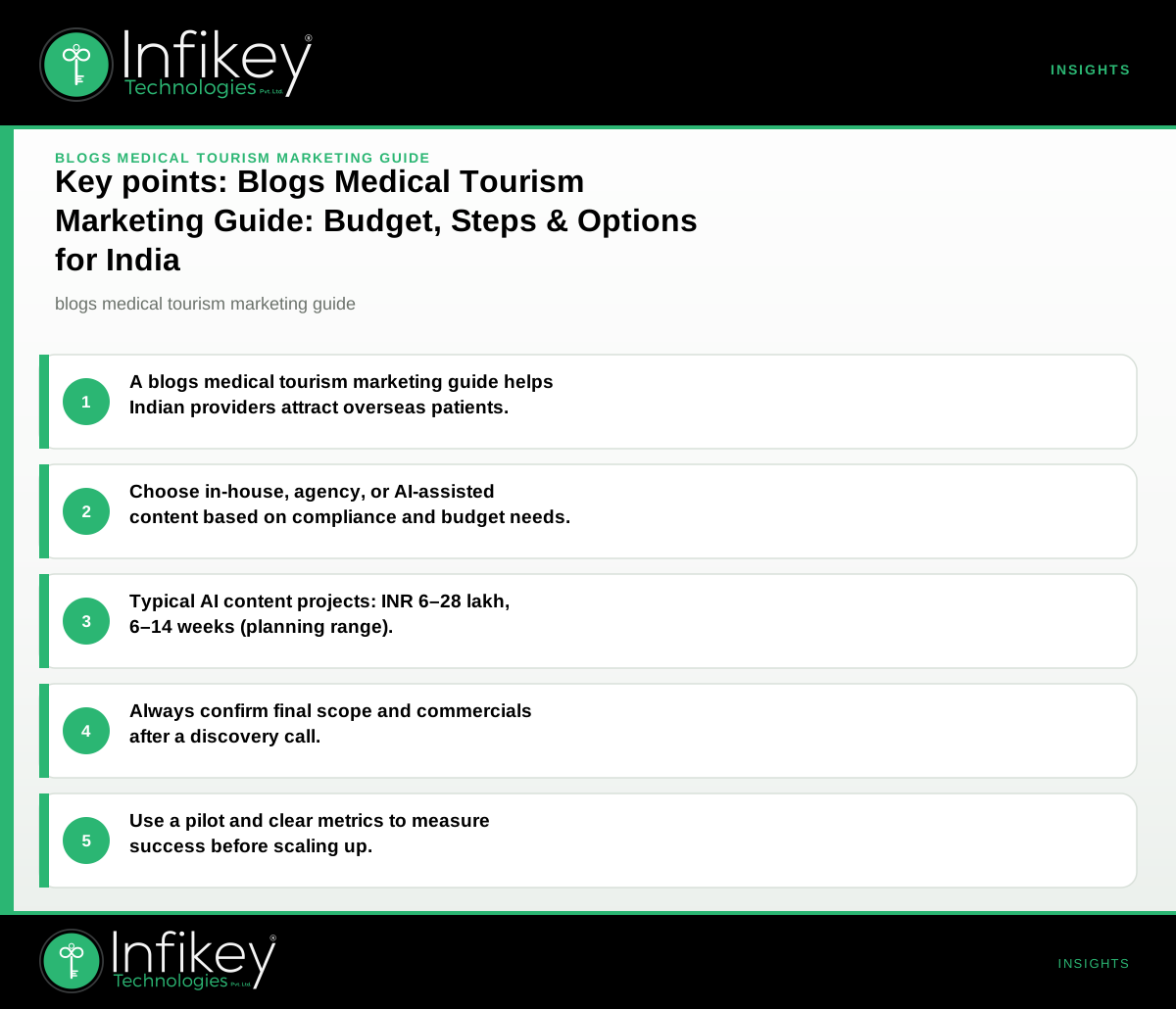
A blogs medical tourism marketing guide shows Indian healthcare providers how to use blogging and digital content to attract international patients, build trust, and drive qualified enquiries. You need this if you want to compete for overseas patients and require a measurable, content-led marketing approach tailored for India’s market and compliance context.
How Medical Tourism Blogging Works: Step-by-Step
On projects like this, we usually follow these steps to ensure your content supports real business goals:
- Discovery & Compliance Check: Identify your target patient segments, preferred source countries, and ensure all content aligns with Indian regulations and hospital policies. This step is crucial for healthcare content compliance in India, as it ensures that all published information meets the standards set by the Medical Council of India and adheres to patient privacy laws. Failing to address compliance can result in reputational and legal risks.
- Content Strategy & Planning: Map patient journeys (awareness, consideration, decision), select blog topics (treatments, success stories, FAQs), and define a publishing calendar. A robust medical tourism blog strategy considers the unique needs of international patients—such as visa information, aftercare support, and local travel guidance—while also highlighting your hospital’s expertise and success rates.
- SEO & Localisation: Optimise every post for relevant keywords (e.g., “knee replacement India”, “Ahmedabad heart surgery cost”), and address international patient concerns (travel, visas, aftercare). Medical tourism SEO in India requires balancing local search intent with global reach. For example, targeting both “best IVF clinic Ahmedabad” and “affordable IVF India for UAE patients” can help you attract a wider audience.
- Content Creation & Review: Write, fact-check, and review blogs with clinical and marketing teams. Include visuals, patient testimonials (with consent), and clear calls to action. This step is where healthcare content compliance India comes into play—every claim must be supported by evidence, and patient stories must be anonymised or published with explicit consent.
- Promotion & Distribution: Share blogs via organic search, paid campaigns, medical tourism platforms, and social media. Track engagement and enquiry sources. Consider platforms popular in your target markets—like Facebook for Middle Eastern patients or LinkedIn for corporate medical tourism partners.
- Measurement & Optimisation: Monitor traffic, leads, and patient conversions. Adjust topics and formats based on real results. Use analytics to identify which blog posts generate the most qualified enquiries, then double down on those topics or formats.
Table: Medical Tourism Blog Approaches, Best Use, and Trade-Offs
| Approach | Best For | Trade-Off |
|---|---|---|
| In-house content team | Hospitals with ongoing needs, tight compliance | Higher fixed cost, slower ramp-up |
| Agency (specialist or full-service) | Clinics/hospitals needing scale, expertise | Less direct control, must ensure compliance |
| Freelancers (writers/SEO) | Small clinics, limited scope | Variable quality, more management needed |
| AI-assisted content creation | Cost-sensitive, rapid topic coverage | Needs human review, risk of generic content |
Decision rule: If you need consistent, compliant, and medically accurate content, use an agency or in-house team; for cost or speed, supplement with AI but always review clinically.
Why Medical Tourism Content Marketing in India Matters
India is a leading destination for medical tourism, with patients arriving from Africa, the Middle East, Southeast Asia, and even developed countries seeking affordable, high-quality care. However, competition is intense—hundreds of hospitals and clinics are vying for attention. Medical tourism content marketing India is not just about publishing blogs; it’s about building trust, answering patient concerns, and demonstrating compliance with Indian healthcare standards.
A well-executed content strategy can:
- Position your hospital as a thought leader in specific treatments (e.g., cardiac surgery, IVF, orthopaedics)
- Address common patient concerns (cost transparency, safety, recovery)
- Build trust through transparent communication and patient testimonials
- Improve international SEO rankings, making your hospital visible to patients searching from abroad
- Generate qualified leads by guiding readers to enquiry forms or teleconsultation bookings
Medical Tourism Blog Strategy: Building Authority and Trust
A strong medical tourism blog strategy should focus on:
- Educational Content: Explain procedures, recovery timelines, and risks in plain language. Use infographics and videos to simplify complex topics.
- Success Stories and Testimonials: Share real patient journeys (with consent), including before-and-after results and feedback on the hospital experience.
- FAQs and Myth-Busting: Address common misconceptions about Indian healthcare, travel safety, and post-treatment support.
- Localisation: Tailor content for different source countries. For example, highlight visa support for Bangladeshi patients or halal food options for Middle Eastern visitors.
- Calls to Action: Every blog should guide readers to the next step—whether it’s downloading a treatment guide, booking a teleconsultation, or submitting an enquiry.
Integrating AI in Healthcare Marketing for Medical Tourism
AI in healthcare marketing is transforming how hospitals attract and engage international patients. AI-powered tools can:
- Automate Blog Topic Research: Identify trending topics and patient questions from search data.
- Generate Draft Content: Quickly create first drafts for human review, speeding up the content pipeline.
- Personalise Content: Use AI to recommend relevant blogs or services to website visitors based on their behaviour and location.
- Chatbots for Enquiries: Deploy AI chatbots to answer common questions 24/7, collect patient details, and route qualified leads to your team.
However, AI-generated content must always be reviewed by clinical and compliance teams to ensure accuracy and safety. Combining AI with human oversight delivers both speed and trust.
Medical Tourism SEO India: Ranking for International Patient Searches
Effective medical tourism SEO India strategies include:
- International Keyword Research: Target keywords used by patients in source countries (e.g., "best cancer hospital India for Nigerian patients").
- Multilingual Content: Offer key pages and blogs in languages like Arabic, French, or Russian, depending on your target markets.
- Local SEO for City-Based Searches: Optimise for city-specific queries (e.g., "Ahmedabad liver transplant cost") to attract patients searching for care in specific locations.
- Technical SEO: Ensure your website loads quickly, is mobile-friendly, and uses structured data for treatments and testimonials.
- Backlink Building: Collaborate with medical tourism platforms, embassies, and patient forums to earn high-quality backlinks.
Healthcare Content Compliance India: Avoiding Pitfalls
Compliance is non-negotiable in healthcare content. Key considerations for healthcare content compliance India include:
- Accurate Medical Claims: All treatment information must be evidence-based and reviewed by clinical staff.
- Patient Privacy: Only publish testimonials or case studies with documented patient consent.
- Advertising Guidelines: Follow Medical Council of India and Ministry of Health rules on what can and cannot be promoted.
- Transparency: Disclose costs, risks, and limitations honestly to avoid misleading patients.
- Regular Audits: Schedule periodic content reviews to ensure ongoing compliance as regulations evolve.
Typical Budget and Timeline: Planning Ranges for India
Medical tourism blogging and digital content projects in India usually fall into these planning ranges (final scope confirmed after discovery):
- AI feature on an existing product (e.g., AI-driven blog topic selection, content generation, or chatbots for patient queries): INR 6–28 lakh, 6–14 weeks
- Custom web application / portal (e.g., patient enquiry portals, blog CMS): INR 12–50 lakh+, 8–20 weeks
- Standalone content/SEO campaigns (agency or hybrid): INR 2–12 lakh per quarter (content, SEO, distribution), ongoing
*Budgets exclude GST. Hybrid on-site + remote delivery is common. Discovery calls clarify compliance, scope, and reporting needs.*
Example Project Shapes: Ballpark Budgets and Timelines
- AI-powered blog automation for a mid-sized hospital: INR 6–28 lakh, 6–14 weeks (AI topic selection, draft generation, human review, compliance workflows)
- Medical tourism content portal with enquiry tracking: INR 12–50 lakh+, 8–20 weeks (custom CMS, blog, multilingual support, analytics)
- Quarterly content and SEO retainer for a specialty clinic: INR 2–12 lakh per quarter, ongoing (content creation, SEO, reporting)
Final commercials are always confirmed after a discovery call. Use these ranges for initial planning only.
How to Get Started: 5 Steps for Indian Healthcare Providers
- Clarify Your Goals: Are you targeting specific treatments, geographies, or patient profiles? Define clear, measurable outcomes (e.g., qualified leads, website traffic growth).
- Audit Your Current Content: Review your website, blogs, and digital assets for accuracy, compliance, and international relevance. Check for outdated information, missing consent, or gaps in patient journey coverage.
- Shortlist Partners: Evaluate agencies or content vendors with healthcare experience and proven SEO/process discipline. Ask about compliance handling and reporting.
- Plan a Discovery Call: Use this to align on goals, regulatory needs, and get a ballpark budget/timeline. Confirm if you need AI features, custom portals, or just content/SEO.
- Pilot & Measure: Start with a 3–6 month pilot (content + promotion). Track enquiries, patient feedback, and SEO performance. Adjust based on results.
Decision Checklist: What to Ask Before You Spend
- Does the content partner understand Indian healthcare regulations and medical tourism trends?
- Will the blogs be reviewed by clinical staff for accuracy?
- How will SEO and keyword targeting address both Indian and international audiences?
- What reporting and lead tracking will be provided?
- Is there a clear process for patient consent on testimonials/case studies?
- How are results measured (traffic, leads, conversions)?
- Can the partner support multilingual content for key source markets?
- What is their experience with AI in healthcare marketing, if relevant?
Questions to Ask Your Vendor (India Context)
- What is your experience with medical tourism content and compliance?
- How do you ensure accuracy and clinical review of blogs?
- Can you support both English and other languages for international patients?
- What is included in your reporting and analytics?
- How do you handle GST invoicing and hybrid delivery (on-site/remote)?
- What steps do you take to ensure healthcare content compliance India?
- Can you provide examples of successful medical tourism blog strategy implementations?
Medical Tourism Content Marketing India: Best Practices
- Consistency is Key: Publish regularly to build authority and maintain search rankings.
- Leverage Visual Content: Use before-and-after photos (with consent), treatment diagrams, and video testimonials to engage international audiences.
- Monitor and Iterate: Use analytics to refine your content topics, formats, and distribution channels.
- Stay Updated on Regulations: Healthcare content compliance India is dynamic; ensure your team or agency stays current with the latest guidelines.
- Integrate with Other Channels: Promote blogs via email newsletters, WhatsApp updates, and medical tourism aggregators for maximum reach.
Next Step: Plan Your Medical Tourism Content with Infikey
If you want a compliant, results-driven approach to medical tourism blogging—whether you need AI-powered content, a new portal, or just better SEO—see our AI services or [[Contact Infikey]({{contact](/in/contact))}} for a discovery call. We help Indian healthcare providers plan, budget, and deliver content that converts international enquiries.