
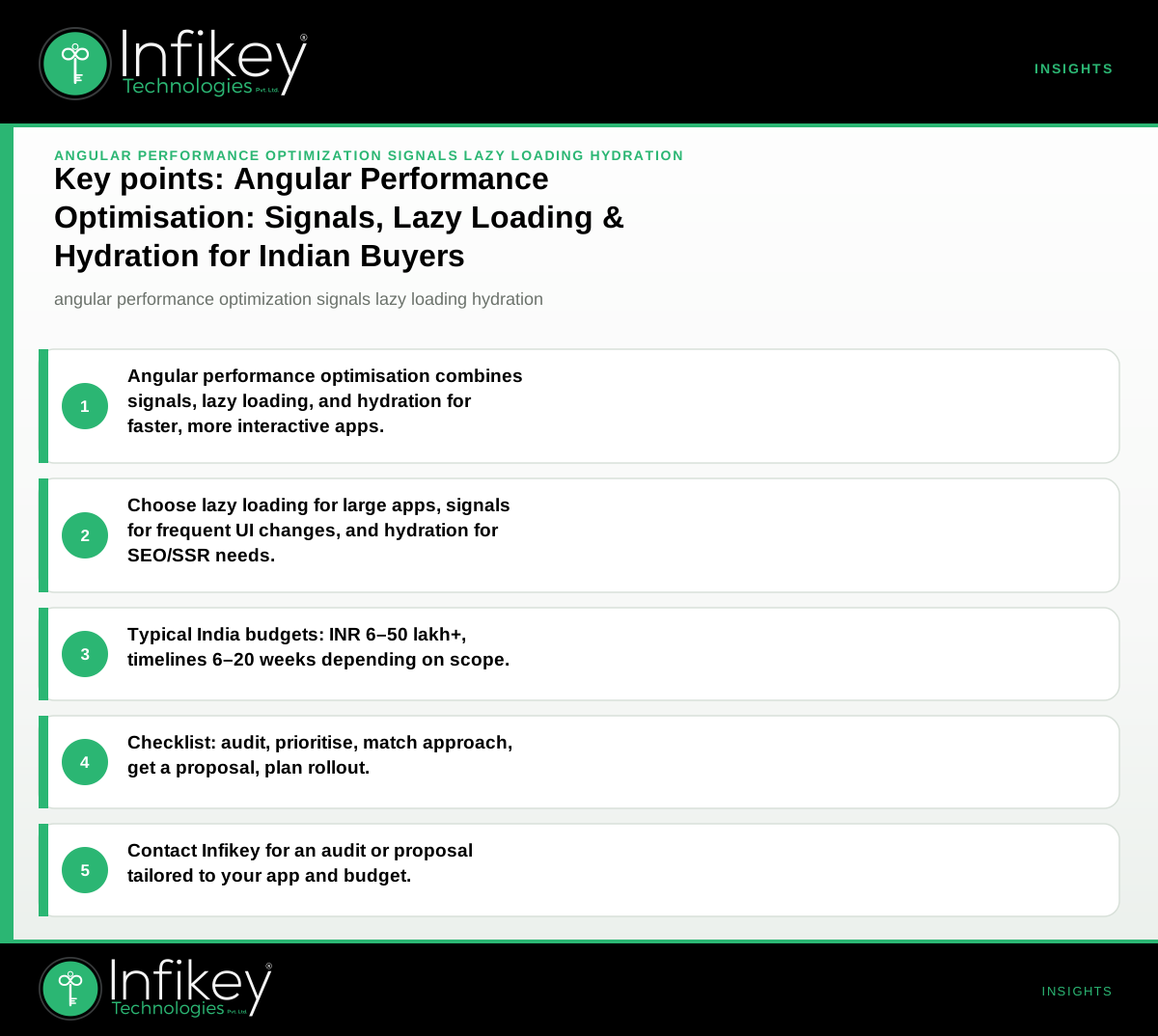
Angular performance optimisation using signals, lazy loading, and hydration means structuring your Angular app so it loads faster, updates efficiently, and feels instant to users—especially critical for large, interactive sites or apps. Businesses need this when slow load times or sluggish updates are impacting user satisfaction or SEO.
How Angular Performance Optimisation Works: Step-by-Step
- Audit and Baseline: Assess current app speed using tools like Lighthouse or WebPageTest. Identify slow routes, heavy bundles, and sluggish updates.
- Implement Signals: Replace traditional change detection with Angular signals to track reactive data more efficiently, reducing unnecessary UI updates.
- Apply Lazy Loading: Break the app into feature modules. Load each module only when the user navigates to it, shrinking initial bundle size.
- Enable Hydration: For server-side rendered (SSR) Angular apps, enable hydration so the client reuses server-rendered HTML, speeding up first interaction.
- Test and Measure: After each change, measure performance again. Focus on Largest Contentful Paint (LCP), Time to Interactive (TTI), and bundle size.
- Refine and Monitor: Optimise further by removing unused code, compressing assets, and monitoring real-user metrics.
Options for Angular Performance Optimisation
| Approach | Best For | Trade-Off |
|---|---|---|
| Signals | Apps with frequent UI updates | Requires refactoring, newer Angular only |
| Lazy Loading | Large apps with many features/routes | Initial setup effort, route planning needed |
| Hydration (SSR) | SEO-critical, interactive, content-rich apps | SSR setup complexity, hosting requirements |
| Bundle Optimisation | Any app with slow load or large JS bundles | Diminishing returns after core steps |
Decision Rule: If your app is slow at startup, start with lazy loading. If updates are slow or CPU-intensive, introduce signals. If SEO or first-paint is a priority, add SSR and hydration.
Budget and Timeline: Typical Ranges for India
On projects like this, we see the following planning ranges (final scope and commercials confirmed after discovery):
| Project Shape | Ballpark INR | Timeline |
|---|---|---|
| AI feature on existing Angular product | 6–28 lakh | 6–14 weeks |
| Custom web application with performance focus | 12–50 lakh+ | 8–20 weeks |
- Signals or lazy loading alone: Usually at the lower end if the app is modular.
- SSR + hydration: Adds complexity, often mid-to-upper range.
- GST and hybrid delivery: Most buyers in India plan for GST and a mix of on-site + remote collaboration.
For a mid-sized business site or portal, expect 6–14 weeks and INR 6–28 lakh for a scoped AI/performance engagement. Larger, multi-module apps with SSR/hydration can reach INR 12–50 lakh+ over 8–20 weeks.
How to Get Started: Practical Steps
- Define your performance goals: Is it load time, SEO, or user interactivity?
- Request an audit: Engage a partner like Infikey Technologies Pvt. Ltd. for a technical review and scoping.
- Prioritise features: Identify modules or flows where users drop off or complain about speed.
- Choose your optimisation approach: Use the table above to match your needs.
- Get a detailed proposal: Insist on a clear breakdown of work, timeline, and cost (with GST).
- Plan for testing and rollout: Include time for user acceptance and monitoring.
Checklist: Questions to Ask Before You Act
- What is the current LCP, TTI, and bundle size for key pages?
- Which features or routes are slowest to load or update?
- Is your Angular version compatible with signals and hydration?
- How will lazy loading affect user navigation and SEO?
- What is the fallback plan if SSR/hydration introduces bugs?
- How will you measure real-world improvements post-launch?
When to Use Angular Signals, Lazy Loading, or Hydration
Use signals if your app has complex, frequently changing UI states and you want to minimise unnecessary updates.
Use lazy loading if your app is large, with many features/routes, and users rarely access all features in one session.
Use hydration (SSR) if SEO, initial paint, or interactive content is critical—such as for e-commerce, content, or B2B platforms.
Example Project Shapes (with INR Ballparks)
- Retail platform adding SSR and lazy loading: INR 12–28 lakh, 8–14 weeks.
- Healthcare portal optimising with signals and bundle splitting: INR 6–18 lakh, 6–10 weeks.
- Education site migrating to SSR with hydration: INR 18–40 lakh, 10–16 weeks.
These are planning ranges; final pricing is confirmed after a technical discovery call.
Learn More or Start Your Angular Performance Project
For a tailored audit or proposal on Angular performance optimisation—including signals, lazy loading, and hydration—see our AI services or [[contact Infikey]({{contact](/in/contact))}}. We work with Indian SMEs and mid-market firms on hybrid delivery, clear GST billing, and measurable outcomes.