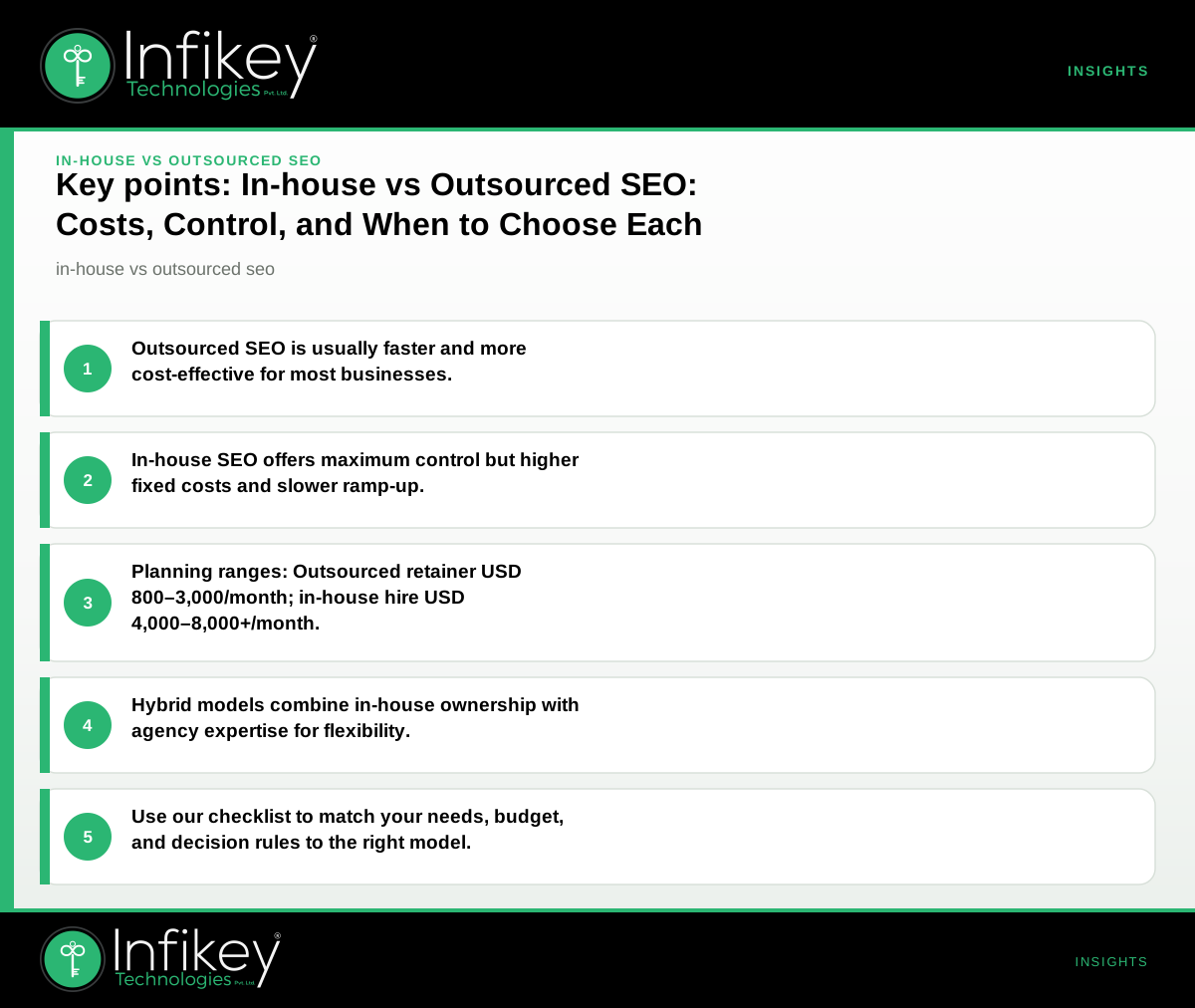
When deciding between in-house vs outsourced SEO, choose in-house if you need daily hands-on control, have long-term SEO needs, and can invest in building expertise; choose outsourcing if you want faster results, specialist skills, or a predictable monthly cost. Most businesses benefit from outsourcing unless they have a large, ongoing SEO workload and the resources to hire and retain a dedicated team.
In-house vs Outsourced SEO: Quick Comparison Table
| Option | Cost (planning range) | Speed to Impact | Control | Risk | Best For |
|---|---|---|---|---|---|
| In-house | USD 4,000–8,000+/month (salaries + tools) | Slow–Medium | Full | Talent, skill gaps | Large, ongoing SEO needs |
| Outsourced | USD 800–3,000/month (retainer) | Medium–Fast | Shared | Vendor fit | Most SMEs and global buyers |
Costs are planning ranges. Final scope and commercials are confirmed after discovery.
Understanding In-house vs Outsourced SEO
The decision between in-house vs outsourced SEO is a strategic one that impacts your marketing efficiency, cost structure, and long-term growth. Both models offer distinct advantages and trade-offs. In-house SEO means building your own team, processes, and expertise. Outsourced SEO means partnering with an agency or specialist to deliver results on a retainer or project basis. Many businesses also consider a hybrid SEO model to balance control and access to external skills.
SEO Outsourcing vs Inhouse: Key Differences
- Resource Commitment: In-house SEO requires hiring, training, and retaining talent, often across multiple roles (technical, content, analytics). Outsourced SEO services provide access to a full team without long-term hiring commitments.
- Expertise: Agencies bring cross-industry experience, advanced tools, and up-to-date best practices. Internal teams offer deep brand and product knowledge but may lack exposure to broader SEO trends.
- Scalability: Outsourcing allows you to flex your investment up or down as needs change. In-house teams are less flexible, with fixed costs and slower ramp-up times.
- Control: Internal teams offer direct, daily control over SEO priorities. Outsourced partners require clear briefs and regular communication to align with your brand voice and goals.
Decision Rules: Should You Choose In-house or Outsourced SEO?
- Choose in-house SEO if:
1. You have a large, complex site or ongoing SEO needs that justify at least one full-time hire. 2. You require daily, immediate control over content, technical changes, and brand messaging. 3. Your industry has strict compliance or confidentiality needs that are hard to delegate (e.g., financial services, healthcare, or regulated sectors). 4. SEO is a core differentiator for your business, and you want to build institutional knowledge.
- Choose outsourced SEO if:
1. You want access to specialist skills (technical SEO, content, link-building, analytics) without hiring multiple people. 2. Your SEO needs change over time (e.g., project-based, campaign bursts, or new market launches). 3. You need predictable costs and faster time-to-impact, especially if starting from scratch or entering a new market. 4. Your internal team lacks the time or bandwidth to own SEO delivery.
Cost of In-house SEO vs Outsourced SEO Services
In-house SEO Costs
- Salary and Benefits: Expect to budget USD 4,000–8,000+/month for a single experienced SEO hire. For a mature program, you may need 2–3 roles (SEO manager, content specialist, technical SEO), pushing monthly costs to USD 12,000–20,000+.
- Tools and Training: SEO tools, analytics platforms, and ongoing training add to the cost. Factor in USD 500–1,000/month for professional tools and courses.
- Hidden Costs: Recruitment, onboarding, ongoing training, and covering absences or turnover can impact your budget and continuity.
Outsourced SEO Services Costs
- Retainer Model: Most agencies (including Infikey Technologies Pvt. Ltd.) offer monthly retainers in the USD 800–3,000/month range for technical SEO, content planning, on-page optimization, and reporting. Media spend is typically separate.
- Project-based Engagements: For specific campaigns or audits, agencies may offer fixed-scope projects. This is ideal for businesses with one-off needs or those testing the waters before committing long-term.
- Scalability: Outsourced SEO services make it easy to scale up or down. You can increase scope for a product launch or reduce spend in slower periods without the HR overhead.
All costs are planning ranges. Final scope and commercials are confirmed after discovery.
What Each Option Delivers (and What It Misses)
In-house SEO
- Strengths:
- Deep understanding of your brand, products, and internal processes. - Immediate access to internal resources and stakeholders. - Full control over priorities, messaging, and compliance.
- Limitations:
- Slower to ramp up, especially if you need to hire or train staff. - Risk of skill gaps or knowledge loss if key team members leave. - Higher fixed costs and less flexibility to scale quickly.
Outsourced SEO
- Strengths:
- Access to specialist skills, advanced tools, and proven processes. - Faster delivery for technical audits, content sprints, and link-building campaigns. - Predictable costs and clear deliverables.
- Limitations:
- Less day-to-day control; requires strong communication and clear briefs. - Potential for misalignment if the agency lacks industry knowledge. - Vendor fit is critical—choose a partner with transparent reporting and relevant experience.
Hybrid SEO Model: Combining the Best of Both Worlds
A hybrid SEO model leverages both internal and external resources for maximum impact. This approach is increasingly popular among global buyers and mid-sized enterprises.
How Hybrid SEO Works
- An in-house marketing manager or content owner sets strategy, priorities, and approves messaging.
- An external partner (such as Infikey Technologies Pvt. Ltd.) delivers technical SEO, content planning, and performance reporting.
- This model ensures brand consistency while filling skill gaps and providing access to specialist expertise.
When to Choose a Hybrid Model:
- You want to keep strategy, compliance, or sensitive data in-house but need external delivery muscle.
- Your business is scaling and you need to cover skill gaps without hiring full teams.
- You operate in a regulated industry but require advanced technical SEO or content at scale.
SEO Agency vs Internal Team: Which is Right for You?
Pros of an SEO Agency
- Broad experience across industries and platforms.
- Access to a team of specialists (technical, content, analytics, outreach).
- Process discipline, regular reporting, and accountability.
Pros of an Internal Team
- Deep integration with your brand and business goals.
- Faster decision-making and direct communication.
- Better alignment with internal stakeholders and other marketing functions.
Questions to Ask Before Deciding
- What is my monthly SEO budget? (Refer to planning ranges above.)
- Do I have the time and skills to manage SEO internally?
- How quickly do I need to see results? (Outsourcing often delivers first signals in 8–12 weeks.)
- Is SEO a core differentiator for my business, or one of many channels?
- **Do I need specialist skills (technical, content, analytics) that are hard to hire or retain?
- How important is day-to-day control over SEO activities?
- Does my industry or location require special compliance or data handling?
Example Project Scenarios and Ballpark Ranges
Project 1: New B2B Service Website
- Shape: Outsource SEO for launch and first 6 months
- Budget: USD 800–1,500/month
- Timeline: First signals in 8–12 weeks
Project 2: Large E-commerce Site
- Shape: In-house SEO manager + outsourced technical audits
- Budget: USD 4,000–8,000/month (in-house) plus USD 1,000–2,000/month (outsourced specialist)
- Timeline: Ongoing, with quarterly technical reviews
Project 3: SME with Limited Time
- Shape: Full outsource
- Budget: USD 1,000–2,500/month
- Timeline: Flexible scope, reporting included
All ranges are for planning only. Final scope is confirmed after discovery.
In-house vs Outsourced SEO: Checklist for Decision-Makers
- [ ] Define your monthly/annual SEO budget.
- [ ] List the skills you need (technical, content, analytics, outreach).
- [ ] Map internal capacity: who can own SEO, and how much time do they have?
- [ ] Decide if you need daily control or just regular reporting.
- [ ] Assess if your industry or location requires special compliance.
- [ ] Request planning ranges from at least two vendors if outsourcing.
- [ ] Plan for documentation and clear ownership, especially with remote/global delivery.
Steps to a Successful SEO Engagement
- Assess your current SEO maturity: Audit your existing traffic, rankings, and technical health.
- Define clear goals: Are you targeting growth, brand visibility, or technical fixes?
- Decide on the right model: In-house, outsourced, or hybrid—based on your needs, budget, and timeline.
- Set expectations: Define scope, deliverables, and reporting cadence.
- Monitor and adapt: Review performance regularly and adjust your approach as your business evolves.
Next Steps
For most global buyers, outsourcing SEO offers the best mix of cost, speed, and access to specialist skills. If you want a tailored plan, clear documentation, and delivery that a non-technical sponsor can approve, see Digital marketing and SEO or [[Contact Infikey]({{contact](/contact))}} for a planning session.