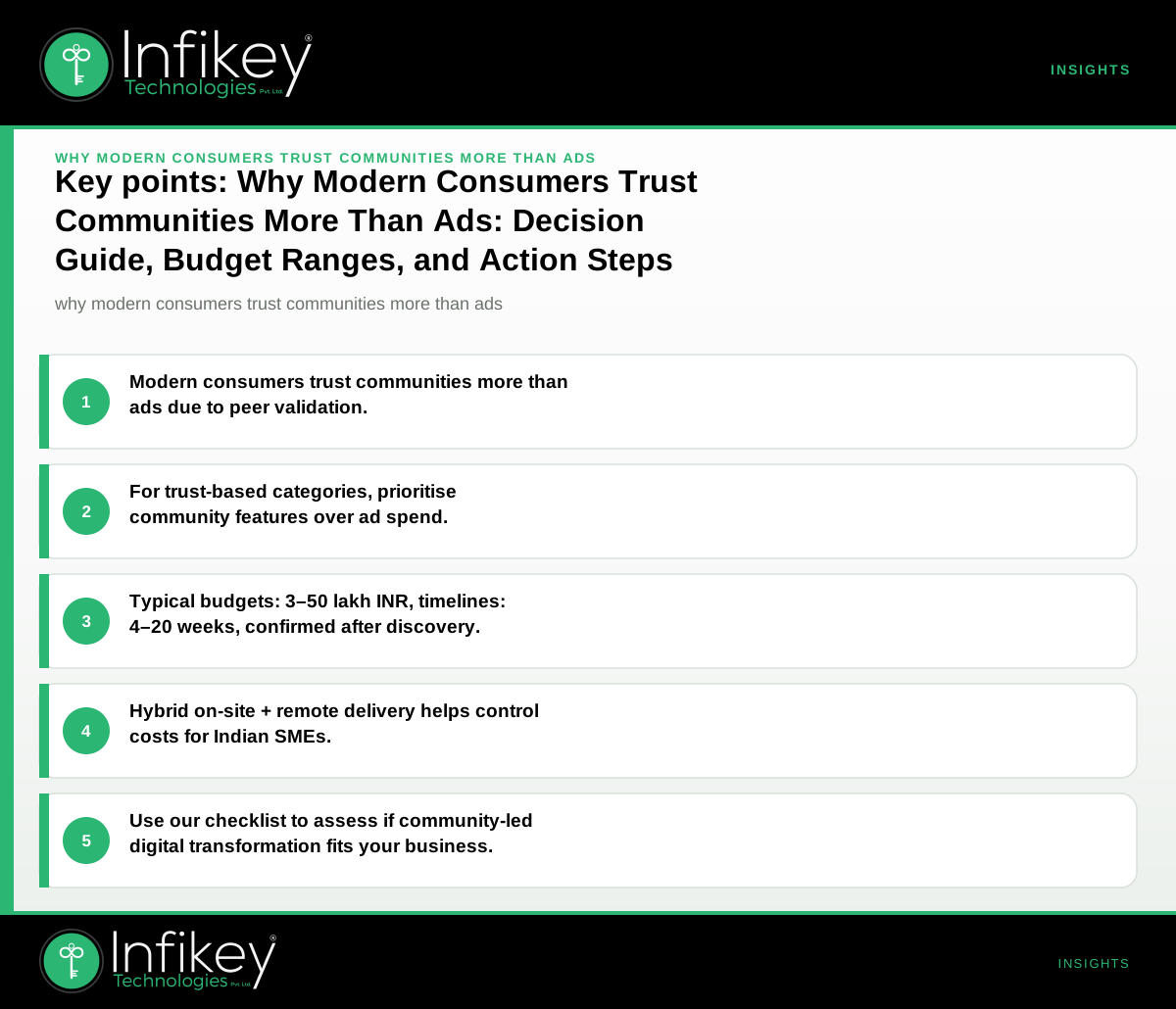
Modern consumers trust communities more than ads because peer recommendations and authentic discussions in groups or forums are seen as more credible, relevant, and unbiased than paid advertising. If your business relies on digital channels for customer acquisition or retention, you need to understand and leverage this shift to remain competitive and credible.
Why Modern Consumers Trust Communities More Than Ads
The digital landscape has fundamentally changed how people make purchasing decisions. Traditional advertising, while still valuable for reach and awareness, often struggles to cut through the noise and skepticism of today’s buyers. Communities—whether on WhatsApp, Facebook Groups, Reddit, or niche forums—provide a space where real users share genuine experiences, answer questions, and offer advice without the filter of brand messaging. This organic, two-way communication builds digital trust signals that are hard for ads to replicate.
The Psychology of Digital Trust Signals
Digital trust signals are cues that help consumers judge whether a brand, product, or service is reliable. These include:
- User reviews and testimonials
- Active community engagement
- Transparent responses to feedback
- Visible customer support in forums or groups
When potential buyers see real people discussing a brand or product, sharing both positive and negative experiences, it creates a sense of authenticity. This is especially true in India, where word-of-mouth and community validation are deeply rooted in buying behavior. The result: community-led marketing often outperforms traditional advertising in building long-term trust and loyalty.
How Community Trust Works: Steps and Decision Points
- Consumers seek advice: People research purchases by asking in WhatsApp groups, online forums, or social media communities.
- Peer validation: They value unfiltered experiences and honest reviews from real users over brand promises.
- Community engagement: Brands that participate authentically in these spaces (not just advertising) are more likely to be trusted.
- Purchase decisions: Recommendations from community members often outweigh traditional ads, especially for high-consideration or local purchases.
Rule of thumb: If your target audience is active in online groups or relies on word-of-mouth, prioritise community engagement over increasing ad spend.
Community vs Advertising Effectiveness: A Comparative View
| Approach | Best For | Trade-Off |
|---|---|---|
| Community management | Brands with loyal users or niche interests | Time-intensive, slow to scale |
| Influencer collaboration | Fast reach in lifestyle/consumer sectors | Can lack authenticity if forced |
| User-generated content | Products with passionate customers | Quality and moderation required |
| Paid digital ads | Quick awareness, broad targeting | Lower trust, ad fatigue |
| Hybrid (community + ads) | Brands needing both reach and trust | Requires coordination, higher cost |
Decision Rules for Indian Businesses
- If your product or service requires high trust (healthcare, financial services, B2B solutions), focus on building or engaging with communities.
- If you sell impulse or low-involvement products, ads can still drive volume, but pairing them with community validation improves conversion.
- If your market is crowded or commoditized, community-led marketing helps differentiate your brand through authentic engagement.
Building Online Communities for Brands: Practical Strategies
Building online communities for brands is not just about creating a group or forum—it’s about fostering a space where customers feel heard, valued, and empowered to share. Here’s how to approach it:
1. Identify Relevant Platforms
- Research where your target audience spends time online (WhatsApp, Facebook Groups, Reddit, LinkedIn, industry-specific forums).
- Consider language and regional preferences, especially in diverse markets like India.
2. Set Clear Community Guidelines
- Define the purpose of your community (support, feedback, knowledge sharing, advocacy).
- Establish rules for respectful engagement and moderation to maintain quality.
3. Appoint Community Managers
- Assign dedicated staff or brand advocates to facilitate discussions, answer questions, and escalate issues.
- Invest in training to ensure consistency and empathy in interactions.
4. Integrate Community Features Into Digital Platforms
- Add forums, Q&A sections, or user-generated content modules to your website or app.
- Enable easy sharing of reviews, testimonials, and discussions across social channels.
5. Recognise and Reward Engagement
- Highlight top contributors, offer exclusive access or early product previews, and publicly thank active members.
Tip: Community-building is a long-term investment. Results compound as trust and engagement grow.
Digital Transformation Budget India: What to Expect
Digital transformation initiatives that prioritise community features require careful planning, especially in India’s value-driven market. Budgeting for these projects involves more than just initial development—you must also account for ongoing moderation, content creation, and community management.
| Project Type | Scope Example | Planning Range (INR, excl. GST) | Timeline |
|---|---|---|---|
| Marketing website | 8–15 pages, CMS, SEO, forms | 3–10 lakh | 4–8 weeks |
| Custom web application / portal | Auth, roles, dashboards, integrations | 12–50 lakh+ | 8–20 weeks |
| Mobile app (iOS + Android) | MVP: auth, core flows, API, store submission | 10–35 lakh | 10–18 weeks |
Community features such as discussion boards, review systems, and social integrations can add to both cost and timeline. For most Indian SMEs and mid-market firms, it’s wise to:
- Plan for GST on all digital transformation spend
- Consider a hybrid delivery model (on-site + remote) to optimise budget and timelines
- Phase in community features to manage risk and cash flow
Final scope and commercials are confirmed after a discovery call.
Community-Led Marketing: How to Get Started
Community-led marketing is about empowering your customers to become advocates and co-creators. Here’s a step-by-step guide for Indian businesses:
- Audit your audience: Identify where your customers gather online (WhatsApp, Facebook Groups, Reddit, industry forums).
- Assess current trust signals: Review your reviews, testimonials, and organic mentions.
- Choose your approach: Decide if you’ll build your own community, partner with existing ones, or blend both.
- Plan your digital transformation: Define which community features you need (discussion boards, user profiles, moderation tools) and map these to your website or app project.
- Budget realistically: Use the planning ranges above and factor in ongoing moderation and engagement costs.
- Book a discovery call: To confirm scope, get a detailed proposal, and align on hybrid delivery options, Contact Infikey or see Digital transformation.
Questions to Ask Before You Invest
- Where do my customers seek advice before buying?
- What are the most trusted sources of information in my category?
- How do competitors engage with communities?
- Which community features would add real value for my audience?
When to Prioritise Community Over Ads: Key Questions
- Are your buyers asking for recommendations in groups or forums before purchasing?
- Do you see more conversions from referrals than from ads?
- Is trust a major barrier to purchase in your category?
- Are your competitors already active in relevant communities?
If you answered yes to two or more, shift budget towards community-driven digital transformation.
Example Project Shapes: Community-Driven Digital Initiatives
- Mid-market retailer: Rebuilding a catalogue site with customer review features and WhatsApp integration. Budget: 3–10 lakh INR, timeline: 4–8 weeks.
- B2B service provider: Launching a client portal with discussion boards and knowledge sharing. Budget: 12–50 lakh+ INR, timeline: 8–20 weeks.
- Consumer app startup: MVP with user profiles, community feeds, and referral tracking. Budget: 10–35 lakh INR, timeline: 10–18 weeks.
All planning ranges are confirmed after discovery. Community features can be phased in to manage risk and spend.
Building Trust Through Communities: A Practical Checklist
- [ ] Map your audience’s online community habits
- [ ] Review your current digital trust signals
- [ ] Select the right mix of community and ad strategies
- [ ] Align digital transformation scope to include community features
- [ ] Budget using realistic INR planning ranges
- [ ] Confirm scope and delivery with your technology partner
For more on integrating community features into your website or app, see Website development or Mobile app development.
Community-Led Marketing in Action: Real-World Considerations
Community-Led Marketing for Indian Brands
Community-led marketing is especially effective in India’s relationship-driven markets. Brands that invest in nurturing online communities see:
- Higher engagement rates
- More organic referrals
- Lower customer acquisition costs over time
Digital Trust Signals: What Matters Most
- Authenticity: Encourage honest reviews and don’t delete negative feedback—address it constructively.
- Responsiveness: Timely replies in forums or groups show you value your community.
- Transparency: Share updates, admit mistakes, and involve your community in product development.
Community vs Advertising Effectiveness: Key Takeaways
- Communities deliver long-term brand equity and loyalty.
- Ads deliver short-term awareness but can suffer from fatigue and skepticism.
- The most effective brands blend both, using ads to drive discovery and communities to build trust.
Next Steps: Make Community Your Competitive Edge
If you’re ready to build trust that lasts and want to understand how community-led marketing can transform your digital presence, Talk to Infikey to scope your project. Our team in Ahmedabad helps Indian businesses design, build, and scale online communities as part of a holistic digital transformation strategy. Explore our Digital marketing and SEO, Website development, and Mobile app development services to see how we can help you put community at the heart of your brand.
Ready to build trust that lasts? Talk to Infikey to scope your digital transformation with community at the core.