
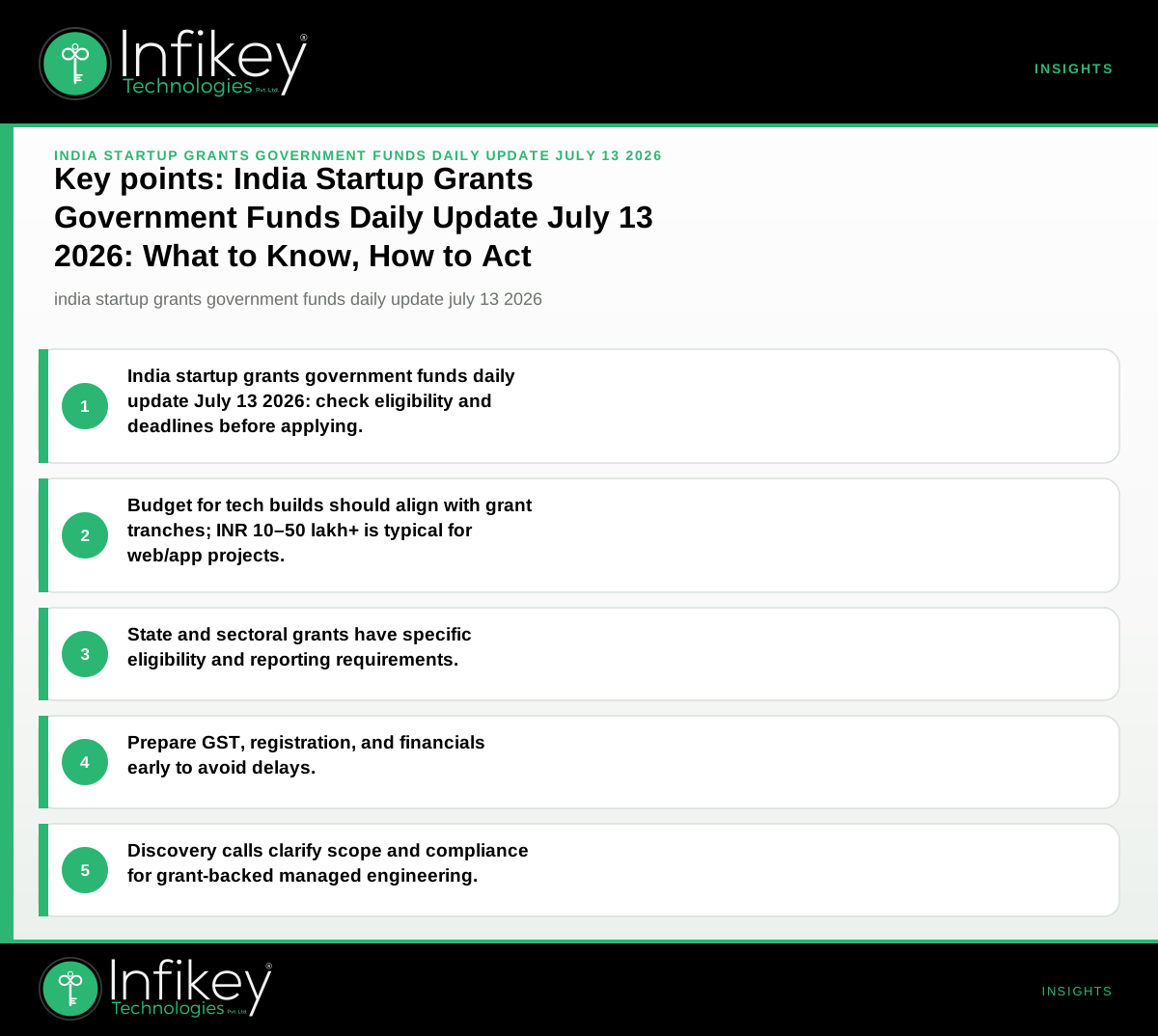
India startup grants government funds daily update July 13 2026 refers to the latest published information on which central and state government schemes are open for Indian startups to apply for funding on that date. Businesses need this when seeking non-dilutive capital or co-funding for technology, hiring, or market expansion, especially before major product or managed engineering investments.
How India Startup Grants and Government Funds Work: Step-by-Step
- Scheme Announcement: Government bodies (central/state) announce new or recurring grant schemes, often with sector or stage focus.
- Eligibility Check: Startups review scheme criteria (age, turnover, industry, registration, GST compliance).
- Application Submission: Apply via official portals (Startup India, state portals, or scheme-specific sites) with required documents and business plans.
- Screening & Evaluation: Authorities review applications, sometimes with pitch rounds or technical assessments.
- Approval & Disbursement: Shortlisted startups receive funds, usually in tranches, linked to milestones or deliverables.
- Compliance & Reporting: Grant recipients must submit utilisation reports and comply with audits.
On projects like this, we usually see founders underestimate the documentation and reporting required.
Understanding Startup India Grant Eligibility
Startup India grant eligibility is determined by specific criteria set by the central government. To qualify for Startup India grants, your business must typically:
- Be recognized as a startup by DPIIT (Department for Promotion of Industry and Internal Trade)
- Be less than 10 years old from the date of incorporation
- Have an annual turnover not exceeding INR 100 crore in any of the previous financial years
- Be working towards innovation, development, or improvement of products or services
- Not be formed by splitting up or reconstructing an existing business
Additional eligibility requirements may be imposed by individual schemes, such as sector focus (e.g., technology, manufacturing, healthcare), founder background, or minimum team size. Always verify the latest criteria on the official Startup India portal before applying.
Table: Grant Options, Best Use, and Trade-offs
| Grant Type | Best For | Trade-off |
|---|---|---|
| Central Govt (Startup India) | Early-stage, pan-India tech startups | Highly competitive, strict eligibility |
| State Govt (e.g., Gujarat) | Local startups, sector-specific | Regional focus, limited to registered address |
| Sectoral Schemes (e.g., MSME, DST) | Niche tech, manufacturing, R&D | Narrow scope, more technical documentation |
| Incubator/Accelerator Grants | Product validation, pilot projects | Often linked to physical presence or demo days |
| Challenge/Prize Funds | Innovative solutions to specific problems | One-off, milestone-based, not recurring |
State Government Startup Funds: What to Know
State government startup funds are a crucial source of support for regionally registered startups. States like Gujarat, Karnataka, Maharashtra, and Telangana operate their own startup missions or innovation councils, often offering:
- Seed grants for early-stage startups
- Subsidies for technology adoption or infrastructure
- Reimbursement of patent filing or market access costs
- Access to state-run incubators and co-working spaces
Eligibility for these funds usually requires a registered office in the state, and sometimes a physical presence or proof of local employment. Some state funds target specific sectors (e.g., manufacturing, agritech, fintech) based on local priorities. For Ahmedabad-based founders, the Gujarat Startup Mission and state innovation schemes can provide a strong foundation for early growth and tech investment.
Typical Budget and Timeline for Grant-Backed Tech Projects
For startups using grants to fund managed engineering (websites, apps, platforms), planning ranges are:
| Project Type | Ballpark Budget (INR) | Timeline (weeks) |
|---|---|---|
| Custom web application / portal | 12–50 lakh+ | 8–20 |
| Mobile app (iOS + Android, MVP) | 10–35 lakh | 10–18 |
| AI feature on existing product | 6–28 lakh | 6–14 |
*Final scope and commercials are confirmed after discovery. Budget must include GST. Most grants disburse in tranches, so ensure cash flow can cover initial outlay.*
Grant-Backed Tech Project Budget: What to Include
When preparing a grant-backed tech project budget, account for:
- Software engineering and development costs (web, mobile, AI)
- Cloud infrastructure and hosting
- Cybersecurity and compliance
- UI/UX and graphics designing
- Testing, deployment, and support
- GST and statutory charges
A clear, milestone-based budget increases your chances of approval and helps with compliance during reporting. If you’re unsure how to structure your budget, see Infikey’s managed engineering service for guidance.
Decision Rules: Which Grant to Target?
- If your startup is less than 5 years old and DPIIT registered: Prioritise Startup India or state startup cell grants.
- If you are in manufacturing, deep tech, or R&D: Look for sectoral schemes (e.g., DST, MSME, BIRAC).
- If you need rapid MVP or pilot funding: Incubator or accelerator grants may be faster, but require pitch/demo.
- If you are Ahmedabad-based: Check Gujarat state schemes for location-based advantages.
How to Apply for Startup Grants in India: Step-by-Step
- Identify Open Grants: Track daily updates on Startup India, state startup portals, and scheme sites for July 13 2026. Bookmark the Startup India portal and your state’s innovation mission for the latest notifications.
- Assess Eligibility: Review each scheme’s eligibility checklist (age, turnover, sector, GST, registration, founder background). If in doubt, contact the scheme helpdesk or a grant consultant.
- Prepare Documentation: Gather all required documents: DPIIT certificate, GST registration, audited financials, detailed project plan, pitch deck, and any required MoUs or letters of support.
- Engage a Delivery Partner: For tech builds, select an experienced managed engineering provider (see Infikey’s managed engineering service) who understands grant compliance, reporting, and procurement norms.
- Apply and Track: Submit your application before the deadline, keep digital and physical copies of all submissions, and monitor the application status. Be ready for evaluation, pitch calls, or technical assessments.
Managed Engineering for Startups: Why It Matters in Grant-Funded Projects
Managed engineering for startups means partnering with a technology provider who can deliver end-to-end solutions (from architecture to deployment) while meeting grant compliance and reporting needs. For grant-funded projects, this approach offers:
- Professional project management and milestone tracking
- Clear documentation for grant reporting and audits
- Experience with government procurement and compliance
- Ability to scale teams up or down as grant tranches are released
This is especially valuable when grants require strict adherence to timelines, deliverables, and evidence of progress. Infikey’s managed engineering services (learn more) are designed to align with these requirements, reducing risk for founders.
Checklist: What to Prepare Before Applying
- DPIIT registration certificate
- GST registration and latest returns
- Audited financials (last 1–2 years, if available)
- Detailed project plan and budget (align with grant milestones)
- Pitch deck and product demo (if required)
- Letters of support or MoUs (for sectoral or partnership grants)
Example Project Shapes: Grant-Funded Tech Builds
1. Custom Web Portal for a Regional Startup
A Gujarat-based SaaS startup uses a state government startup fund to build a custom web portal. Planning range: INR 12–50 lakh+, timeline 8–20 weeks. The project budget includes software development, cloud setup, and compliance reporting. The grant covers 70% of costs, with the startup funding the balance until tranches are released.
2. Mobile App MVP for Early-Stage Healthtech
A healthtech founder applies for a central sectoral grant to develop a mobile app MVP. Planning range: INR 10–35 lakh, timeline 10–18 weeks. The grant requires a detailed project plan, compliance with data privacy norms, and milestone-based reporting.
3. AI Feature Integration for an Existing Product
A startup leverages a sectoral grant to add AI features to an existing product. The grant-backed tech project budget is INR 6–28 lakh, timeline 6–14 weeks. The delivery partner manages technical documentation and supports grant reporting.
*Discovery calls with delivery partners help clarify scope, compliance, and cash flow needs. Contact Infikey for a project planning session.*
Key Questions to Ask Before Spending on Managed Engineering
- Does the grant cover all tech build costs, or only part?
- Are there restrictions on vendor selection or procurement?
- What evidence/reporting will be needed for each milestone?
- How will GST and tranches affect cash flow?
- Can the delivery partner support hybrid (on-site + remote) work as required by the grant?
- Does the provider have experience with grant-funded projects and compliance?
Daily Update: Where to Find India Startup Grants Government Funds on July 13 2026
To stay current, check these sources daily:
- Startup India portal for national schemes and updates
- State government startup mission websites (e.g., Gujarat Startup Mission)
- Sectoral ministry sites (MSME, DST, BIRAC)
- Incubator and accelerator program announcements
- Industry association bulletins and newsletters
Set calendar reminders to review updates, as new schemes and deadlines are often announced with short notice. Early application increases your chances of success.
Ready to align your grant-funded project with a delivery partner who understands India’s grant landscape? [Talk to Infikey](/in/contact) or see our [managed engineering services](/in/services/managed-engineering) for next steps.