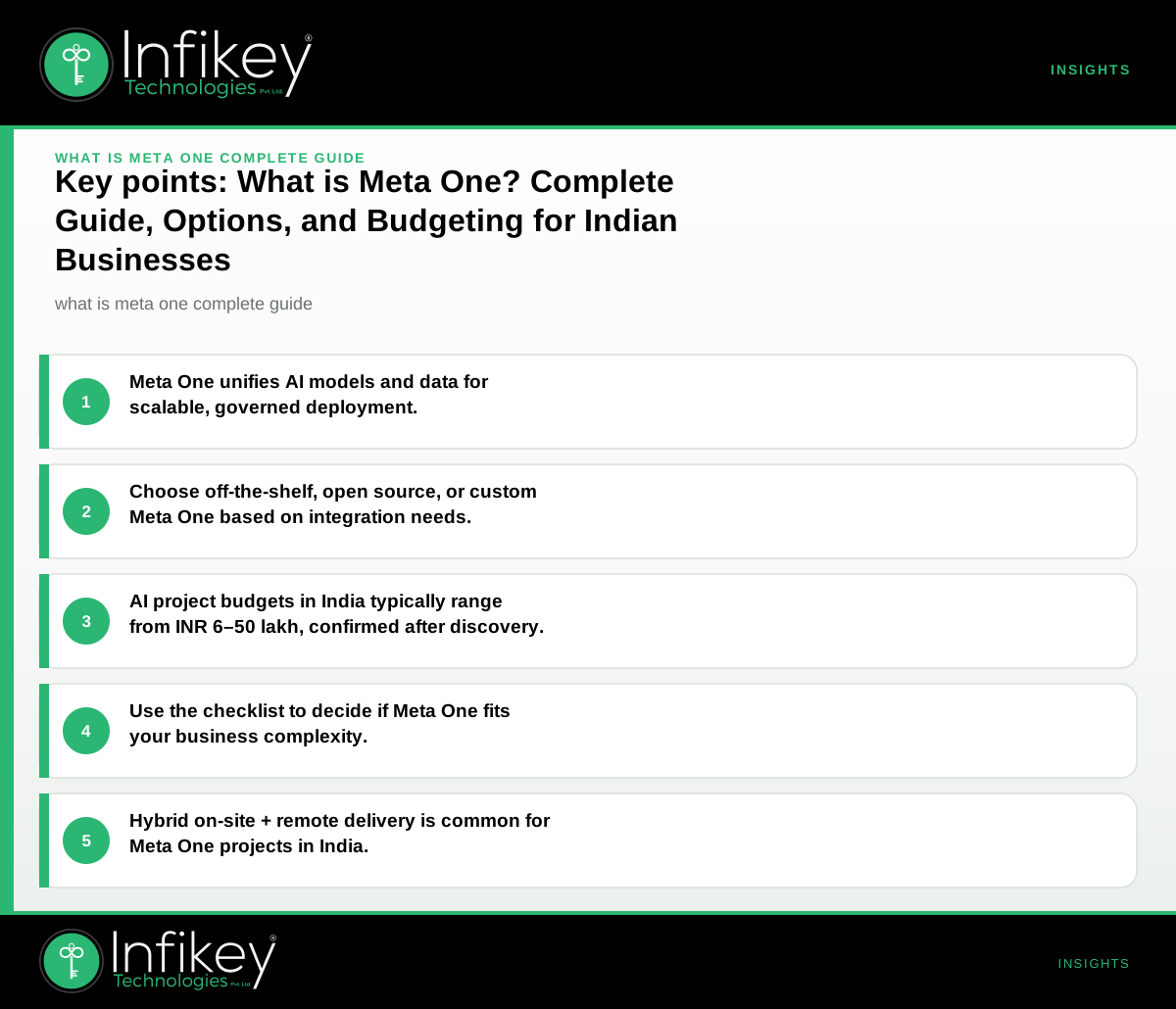
Meta One is a framework or platform for managing, integrating, and deploying AI models and data pipelines in a unified environment. Businesses need Meta One when they want to streamline AI adoption, reduce integration overhead, and ensure governance across multiple AI tools or data sources—especially as projects move from pilot to production.
What is Meta One? Complete Guide
Meta One acts as a central nervous system for AI-driven businesses. Instead of handling each AI model, data pipeline, or integration separately, Meta One brings everything together into a single, orchestrated platform. This means you can manage complex workflows, enforce security and compliance, and accelerate AI deployment without the chaos of point-to-point integrations. For organisations in India—especially those scaling from initial pilots to enterprise-wide AI—Meta One offers a structured path to reliable, maintainable, and auditable AI operations.
Why Meta One Matters for Indian Businesses
In fast-growing markets like India, digital transformation is accelerating across sectors such as financial services, healthcare, retail, and manufacturing. As companies in Ahmedabad and beyond adopt AI, they quickly encounter challenges:
- Multiple AI models from different vendors or open-source projects
- Disparate data sources (legacy systems, cloud, third-party APIs)
- Rising compliance and data privacy requirements
- The need for rapid scaling without losing control
Meta One addresses these by providing a unified platform for integration, governance, and monitoring—reducing both technical and operational risk.
How Meta One Works: Step-by-Step
On projects like this, we typically see these steps:
- Assessment: Identify business processes or products that would benefit from AI integration and where multiple models or data sources must be managed.
- Platform Selection or Build: Choose a Meta One solution (off-the-shelf, open source, or custom) that fits your integration, security, and scalability needs.
- Integration: Connect existing data sources, APIs, and AI models to the Meta One platform. This may involve adapting data formats or setting up secure connections.
- Orchestration: Configure workflows so that data flows between sources, models, and outputs as required. This is where Meta One adds value—centralising control and monitoring.
- Governance & Monitoring: Set up user permissions, audit trails, and model monitoring to ensure compliance and performance.
- Deployment: Launch the integrated solution, either as a new product, feature, or internal tool.
- Iteration: Monitor results, retrain models, and update integrations as business needs evolve.
Meta One Integration Steps in Detail
- Data Mapping: Catalog all data sources, including on-premise databases, cloud storage, and external APIs.
- Model Registration: Register AI models within the Meta One platform, ensuring version control and traceability.
- Connector Setup: Configure connectors or adaptors for each data and model endpoint, ensuring secure and reliable data flow.
- Workflow Orchestration: Define business logic—how data moves, when models are invoked, and how results are routed.
- Testing & Validation: Simulate data flows and model outputs to validate integrations before going live.
- Monitoring Dashboards: Set up real-time dashboards to track data movement, model performance, and system health.
Meta One Platform Options: Off-the-Shelf, Open Source, Custom, and Managed
| Option | Best For | Trade-off |
|---|---|---|
| Off-the-shelf Meta One tools | SMEs needing quick deployment, limited customisation | Lower flexibility, ongoing licence costs |
| Open source frameworks | Tech teams with integration skills, cost-sensitive | Requires more setup, community support |
| Custom Meta One build | Complex workflows, unique compliance needs | Higher upfront cost, longer timeline, full control |
| Cloud-based managed services | Fast scaling, minimal IT overhead | Data residency, vendor lock-in, recurring charges |
Choosing the Right Meta One Platform Option
- Off-the-shelf: Ideal for businesses that want to get started quickly with minimal IT investment. These platforms offer core features out-of-the-box but may limit customisation.
- Open source: Suited for organisations with in-house technical expertise. Offers flexibility and cost savings, but requires more effort in setup, integration, and ongoing support.
- Custom build: Best for enterprises with unique workflows, regulatory requirements, or integration complexity. Provides full control but demands a larger initial investment and longer delivery timeline.
- Managed cloud services: Enables rapid scaling and reduces IT overhead, but may introduce concerns around data residency and vendor lock-in—important factors for Indian businesses with local compliance needs.
Meta One Budget in India: Example Project Shapes, Budgets, and Timelines
When considering a Meta One implementation, it’s essential to align your project scope with realistic budget and timeline expectations. Here are typical project shapes and planning ranges for Indian businesses:
| Project Type | Typical Scope | Ballpark Budget (INR) | Timeline |
|---|---|---|---|
| AI feature on existing product | Use-case, prompts, evaluation, launch | 6–28 lakh | 6–14 weeks |
| Custom AI web application | Auth, roles, dashboards, integrations | 12–50 lakh+ | 8–20 weeks |
| Mobile app with AI integration | Auth, core flows, API, store submission | 10–35 lakh | 10–18 weeks |
Planning ranges only. Final scope and commercials are confirmed after discovery. GST is typically extra. Hybrid on-site + remote delivery is common for Ahmedabad and India.
Example: AI Integration for a Mid-Market Retailer
A retailer in Ahmedabad wants to add AI-powered product recommendations to their e-commerce site. Using a Meta One platform, they:
- Integrate sales and inventory data from their ERP
- Connect a recommendation model (either open source or custom)
- Orchestrate workflows to deliver real-time suggestions on their website
- Set up dashboards for monitoring and retraining
Estimated budget: INR 10–28 lakh, delivered over 8–14 weeks, depending on the complexity of integrations and customisation required.
Meta One Integration Steps: A Practical Checklist
Implementing Meta One involves a series of technical and business steps. Use this checklist to guide your project:
- [ ] Map business objectives to AI opportunities
- [ ] Inventory all relevant data sources and AI models
- [ ] Evaluate Meta One platform options (off-the-shelf, open source, custom, managed)
- [ ] Define integration points and security requirements
- [ ] Plan for governance (user roles, audit trails, compliance)
- [ ] Estimate budget and timeline (see above table)
- [ ] Run a pilot project to validate approach
- [ ] Set up monitoring and retraining workflows
- [ ] Prepare documentation and user training
Meta One vs Direct Integration: Pros, Cons, and Decision Factors
| Approach | Pros | Cons |
|---|---|---|
| Direct Integration | Fast for single use-cases, minimal setup | Hard to scale, difficult to govern, brittle |
| Meta One Platform | Centralised control, scalable, easier compliance | Requires upfront planning and setup |
| Cloud AI Services | Rapid prototyping, managed infrastructure | May not meet local compliance, potential lock-in |
When to Choose Meta One Over Direct Integration
- Scaling Up: If your business is moving from a single AI model to multiple models or workflows, Meta One provides structure and scalability.
- Governance Needs: When auditability, compliance, and monitoring are critical (e.g., in financial services or healthcare), Meta One’s centralised controls are essential.
- Integration Complexity: If you have many data sources or need to orchestrate complex workflows, Meta One reduces integration overhead and risk.
Meta One Checklist: Is It Right for Your Business?
- Do you need to manage multiple AI models, data sources, or workflows in one place?
- Is integration between existing systems and new AI tools a major challenge?
- Are you scaling from pilot AI projects to production or enterprise-wide use?
- Do you require strong governance, auditability, or compliance controls?
- Is your team prepared for the technical lift (integration, monitoring, retraining)?
If you answer “yes” to 2 or more, a Meta One approach can save time and reduce risk.
How to Get Started: 5 Practical Steps
- Define your AI goals: Pinpoint where AI will deliver measurable business value.
- Map your data and models: List sources, current tools, and integration points.
- Shortlist Meta One options: Compare off-the-shelf, open source, and custom builds for your needs.
- Budget and timeline planning: Use the table above or estimate your AI project cost with expert guidance.
- Book a discovery call: Discuss your use case, integration needs, and get a tailored proposal—Contact Infikey.
Key Questions to Ask Before Committing
- What data privacy or compliance requirements apply to your industry?
- How will you monitor and update AI models over time?
- Who will own the platform and integrations—internal IT or a partner?
- What is your fallback if a model or integration fails?
- How will you handle ongoing retraining and support?
Comparing Meta One to Other AI Integration Methods
- Direct integration: Fast for single models, but hard to scale or govern. Best for quick pilots or proof-of-concept work.
- Meta One platform: Centralises control, easier to scale, but requires upfront setup. Ideal for businesses aiming for long-term, maintainable AI operations.
- Cloud AI services: Great for rapid pilots, but may not meet data residency or compliance needs in India. Useful for experimentation but consider local regulations.
What is Meta One? Complete Guide—Summary
Meta One is best for businesses aiming to scale AI use, manage complexity, and maintain control as they integrate multiple models and data sources. Typical Indian project budgets for Meta One-style AI work range from INR 6–50 lakh, depending on complexity and scope. Use the checklist and decision table above to clarify your needs, then talk to Infikey for a tailored approach.
For more on AI integration, see our AI services page, website development, or digital marketing and SEO.